
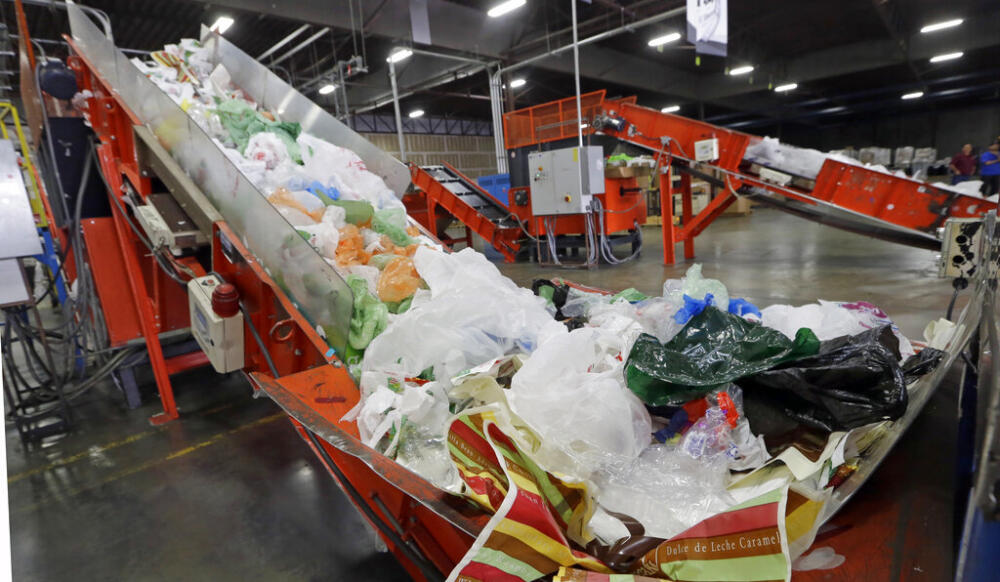
Americans have been told for decades to toss plastic into the recycling bin. But only a small share actually gets recycled.
Now, California is trying to overhaul the system by cracking down on misleading labels and holding companies responsible for their plastic waste. Will it work?
Guests
Susanne Rust, investigative environmental reporter for the Los Angeles Times.
Kate Bailey, chief policy officer for the Association of Plastic Recyclers.
Also Featured
Katie Davey, executive director at the Dairy Institute of California.
Valerie Bruyninckx, manager of corporate affairs at Fost Plus in Belgium.
The version of our broadcast available at the top of this page and via podcast apps is a condensed version of the full show. You can listen to the full, unedited broadcast here:
Part I
AMORY SIVERTSON: Nearly 500 pounds per person every year. That is how much plastic waste we generate here in the United States, more per capita than anywhere else in the world, and very little of that plastic ever gets reused. Nationwide, less than 10% of plastic waste is recycled.
The rest goes in a landfill, it gets burned, or it becomes the litter on the side of the road. Now, there are a lot of reasons for this. Some plastics are difficult or just expensive to recycle. Some aren’t accepted by recycling programs. And some products that look recyclable simply aren’t, yet.
California is trying to change this.
ALLEN: Thank you, Madam President. Sometimes I feel like the Man of La Mancha, tilting at windmills on this issue relating to plastics.
SIVERTSON: That’s State Senator Ben Allen back in 2021. He’s the architect of two laws aimed at overhauling recycling in California. One target, the familiar chasing arrows symbol.
ALLEN: We see it on all sorts of plastic products, even when those products aren’t realistically going to be recycled.
Recycling’s incredibly confusing for people. People are continually putting items into their blue bins with a recycling symbol on them, and yet it’s actually muddying the waters. It’s contaminating the system.
It’s making it more difficult.
SIVERTSON: Allen wrote California’s Truth in Recycling law, which is supposed to go into effect later this year. The idea is that if something carries that chasing arrow symbol, that should mean the material can actually make it through California’s recycling system to then be turned into something else.
But Allen says better labels only solve part of the problem. Even if consumers know exactly what belongs in which bin, California is still left with enormous amounts of packaging that are really hard to recycle. That brings us to Allen’s other big law, which he introduced in 2022.
ALLEN: We start with the basic EPR premise, extended producer responsibility, that the producers of a material should be responsible for the end-of-life costs to manage that material, not the local communities who pay for waste management and recycling.
SIVERTSON: California Senate Bill 54, now signed into law, shifts much more responsibility for packaging waste to plastic producers. It requires them to help fund the state’s recycling system, and it pushes companies to make more environmentally friendly packaging. Taken together, both laws amount to an ambitious experiment.
Make recycling labels reflect what actually happens in the recycling system, and make producers more responsible for the waste they create. Today, we’re looking at California’s attempt to rewrite the rules of recycling, how the system is supposed to work, where this legislation is running into resistance, and whether it can actually make a difference.
Susanne Rust is an investigative environmental reporter for the Los Angeles Times. She’s been covering plastic and recycling for years, and has been following California’s recycling legislation. Susanne, welcome to On Point.
SUSANNE RUST: Hey, thank you for having me.
SIVERTSON: It’s great to have you, and I’d love to just zoom way out to start and ask why are we so bad at recycling in the U.S.?
RUST: It goes way, way back. The fossil fuel companies, back in the 1950s realized they had this byproduct for gasoline and oil and wanted to turn it into a product, and so they started manufacturing plastics. And plastics are fantastic materials. We all know this, right?
I’m sitting here talking into a microphone, and it has its whole housing in plastic, and it makes it lightweight, and I can move it around. Our cars are more fuel efficient because they have plastic in them. They’re not just metal. Same with airplanes, et cetera, et cetera. But there’s so much of this byproduct around, manufacturers realized they could start putting it everywhere, into everything.
And today you can walk into a grocery store, and you had this clip at the beginning you can see that, cucumbers are wrapped in plastic. Plastic is just everywhere. And so there’s this sort of overwhelming amount of plastic that is now in our environment that we just can’t handle.
There’s this sort of overwhelming amount of plastic that is now in our environment that we just can’t handle.
Susanne Rust
We don’t have the infrastructure for it. We have increasingly become a society that really is about disposal, and convenience. And we just, we don’t have the infrastructure available to handle all of that, so we’re overwhelmed with plastic right now.
SIVERTSON: Yeah, and I want to dig into that infrastructure, but first I’m just gonna ask what to some may seem like a really obvious question, and to others who probably see people toss plastic into just regular trash bins every single day, since you focus on environmental issues in your reporting, can we just get a brief reminder of why recycling actually matters?
Why we can’t afford from an environmental perspective to be as bad at recycling as we are?
RUST: Yeah, and I just, I would take a step back there, too, whether it’s recycling, and I think a lot of people actually have problems with recycling as well, but just the overwhelming amount of plastic in the environment, it is really a concern.
There’s statistics right now, I think in 2050 or something like that, there is supposed to be more plastic in the ocean than there is fish or are fish life. And you start looking at the human body. Every time scientists begin to look at organs or different systems in the human body, they’re finding microplastics.
The dust in your house is largely little pieces of plastic and fibers of plastic. We’re just, we’re swimming in a world of plastic right now, and we don’t yet understand the implications of that for our health, but it’s clearly everywhere. And there are really big concerns about it. There, yeah.
We’re swimming in a world of plastic right now, and we don’t yet understand the implications of that for our health.
Susanne Rust
SIVERTSON: Yeah, so the amount of plastic is one piece of this puzzle, but I’m also curious how we got to this point where only 10% of plastic waste in the U.S. is being recycled.
RUST: Yeah. Again, this goes back to infrastructure. This goes back to NPR did this fantastic investigation years ago that looked at how the fossil fuel companies and the chemical industry manufactured this idea that plastics could actually be recycled even though they knew it would never really work.
And so they started putting these labels on different products so that consumers would feel fine about taking a plastic yogurt container. Because they just assumed it would be recycled, and we’ve just been living like this for decades. But again, we’ve never really built the infrastructure for it.
Many of these plastics, while they can theoretically be recycled, nobody wants the product on the other end. So we just have this system of creating this waste that has no market, that has no use and in many places just can’t be dealt with.
SIVERTSON: And why is plastic so hard to recycle?
RUST: First of all, one of the issues with it, there are some plastics that can be recycled once or twice, but eventually the bonds, the chemical bonds that keep these molecules together start breaking down. So you can recycle them once, you can recycle them twice. Many of the products we use, to cover food or toxic chemicals, it’s really hard to recycle those things. Because you can’t use them again for food.
They become contaminated. There are concerns about it. And also, if you start looking at what’s in your waste bin, you have number fives, number sevens, number ones. The mechanical recycling facilities, which people call MRFs, are pretty good at sorting them, but some are so contaminated, some products have so many different kinds of plastic in them that you can’t actually sort them, and so you don’t have a single stream at the end that can actually be recycled.
It’s just, it’s a stew and a mess of plastic that we put into our waste bins, with very little left at the end.
SIVERTSON: Yeah. Recycling is very confusing, and we will be talking more about that, but I want to talk about these two bills in California that we’ve mentioned. So starting with the Truth in Recycling law or the Truth in Recycling and Labeling, this is the one that says, if you’re going to have a recycling symbol on your packaging, you have to actually be able to recycle it to a certain extent.
Can you break that down for us a little bit?
RUST: Yeah. So it doesn’t seem like this is rocket science, but legislators in California realizing that people were confused that we have this problem of plastic not getting recycled. And just to take a step back, too, we used to send so much of our plastic to China.
They would take it, but in 2018 they stopped taking our plastic, and so suddenly, particularly on the West Coast, but around the country, people were having issues of, what do we do with all of this plastic? And so it’s really become a problem for local waste haulers, and again, these mechanical recycling facilities to figure out what to do with all of this stuff.
So a California lawmaker, and you had him on earlier, Ben Allen, came up with this law that said, alright, let’s see what is actually recycled in the state, what we can actually find end markets for, what consumers, what California residents can actually get recycled and say, ‘This product gets a recycling label. It is actually getting recycled.'” And it’s called, the way they do it is the 60/60 law. So 60% of California’s population has to have access to recycling for this kind of product, and then 60% of the local waste haulers are able to sort that plastic. So it has to meet both of those requirements and then it gets the label.
So that’s the idea. And if a product or a material cannot meet that 60/60 sort of basis, then it doesn’t get the recycling label. And of course, that’s a real concern for a lot of material manufacturers, right? If they can’t get the recycling label, that’s a real, I think consumers do look for those recycling labels. Because it makes them feel better about what they’re purchasing and knowing they’re not creating to the overburdening of waste and plastic out there. So that’s basically the law.
SIVERTSON: Sure, yeah. So those numbers might make us feel better, but it doesn’t necessarily mean something’s being recycled.
We have to take a break here in just a minute, but can you briefly explain this other piece of legislation, this plastic pollution prevention, the law requiring producers of plastic and packaging to design packaging differently?
RUST: So that sort of takes it to the next level, right?
So we know what’s getting recycled, we know what isn’t, and SB 54, that’s what we call it because it’s a lot less to say than the title of —
SIVERTSON: We’ll go with that.
RUST: … Yeah. But the idea of that is that you get this circular economy, right? So what comes into the state must either be recyclable or compostable, and it has these strict requirements.
So basically by the year 2032, any single-use plastic that comes into the state must either be recyclable, compostable and there needs to be an overall 25% reduction in the amount of plastic that’s actually single-use plastic that’s coming into the state. So that’s the idea there.
By the year 2032, any single-use plastic that comes into [California] must either be recyclable, compostable.
Susanne Rust
Part II
SIVERTSON: Susanne, you were talking about these two pieces of legislation, the second of which has to do with plastic packaging, and that law went into effect just this past May, right? So is it too soon to know how this is going or what can you say about what this law looks like in practice so far?
RUST: Yeah, so this law has, it went into effect in May, and almost immediately the state was sued. So it’ll be interesting to see where this all goes right now. But let me take it back even a step further, just to give you a little history on this. So in 2022, the law was passed.
But before that, there had been a ballot initiative that was going to go onto the ballot in November that Californians were going to vote on, which would have basically met all of these criteria that SB 54 have laid out, to make sure that all single-use plastic was either recyclable or compostable to get a reduction in plastic, and also actually just to ban polystyrene as a single-use plastic.
That’s the brand name Styrofoam in the state. And the industry worked really hard with lawmakers in California to get that ballot initiative off the ballot. And it was this big deal here that summer. Because environmental groups were like, “No, we’re not going to work with the manufacturers and the plastic companies because we don’t believe they actually really are going to go through with any law. We want this ballot initiative.”
But nevertheless, as the deadline came, they agreed to go forward with this law, and there was a ton of excitement. The law passed. Everybody seemed behind it. I remember writing stories about supermarkets are going to look completely different. You’re going to walk in someday with your glass jar or your reusable plastic bucket to get your laundry detergent, right?
It’s just going to be different. Anyway, so the law was passed but then as they began writing the regulations, the things that actually will make this law work, concerns started leaking out, right? The chambers of commerce didn’t like it. Businesses didn’t like it. And I think it was in March of last year, Governor Newsom actually came out after getting a lot of pressure and started, demanded that CalRecycle just before, CalRecycle is our waste agency, right before they finalized the regulations, that they water it down a bit, and everybody went nuts, right?
And then in May, basically they came out with the final regulations, and it was watered down quite a bit. Suddenly, there were exemptions for anything that the USDA or FDA might have jurisdiction over. So that’s, you know, that’s any kind of meat or produce or medicine or, you know, pet food.
And it also suddenly allowed for this idea of chemical recycling to come in, which in the way the law had been written, wouldn’t have allowed it. Nevertheless, there was still hope. The law kept going forward. And then in May of this year environmental companies, so right after the law went into effect, sued. Because they said the law was so watered down at this point that it wasn’t going to be as effective as the law was intended to be.
And then soon after that, 17 states sued as well. So attorneys general from Nebraska, Alabama, Florida, a bunch of red states sued as well. They were saying the law had an unconstitutional overreach, that it was regulating beyond the borders, that it gave a private entity. So part of the way this law works is that the industry actually oversees the law, so they see what’s coming into the state.
They require fees from all the companies that are distributing, selling plastic in the state. They have to register with this entity and then pay fees to be able to sell their products here. So anyway, they were sued over these items. And that’s where we are right now with it.
Oh, and then, and the last part of it is the legislature is about to go into recess and the agricultural trade industry here, as well as the Chamber of Commerce, is really pushing to have lawmakers just scuttle the law completely before the end of the week.
SIVERTSON: Oh, boy. There are so many interests here that have to be taken into consideration, which is part of what makes change so hard. But at this point, do you think that these laws still have real teeth to them? Could they, taken together, have a meaningful impact on the recycling rate and on reducing waste in California?
RUST: I think if they are carried out as they were intended, yes, I believe they could. I think if you look at what Californians want, like if you look at polls, they’re really interested in reducing plastic. It’s, I think, something like 85% of Californians want something done about plastic here, and I think the lawmakers here know that.
And if they can get this thing to work, part of the way this works is this entity, this private entity that I was talking about, has to pay the state $500 million a year, which it gets from its members, and that goes into remediation, right? Environmental remediation both for communities that are impacted, as well as beaches and streams and rivers.
So they’re responsible for that. But they also can’t sell their products, or if they do sell their products in ways that are not legal, they have to pay higher fees. And so the incentive is if you want to sell your stuff in this state, you have to make it recyclable or compostable. There’s just no way around that.
So if this law goes forward as it was intended, it will have an impact. And because California is such a huge economy, what are we, the fifth-largest economy on the planet, it will have ripple effects everywhere. So this is really meaningful legislation that I do believe could have an effect.
SIVERTSON: Okay. Susanne, stand by here. I want to bring another voice into this conversation, someone from the recycling industry. Kate Bailey is the Chief Policy Officer at the Association of Plastic Recyclers, which is a nonprofit focused exclusively on plastic recycling. Kate, welcome to On Point.
KATE BAILEY: Hi, Amory. Thanks so much for having me, and really appreciate the opportunity to dig into why plastics recycling is important, what’s working and what’s not, and how we’re working to fix that.
SIVERTSON: Okay. Let’s do it. So first, I really want to understand the current statistics around recycling in the U.S. a little better in hopes that it will help us hone in on what we’re really up against here.
So when we say that only or roughly 10% of plastic waste is recycled in the U.S., does this mean that we’re talking about plastic items that are thrown into the trash as opposed to a recycle bin? Or is this plastic that’s thrown into a recycle bin and just isn’t being recycled?
BAILEY: This 9%, 10% number, it’s very confusing, and it does not have to do with what you actually put in the recycling bin.
So if you put the right materials in the recycling bin, and by that I mean plastics, bottles, tubs, jugs, jars, the materials that your community is saying, “Please put those in the bin,” by and large, those materials get recycled, and we can recycle them across the country. We do recycle them every single day.
But as Susanne pointed out, plastics are used for thousands of applications. Many of those never go in the recycling bin. They weren’t meant to go into the recycling bin. So in order to really scale up plastics recycling and solve for plastic pollution, we need to look at better packaging recycling, but we also need to look at recycling programs for electronics and clothing and carpet and building materials, and much more than what we just have in front of us at our homes.
SIVERTSON: Okay. So I hear that, and yet I also, as someone who does their best to recycle and does their best to try to set others up for success, recycling is just confusing. We’ve tried to improve it here at our office, at our home station here, WBUR, where we have cheat sheets in the kitchen of, your lid goes here, but your cup goes here.
Your teabag goes here, but your teabag wrapper goes here. So I can appreciate the textiles, electronics, the next levels, but it feels like we can’t even get the basics right. So is this part of why so much plastic is being discarded as trash rather than recycling, because we just don’t know what we’re doing?
BAILEY: People are right to be confused about recycling, and that’s one of the reasons we have state laws like California that are working to make it better. But I really want to emphasize that there are things that are working today. We recycle 5 billion pounds of plastic packaging every year in the U.S.
That’s the equivalent of keeping over 340 trucks out of the landfill every single day. So we know that there are things that can work, and we know that there are things that can work better.
SIVERTSON: Okay. And when we think about why so much plastic is being discarded as trash, is there, I want to get to some of the reasons why that might be.
Not just that it’s confusing, but is there a lack of maybe education and awareness around recycling, or are there just not enough recycling bins?
BAILEY: Yes. So the biggest challenge we face is that most recyclable materials never make it into the bin to start with, and that’s not just plastics. It turns out the U.S. is terrible at recycling all of our materials, our aluminum cans, our cardboard boxes, our paper, and our plastics.
So the national data tells us that over 75% of what could be recycled from your home never makes it into the recycling bin to start with. So we have a problem right at the beginning that we’re not capturing what could be recycled. And a big part of that is if you look around the country, a lot of people don’t have a recycling bin.
Over 75% of what could be recycled from your home never makes it into the recycling bin to start with.
Kate Bailey
So if you live in an apartment, 60% of people who live in apartments don’t have recycling bins. We have a large number of single-family homes across the country as well. We have over a dozen states where 40% or more of residents don’t have a recycling bin. So we have a fundamental problem of recycling is not convenient for most people, and in order to make recycling work, the first law is make it convenient.
It has to be easy, and it has to be simple. And that’s also where we need, not just better labeling, but better product design. We want to take the guesswork out of recycling. We envision a future where you’re never looking at the bottom of the bottle for a small little number anymore. You just say, “Plastic bottle, goes in the bin,” and then the system takes care of the rest.
SIVERTSON: I wonder if maybe a lack of faith is also at play here, Kate, because I think many of us have heard before cynically and correctly or not, that it doesn’t matter if you put something in the recycle bin, it’s all going to go in the trash anyway. So say it isn’t Kate. Do we know what percentage of plastic that’s put in a recycle bin is actually being recycled?
BAILEY: We know for certain materials. So we know your water bottles, your milk jugs, your yogurt containers, once they make it to the recycling facility, we can sort about 85% of those, and then we could use most of that to make new products. But you’re absolutely right to be skeptical. There are hiccups in the system.
There are times when the truck doesn’t make it to the recycling facility. There are times there’s a recycling bin in a business that never makes it to the recycling bin outside, which is why we need more transparency, more accountability, and more coordination across the recycling system so we can move from most of the time those materials get recycled to all of the time those materials get recycled.
SIVERTSON: So I’m hearing you say, we save however many hundreds of pounds of recycling from going to a landfill every year. I hear Susanne Rust saying, “But there’s more plastic in the ocean than there are fish.” And so I personally am trying to weigh, what’s happening here?
How are things actually going? So I’m wondering if things feel as urgent inside the recycling industry as they do to probably many of us after hearing some of these statistics about how low the recycling rates actually are and how much plastic really is just going to a landfill.
BAILEY: There is absolutely a lot of urgency.
There is a problem with recycling that it’s pretty much stagnated across the country, and what we’ve seen is the amount of plastic being used continues to skyrocket. So that’s where we have a big disconnect. And the good news is that we have states like California and many others who are digging in, and not just scratching at the surface, but doing a complete overhaul on how we fund and manage recycling programs, and looking at how much plastic we produce.
SIVERTSON: So you work with states on recycling to some extent. Is there excitement about what California is trying to do, given its sheer size and the impact that these laws could potentially have?
BAILEY: California and six other states have adopted what we call extended producer responsibility laws, and there is huge excitement about that across the recycling industry.
This is the biggest thing we’ve done in decades. It really is a complete overhaul of the recycling system. And I think the most important point is that we’re moving from what we have today is a patchwork of programs funded primarily by local governments. It’s very hit or miss across the country, whether you have a program, whether it’s a good program.
We’re moving to a system that has broader statewide coordination. It’s not funded by local government. It’s funded by the producers, the companies that make that packaging, and it’s giving them incentives to design that packaging to be recycled and to use that packaging again when it comes back to them in a recycled form.
So we’re making new products out of old recycled plastics and building a more circular economy.
SIVERTSON: And how much of a paradigm shift for recycling in the country could this be if these laws are meaningfully enacted in California?
BAILEY: I can’t think of a bigger paradigm shift, to be honest. This is the biggest thing that we’ve done, and change is hard, and so it’s gonna take some time, and we’re gonna need to go a lot beyond just California.
So California’s on the cutting edge, not just with recycling, but also looking at reducing plastic. Other states need to just scale up their recycling programs to start. But California and other states are definitely paving the way and creating a blueprint for other states to follow.
SIVERTSON: Because part of what’s happening here is that the financial burden has mostly, up to now, it’s mostly been local governments who are footing the bill, funding recycling programs.
And what California is doing, and what these other six states are doing, is trying to shift that to the plastic producers, right?
BAILEY: Yeah, so it’s a fundamental change in who is in charge of funding and managing the program, and funding is what we need to make sure that everyone has a recycling bin, everyone is educated about how to use it, we have reporting.
So we have these new laws that are just fundamentally changing who is responsible, and it’s also just taking a completely different perspective on recycling. Instead of just thinking about it as something a local government is doing to send less materials to landfill, we’re starting to think about recycling as domestic manufacturing in a resilient supply chain, that companies design a product to get recycled so that they use that product again and reduce the production of new plastic.
Part III
SIVERTSON: Katie Davey, she’s executive director of the Dairy Institute.
She says that when these two laws passed, her members found out that milk cartons, the standard ones that are probably in your fridge right now, those do not meet the state requirements for recycling. And ironically, she says complying with the state’s new legislation would cause her industry to use more plastic, not less.
DAVEY: If we lose the right to communicate to our customers that the symbol is recyclable, we’re looking at having to transition fluid milk and all the other fluid products we manufacture, from creamers to juices, to water, to almond beverage, to oat beverage. All of that would have to go into a plastic container.
It would require retooling of our plants and our facilities. We got quotes on those numbers. You’re looking at $40 million per processing line for a mid to large level processor. That’s an incredible cost.
SIVERTSON: So Susanne Rust, you’ve reported on this extensively, and I’m curious what you make of that argument that this type of legislation is going to cause something like the milk carton manufacturer to resort to plastic milk cartons rather than these paper cardboard composite ones that can’t be recycled.
RUST: Yeah. Just to say, there is plastic in those paper cardboard cartons. The lining inside is some sort of like polyurethane or some sort of lining in there. But yes, it would, right now, those cartons cannot be recycled. They’re a hodgepodge of different kinds of materials.
This is what we were talking about earlier. There are products out there that have so many different materials that they can’t be recycled, and so that would definitely change what milk producers can use, and it would be a big change. It would be a one-time change.
They would have to put them all back in the plastic jugs, which you can still, if you’re buying a gallon of milk, you still get it in a plastic jug. But yeah that’s entirely true. Right now, the reporting I’ve done on those cartons is I think less than 2% of them are actually recycled, and that might be generous.
SIVERTSON: Okay. Now, another thing we’ve touched on is where the responsibility, excuse me, is shifting with this legislation, and this is another thing that Katie Davey of the Dairy Institute of California spoke to. She says that these laws essentially punish the wrong companies.
DAVEY: If you own a national brand, think of those large national brands that we see across America, you’re not making the cartons or the plastic bottles in-house.
You’re buying that from a packaging supplier. But you’re required to register as a producer if you sell into California or you manufacture and sell in California, and you own the brand, even though you have no control over the manufacturing of the package. You have no control over where the packaging goes the minute it leaves your facility with the product in it.
SIVERTSON: Okay, so it sounds like the definition of what a producer is a little complicated here. Kate Bailey, why is it that a milk company like Horizon or Organic Valley would have to carry the cost rather than the company that’s making the non-recyclable containers?
BAILEY: I want to start by first saying that there are a lot of different types of packaging, and there are a lot of different producers, and there’s a lot of difference in opinion on these laws.
In fact, there are large numbers of producers who have advocated in support of these laws across the country, and producers who are, in fact, advocating at the UN level to have the shift in responsibility as part of the UN Global Plastics Treaty. So there’s a large share of producers who see that not only should they be responsible for their packaging, but that recycling is their supply chain to get materials back, and they see that it’s more resilient to be able to rely on recyclables collected from within the U.S. than being subject to geopolitical issues with having to import materials from other countries.
So I just want to first start with there’s a wide difference of opinion within the producers on these laws themselves. And part of that is because packaging is complicated, and there is no one type of packaging for one type of product, and so these are programs that are going to have to take years to evolve.
They’re going to have appropriate timelines, and those timelines might not be the same for every industry, but that doesn’t mean we shouldn’t move forward, and that doesn’t mean there isn’t some really low-hanging fruit to tackle. So for example, water bottles. We could recycle every single water bottle, or milk jug for that matter, across the country.
We only collect three out of every 10 water bottles or milk jugs, so seven out of 10 are ending up in landfills and littered. That is a problem we can solve today while we work towards some of the longer term solutions on packaging design that do take a little bit longer to implement.
SIVERTSON: So timelines are a real concern, and I know expense is also a real concern here because it is, it can be more expensive to make more environmentally friendly packaging. So this is something Katie Davey also spoke to. She says these laws are just too expensive for an already expensive state.
DAVEY: This is all funded by producer fees, and that’s going to directly translate to cost increases for Californians.
The affordability crisis in California is real. There are a lot of views in the legislature where they’re taking a fresh look at this program, and they’re seeing the compliance costs and saying, “This is not what we envisioned.” We know that the people in our district are struggling to make ends meet, and this is gonna make things worse.
The affordability crisis in California is real.
Katie Davey
SIVERTSON: So Susanne Rust, how do we prevent the increased cost of more environmentally friendly packaging from being passed down right to the consumer?
RUST: Yeah, it’s a real pickle right now. There are concerns about that. But having said that, I’ve talked to economists and environmentalists who’ve looked at this, and it’s a movement of cost.
Right now, like in California, to get your curbside garbage picked up, all of our collection fees have just skyrocketed in the past few years. We’re paying more and more to get our waste hauled. That number would go down with this program, right? And instead, some products may become more expensive.
But I think what economists have been saying is it’s a wash, and over the long term, five, 10 years from now, what actually happens is because the local governments are spending less money on cleaning everything up because collection fees are going to go down, consumers will actually be saving more money.
But there is this sort of immediate turn. Another part of this law that was supposed to happen is that these product manufacturers are not supposed to convert these changes and put them on the consumer. That’s part of the law. But of course, if they’re spending this much money to redo everything, they have to get that money somewhere.
So it probably will be consumers who are charged a bit more. How much that is, I think is really debatable. And I know that numbers are flying around right now. But the government had looked at this before, and I think California, and I could be wrong here and somebody will probably call me out on it, but I think they’re at the initial economic analysis was something like either $180 or $300 more per year for a consumer, which is a really big deal right now as people are challenged by costs.
But over time, they would actually see a net profit.
SIVERTSON: Huh, okay. So Susanne and Kate, whenever there’s talk of something that is going really wrong in the United States, it always makes me wonder, who is getting it right? Who’s doing this differently? So Belgium is an example. They’ve spent three decades building one of Europe’s most successful recycling systems, and one of the basic ideas behind it is that recycling can’t just be the consumer’s job.
VALERIE BRUYNINCKX: So it’s really a shared responsibility, and there needs to be a framework that enables that responsibility for each and every one.
SIVERTSON: That’s Valerie Bruyninckx. She’s with the nonprofit Fost Plus, which manages the recycling system in Belgium. And since the 1990s, households there have used blue bags for things like cans, bottles, and drink cartons.
But for years, only certain kinds of plastic could go inside of those bags, which means that a lot of it ended up in the trash. But then about five years ago, Belgium expanded what people could put in those blue bags.
BRUYNINCKX: From that moment onwards, consumers could put all plastic packaging, which is bags, trays, caps, all sorts of plastic packaging would be collected as well, and once you could collect it, we can sort and recycle it.
SIVERTSON: And then if someone puts the wrong stuff in their blue bag, Fost Plus leaves the bag on the curb with a little sticker on it explaining what needs to come out.
BRUYNINCKX: We have one sorting message in the entire country. Okay, admittingly, Belgium is not the biggest country, but it’s one uniform sorting message.
You can just put your sorted materials on the curb, and we come collect it every week, every two weeks.
SIVERTSON: Belgium now recycles about 60% of its plastic packaging, more than anywhere else in Europe and a lot more than here in the United States. But putting more things in one bag only works if there’s a system behind it that’s capable of dealing with all that material.
Belgium sorting centers separate what they get from those blue bags into 16 different streams, and they have contracts with companies who guarantee that they can turn those materials into new products.
BRUYNINCKX: So it’s not a theoretical question. It’s an effective reality on the field, and it’s not just one plant, obviously.
We have a number of partners, and it has to work with them. They will need to an- innovate to make sure that they can accept as much as possible, but obviously, the packaging industry has to make sure that whatever they put on the market is as compatible as possible as well.
SIVERTSON: That was Valerie Bruyninckx.
She’s with Fost Plus, which manages the recycling system in Belgium. And Susanne Rust, as someone who covers the recycling system in California and looks at what happens nationally here, what jumped out to you about Belgium’s different approach?
RUST: Yeah, I’m old. I was born in, I was born in the 1970s, but I remember when recycling came to my little neighborhood in New York, and we had, I think, four different bins.
You put paper in one, paper and cardboard in one. And I do think doing sorting at home makes a huge difference. It enables recyclers to be able to sort more effectively. I think that is really important. And I know it’s been a real problem. Cities don’t want to make consumers or taxpayers or residents do that because they feel like it’s burdensome.
But I don’t know if it actually is. Nevertheless, there’s that, so instead of getting the mixed stream, doing the sorted stream. And also, again, it sounds like what California’s trying to do. If you are a manufacturer, making sure that whatever you are selling in the state or in Belgium can actually comply and be a part of this.
It’s one of these things where you need individuals, you need the government, and you need the product manufacturers to work together, and it sounds like that’s what California wants to do. It sounds like that’s what’s happening in Belgium, and I suspect that’s the way forward here, is if you get everybody involved.
SIVERTSON: So Kate Bailey, Susanne, they’re saying we need all of the parties to work together. But is there too much onus on the consumer in the U.S. to get it right when it comes to recycling, and maybe not enough regulation on the plastic and packaging ma- manufacturers? Or maybe we just need better sorting.
Maybe the recycling piece of the puzzle needs to look different, where don’t expect the consumer to put things into 16 different bins. Let them put it into one bin, and let’s make these sorting centers far more robust.
BAILEY: Belgium and most of Europe and Canada have got the framework correct, where they have producers, the manufacturers paying into the system, and then they have a coordinated program.
As Susanne said, all of the players are at the table making the investment, designing the packaging, investing in infrastructure, figuring out sorting programs. That’s what we need in the U.S. We need that fundamental framework and that harmonization. Sorting might look different in a big city like LA versus a small rural part of the U.S., but that’s okay.
We can have different programs. There’s not gonna be a one-size-fits-all, but we need to have that fundamental structure of who’s paying it, and are we coordinated across a state or across the country to move together toward recycling targets? So really good models for us in Europe and Canada to prove that we can do a lot better at plastics recycling.
But I will say we also don’t need to look that far. There are great programs in U.S. cities, and everywhere I travel across the country, I see a city, I see an airport, I see a stadium, I see a university that has a great recycling program. So really a part of it is just scaling up what we know works well across the country, funding it, and making it more efficient as a whole system.
SIVERTSON: Given all of these pieces of the puzzle, the various parties that need to work together in concert, I don’t want people leaving this conversation feeling like there’s nothing that they individually can do, or that what they individually can do only has so much impact and might not be worth it.
A question for both of you as we end this is, is there something that we can all be doing, we the consumer can all be doing today differently that will actually make an impact? Susanne, I’ll start with you.
RUST: All right. Yeah I’ll just jump in. I’ve been reporting on plastic long enough that I know when consumers decide that they want to have something recyclable or have something not contaminated it’s their money that will actually get producers to change.
So when you go to the store look for those products that actually have recyclable material that you can throw into your blue bin and know will for the most part be recycled. It’s just making that decision and that does make a difference.
SIVERTSON: And Kate Bailey, a quick answer from you.
BAILEY: Two things. Keep recycling. We need and can recycle more of your plastic bottles and containers every day. And speak up. Tell your local government, your state legislators recycling is important to you and you want a better program.
The first draft of this transcript was created by Descript, an AI transcription tool. An On Point producer then thoroughly reviewed, corrected, and reformatted the transcript before publication. The use of this AI tool creates the capacity to provide these transcripts.