
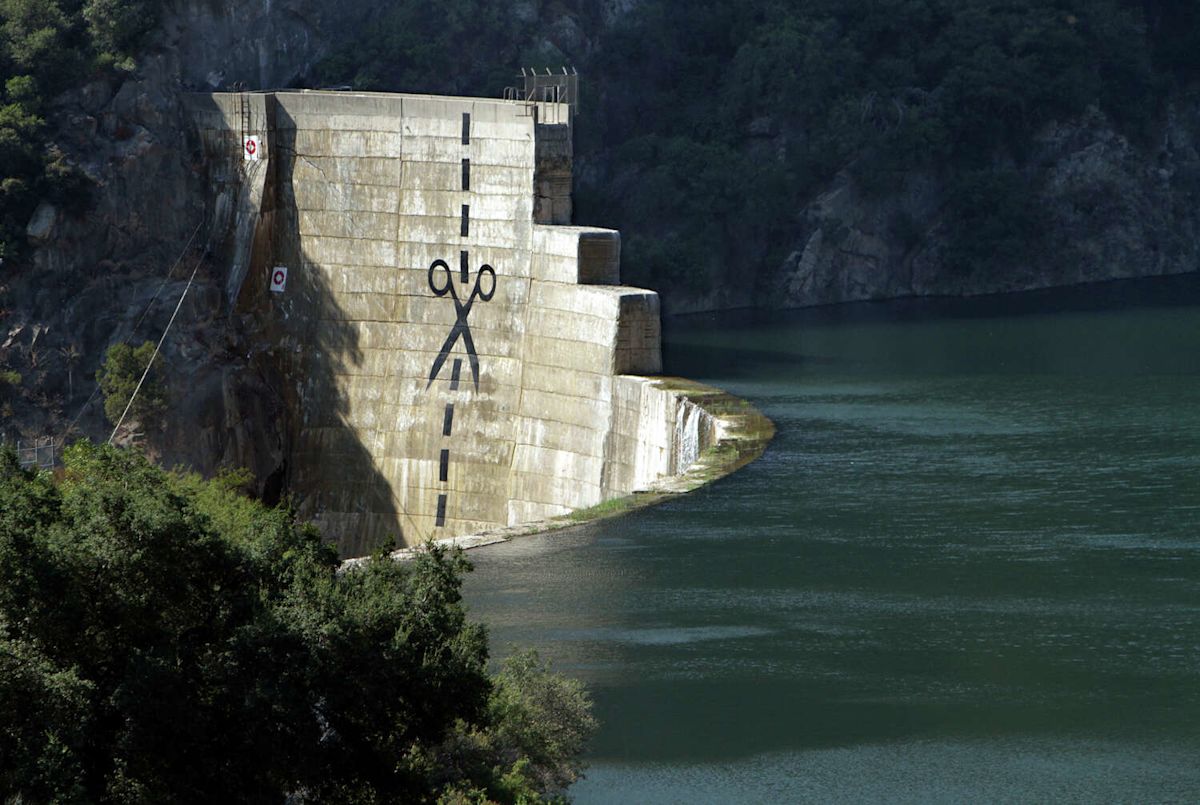
To drivers passing by on Highway 33 and even those who pull off along the side of the road to cool off in the waters of Matilija Creek, the hulking concrete structure tucked behind a rocky hillside is all but invisible.
But for nearly 80 years, Matilija Dam has wielded a quiet power over the city of Ventura and the Ojai Valley north of Los Angeles County, reshaping the landscape of both the creek and beaches over a dozen miles away. It’s also sat useless for decades – and it finally might come down in the next one, if Ventura County can scrounge up around $300 million.
Matilija Creek’s headwaters start in Santa Barbara County’s Santa Ynez Mountains, and the creek then winds through the Matilija Wilderness in Ventura County before eventually connecting with the North Fork of Matilija Creek, where the two waterways combine to form the Ventura River, which stretches for 15 miles out to the Pacific Ocean.

People hang out along Matilija Creek near Ojai, Calif. (Erin Rode/SFGATE)

An overhead view of Matilija Dam and the reminants of Matilija Lake near Ojai, Calif. (Ventura County Public Works)
Matilija Dam, which blocks Matilija Creek before it connects with the North Fork, was constructed for water storage and flood control back in 1947 at the urging of Ojai farmers and ranchers. It was nearly doomed from the start. In the dam’s early years, an alkali silica reaction in the concrete reduced its strength and it experienced rapid sediment accumulation. In 1965, less than 20 years after the dam’s completion, its height needed to be notched lower to relieve pressure – and it was lowered again in 1977.
More Los Angeles Coverage
–California’s e-bike war explodes in Orange County
–Disneyland cracks down on dangerous but common behavior
–As a local swimming hole goes viral, neighbors cash in on the chaos
–This little-known LA area campus restaurant has no business being so good
For more SFGATE LA stories, subscribe to our new weekly newsletter The Southland here.
“The dam no longer serves its original purpose and has been considered non-functional for decades due to structural concerns and extreme sediment build-up,” states the county’s website focused on the Matilija Dam Ecosystem Restoration Project.
The lake behind the dam has “essentially disappeared with a capacity of less than 2 percent of the original lake volume” only during short periods of time during the rainy season, according to the county. The rest of the time, the “lake” is essentially a dry forested meadow.

An aerial view of Matilija Dam north of Ojai, Calif., when full with water in February 2004. (Stephen Osman/Los Angeles Times via Getty Images)

An overhead view of Matilija Dam and the remnants of Matilija Lake near Ojai, Calif. (Ventura County Public Works)
For the past 15 years, a giant graffitied pair of scissors cutting along a dotted line has adorned the concrete wall of the 168-foot-tall, 620-foot-wide dam. Ventura County has planned on tearing the dam down for even longer than that. The county’s Board of Supervisors passed a resolution in support of removing the dam back in 1999.
“I would say the Matilija Dam is the poster child for dam removals for the country and the world,” Redgie Collins, vice president of legal and government affairs at California Trout, told SFGATE by phone Wednesday, noting the infamous pair of scissors and the decades-long history of problems at the dam.
Since its completion, the dam’s sediment buildup has made it “incapable of fulfilling any of its original purposes for water supply and flood control,” says California Trout’s site, which has Matilija Dam on its “Top 6 California Dams Out” list, along with the Rindge Dam in Malibu and the Klamath Dams, which were removed in 2024.
“With dams like this that obviously need to be removed and that provide no water supply security and offer really no advantages, you can never move them quick enough that would satisfy California Trout. So right now, it’s kind of baffling that the dam has not been removed yet,” said Collins, noting that Ventura County has spent “30 years pointing towards their commitment to remove this facility.”
Matilija Dam is also a “complete barrier to the migration of endangered Southern California steelhead,” according to California Trout. Fewer than 500 total adults are estimated to remain in the wild, a far cry from the 30,000 to 50,000 fish that once spawned in Southern California rivers and streams. (The fish are anadromous, which means they live in the ocean but migrate to fresh water to breed.)

The road to Matilija Dam in Ojai, Calif., is closed off to the public. (Erin Rode/SFGATE)
The fish can now only reach about a half-mile of Ventura River habitat from the ocean, while over 15 miles of habitat is unreachable upstream from the dam, according to the California Department of Fish and Wildlife. The local population of steelhead has steeply declined in recent years, with just three fish observed in the lower sections of the Ventura River in 2021.
The giant piece of concrete over 15 miles inland has also negatively impacted Ventura’s beaches by trapping approximately 9 million cubic yards of sediment that otherwise would have made its way through the Ventura River and out to beaches like Surfers’ Point, which is located near the mouth of the Ventura River. And at a time when coastal erosion is rapidly shrinking California beaches, every potential grain of sand counts.
Roughly 20,000 cubic yards of sand were added at Surfers’ Point last year as part of the beach’s managed shoreline retreat project, which also involves moving back a bike path and parking lot.
Of course, fixing the nearly 80-year-old dam’s litany of problems will take time. Simply blowing up the dam and removing it all at once could have devastating downstream impacts, since bridges, roads and communities are all unprepared to take on the Ventura River’s full power.
The county has a list of infrastructure projects to complete first, including replacing downstream bridges with larger ones that could better handle a more powerful Ventura River flow. Three levees also need to be modified to prepare for a newly wild Ventura River, as does the Robles Diversion Facility, which diverts river water into Lake Casitas, a vital source of drinking water for the region.
After all of those infrastructure projects are completed, the plan is that two tunnels would be drilled into the dam, according to the Matilija Dam Ecosystem Restoration Project. Once a storm hits, some of the trapped sediment would flow out from behind the dam walls into the creek and beyond, lessening the total amount that needs to be hauled out via trucks. Then the dam can finally be dismantled.
The expected cost of the dam removal and these attached infrastructure projects is approximately $300 million. Since 2017, the Matilija Dam Ecosystem Restoration Project has secured more than $44 million in funding for planning, design and construction of portions of the project, on top of an additional $29 million in state and federal funds that covered the initial project planning prior to 2017, according to Ventura County.
The county estimates “an additional $200 million in state, federal, local and private philanthropic investments will be needed from 2024 to 2029 to meet the ambitious goal of being ready for sediment release by 2030.”
Then, another $40 million would be required “for Dam demolition and site restoration, and to support initial post-removal investments in outdoor recreation, improved public access, restored habitat monitoring and long-term stewardship.” Full dam demolition is targeted for sometime in the mid-2030s.

What remains of Matilija Lake behind the dam near Ojai, Calif. (Ventura County Public Works)
Meanwhile, the dam’s continued existence looms as a quiet threat behind the small unincorporated communities, like Meiners Oaks and Casitas Springs, near Matilija Creek. The state’s Division of Safety of Dams classifies the Matilija Dam as in poor condition, with downstream hazard classified as “extremely high.”
“The reservoir is absolutely chock-full of sediment, so a structural failure wouldn’t release a lake. It would release 9 million cubic yards of sediment in an uncontrolled pulse down a canyon that runs through [downstream communities]. Planned removal lets that sediment move on a schedule that engineers choose, and dam failure, during seismic activity or if it crumbles, does not,” said Collins.
“We view this not only as an opportunity to restore ecosystems, but a present danger to the lower community. All that is to say, this dam should be removed and should be removed quickly.”
More LA Outdoors Coverage
–Channel Islands National Park gets a new campground
–As a California trail goes viral, neighbors cash in on the chaos
–Lake Havasu, Colorado River’s party lake, isn’t allowed to run out of water
–Guerrilla kayakers saved the LA River. Today, you can ride along with them.
For more SFGATE LA stories, subscribe to our new weekly newsletter The Southland here.
This article originally published at A ‘baffling’ 30-year wait to destroy California’s Matilija Dam.