
RUTH — After a California district court ruled the Department of Labor must publish new rates and methodology for calculating Adverse Effect Wage Rates (AEWR), Michigan specialty crop growers are left wondering what’s next.
On Thursday, Sen. Elissa Slotkin wondered the same thing, especially after the U.S. District Court for the Eastern District of California ruled Tuesday against DOL’s interim final rule that overhauled calculations for the H-2A program’s minimum wage (AEWR) and could have saved farmers billions of dollars per year.
The California court found the interim final rule unlawful yet stopped short of invalidating the rule.
Now, Michigan growers and ag leaders await guidance from the DOL.
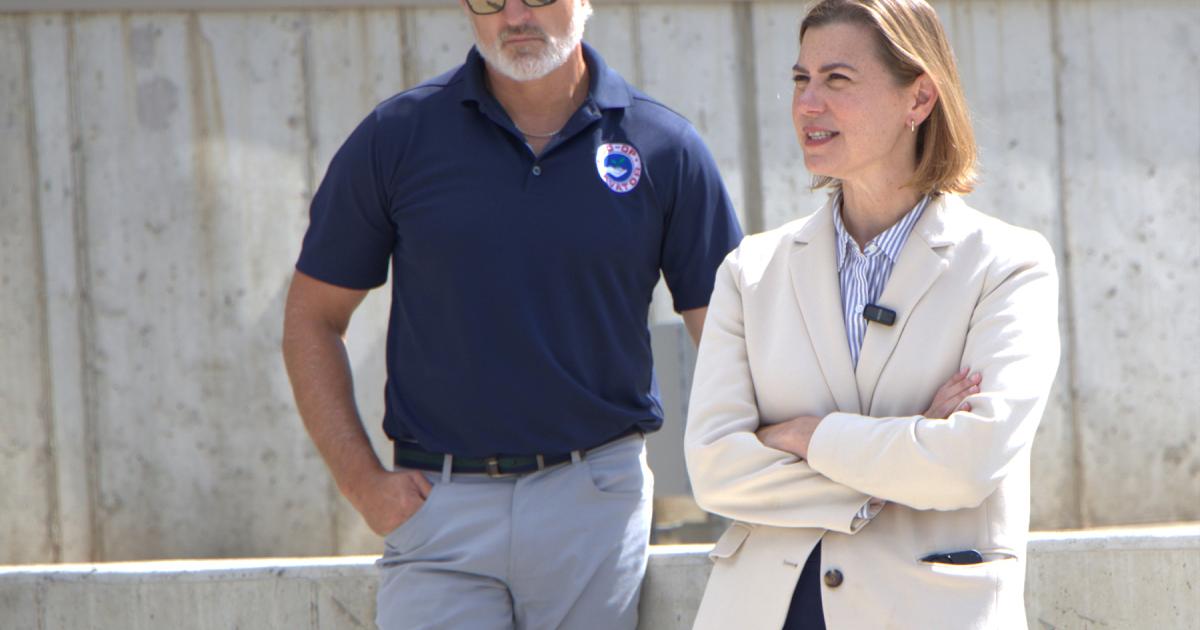
“I don’t know what’s going to happen,” said Slotkin, who toured the Cooperative Elevator Co. in Huron County on Thursday. While there, she walked past mounds of potash and slopes of urea, asking questions about the fertilizer supply chain.
She’s always wanted to know “the math” for Michigan growers.
“This has always been about making sure the math on a farm works, particularly for a small- and medium-sized farm that we have so many of in Michigan,” Slotkin told Michigan Farm News.
“If you’re paying more than you’re bringing in, you’re not going to be a farm for much longer. And that to me was always just the kind of basis for why I was pushing for a rational wage.”
That wage would have looked a lot different after the DOL released its October 2025 interim final rule, which moved Michigan’s wage rate for 2026 to $13.78/hour for Skill Level I employees and $17.47/hour for Skill Level II. DOL calculated the hourly AEWR via the Bureau of Labor Statistics’ Occupational Employment and Wage Statistics survey.
Michigan growers had previously paid $18.15/hour for H-2A workers, with an increase expected in 2026.
According to Jacob Smith, associate national legislative counsel for Michigan Farm Bureau, the DOL has two weeks to release new AEWR guidance.
READ NEXT: H-2A WAGES PLUNGED INTO LIMBO BY CALIFORNIA JUDGE’S RULING
“This unfortunate uncertainty couldn’t have come at a worse time for our growers who are on the cusp of entering harvest season, when H-2A guest workers are critical to the future of their farms,” he said.
It’s a future that looked brighter earlier this week, when MFB President Ben LaCross reiterated his call to Congress to pass House Ag Committee Chair Glenn “GT” Thompson’s Securing Agriculture’s Workforce Act (SAWA).
SAWA would codify improved AEWR methodology and establish safeguards to prevent unpredictable AEWR fluctuations.
“We’ve been heartened to see (DOL) potentially expand the use of H-2A to dairy farms and some other livestock farmers, but it’s time to codify those changes and that certainty on labor into law,” LaCross told members on Wednesday during a Dinner on the Farm event.
“We look forward to working with our federal partners to pass some sort of common-sense agricultural labor reform that gives us all certainty.”