
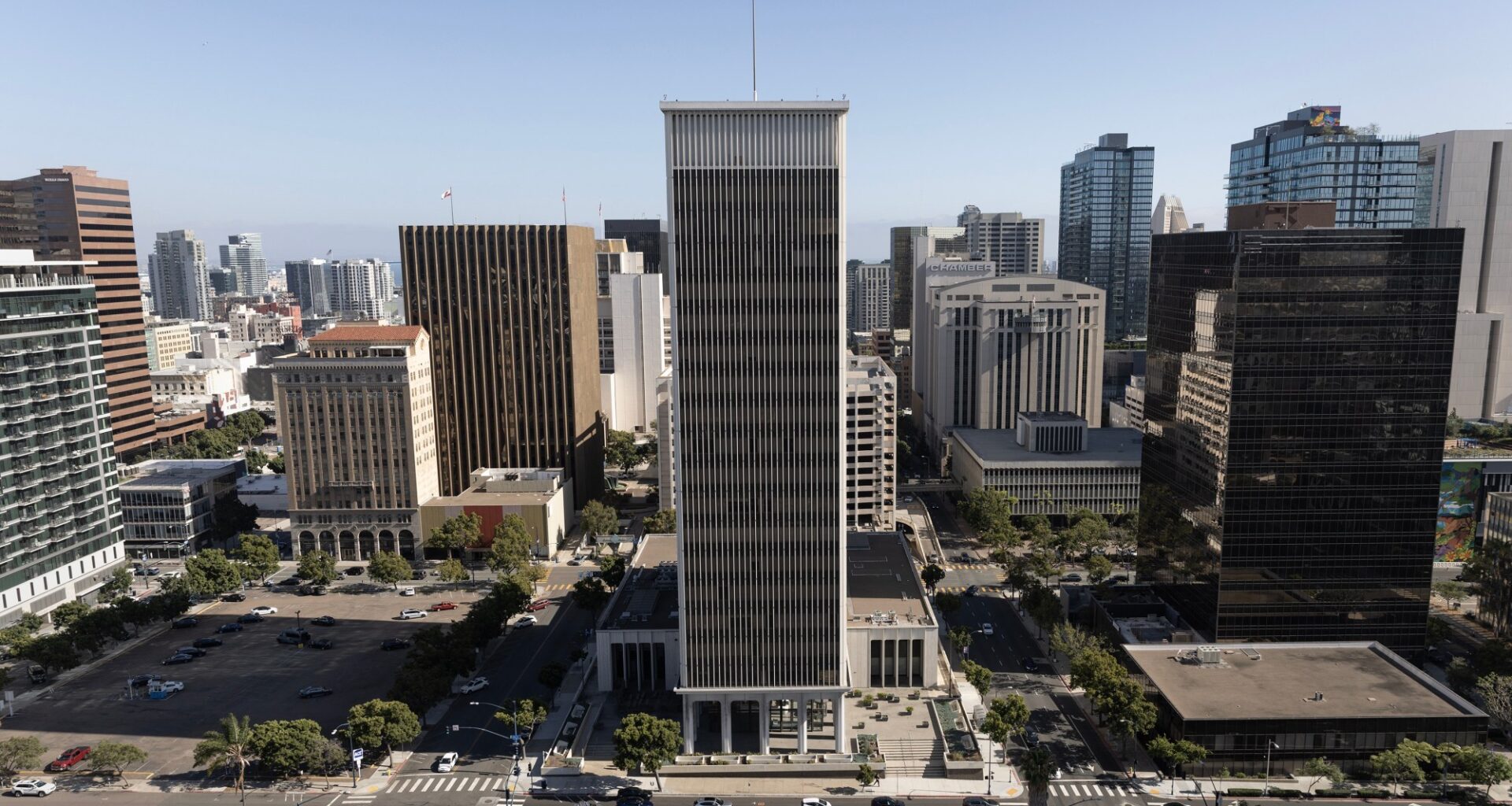
Thirteen months after its approval, the high-stakes real estate transaction for the city of San Diego’s 101 Ash St. property is set to be finalized pending some consequential edits to the city’s contract with the developer.
On Sept. 15, San Diego City Council members will vote on a proposed amendment to its ground lease disposition agreement with 101 Ash Venture LP, which is planning to convert the office tower into apartments for low-income families.
The development entity consists of housing developer MRK Partners and Create Dev LLC. The team recently changed the project’s name and address to 107 Ash St.
The amendment seeks to add five years to the current 60-year lease term, increase the city’s interest rate and require the developer to deed restrict the units as affordable for the entire lease term. The developer has also upped the project’s unit count by two for a total of 252 apartments.
A notice for the public hearing was published Friday.
The changes were described by city executive and deal negotiator Christina Bibler as routine and favorable to the city. They are necessary, she said, to satisfy conditions required by project lenders and related parties, including the U.S. Department of Housing and Urban Development, or HUD, which is insuring the largest loan.
If council members sign off on the edits, the city and the developer expect to close on the transaction by the end of September, Bibler told the Union-Tribune.
“The city is looking forward to turning the chapter on what has been a difficult real estate transaction to something that citizens of San Diego can be proud of and that provides homes for generations to come,” said Bibler, who heads San Diego’s Economic Development Department.
The developer, through a spokesperson, expressed continued confidence in the deal.
“Our team respects the city’s intentional and transparent process in this work over the past year, and we remain confident in it and in our partners,” Margie Newman Tsay, 101 Ash Venture spokesperson, said. “We are on track to close soon and look forward to kicking off construction on much-needed, high-quality, affordable housing in downtown San Diego.”
Opened in 1968, the 21-story office tower at 101 Ash St. takes up a full city block in downtown San Diego and was the longtime home of Sempra Energy until 2015. After a 2017 lease-to-own deal went awry, San Diego bought the asbestos-ridden building outright for $86 million in 2022 in a controversial settlement agreement. The following year, the city offered the property for sale or lease alongside its other Civic Center real estate assets. The MRK-Create bid for the beleaguered tower surfaced as an unsolicited proposal alongside others after the initial solicitation process fell flat.
In July 2025, the city approved a 60-year lease and redevelopment agreement with the 101 Ash Venture LP entity.
The updated development plan now calls for 249 units deed-restricted for families earning 30% to 80% of the area median income, or what’s considered affordable housing. There are also three unrestricted manager units. The project includes 25,000 square feet of retail space and a 4,000-square-foot child care center.
At the time of approval, the parties entered into a ground lease disposition agreement, giving the developer a two-year window to secure the federal housing subsidies needed to fund the project.
In December, the Ash Street project was awarded the subsidies — tax-exempt bonds and low-income housing tax credit equity — but the transaction has been on hold as the developer tried to close a multi-million-dollar gap in the budget.
The group has since secured a $6 million loan commitment from the San Diego Foundation.
In total, the project has eight sources of funds, including a city promissory note with a newly revised interest rate. San Diego originally agreed to loan the value of the Ash Street building, or $45.6 million, at a simple interest rate of 4%.
Under the proposed amendment, the developer will pay 5% compound interest on the unpaid principal balance. The city note will also be subordinate to the HUD-insured permanent loan to satisfy senior financing priority requirements, Bibler said. The priority structure is consistent with the original development agreement, but the amendment spells out the specifics now that the funding sources are finalized, she said.
The project’s development costs are $209.1 million, according to an updated report from city consultant Keyser Marston Associates Inc. The report lists the developer’s largest source of funding as a $73-million HUD-insured permanent loan. The group is also receiving $70.8 million in tax credit equity financing and $24.5 million in historic tax credit equity. In addition, the development entity is now loaning the project $4.4 million.
When including the city note as an acquisition cost, the total project cost is $254.7 million, or more than $1 million per unit, the KMA report shows.
The proposed changes to the ground lease disposition agreement will have a ripple effect on the overall financials of the deal, with some changes more pronounced than others.
For instance, total compensation to the city grows to $145.1 million with the amendment — or nearly $55 million more than the original deal — according to the KMA report. But the net present value of the transaction decreases by $52,000 to $3.5 million.
Net present value looks at the current value of future dollars. Although the city will receive more money over the longer, 65-year term, the net present value is lower because most of the compensation comes further in the future when the dollars are worth less.