
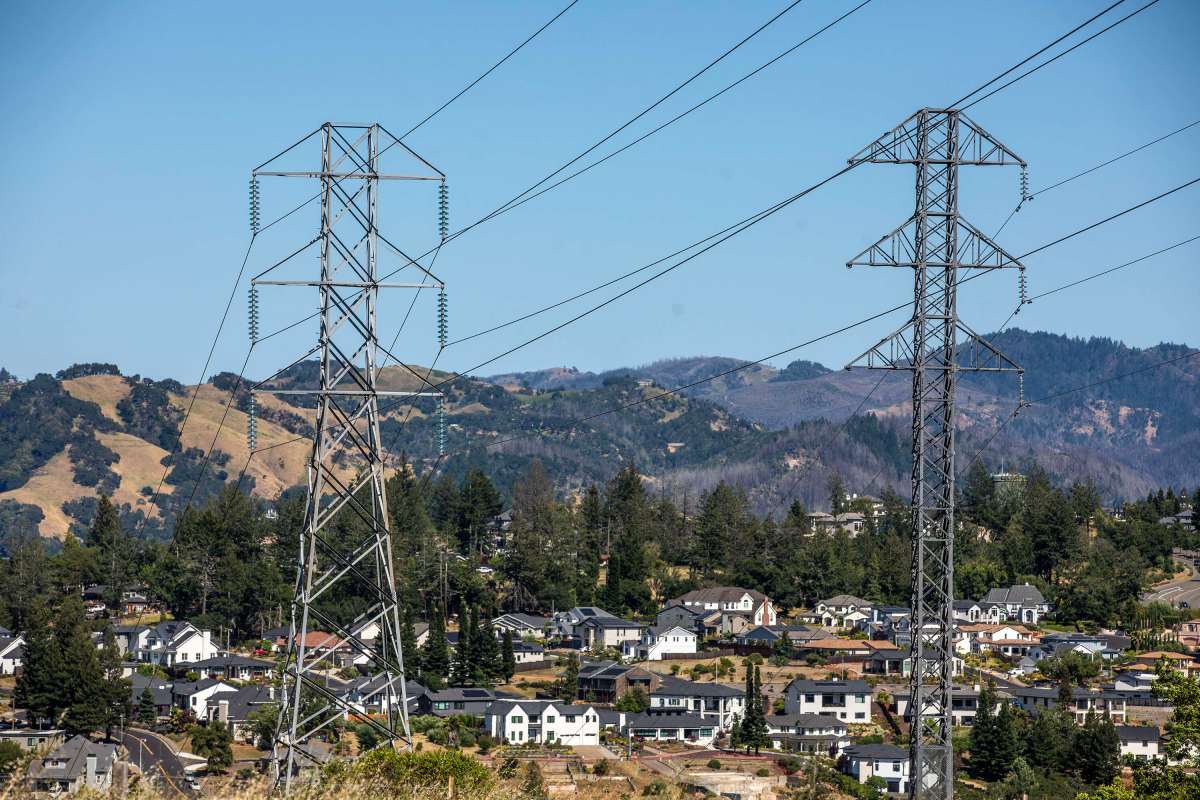
Amid a chaotic end to California’s legislative session, as lawmakers yet again debate sweeping 11th-hour wildfire recovery reform, Northern California wildfire survivors secured a narrow but concrete victory with the state Senate’s unanimous passage of Assembly Bill 2700 this week.
The bill would require the California Public Utilities Commission to identify pathways for full restitution for victims of wildfires sparked by utility giant Pacific Gas & Electric Co .
The group includes survivors, never made whole, who lost homes, businesses and loved ones in blazes spanning the 2015 Butte Fire, the 2017 North Bay firestorm that claimed 40 lives and more than 6,000 homes and the 2018 Camp Fire that leveled the town of Paradise, killing 85 people.
“This has been a herculean effort by wildfire survivors,” said Will Abrams, a 2017 Tubbs Fire victim who leads the Utility Wildfire Survivor Coalition and championed AB 2700. “This legislation centers the restitution of fire victims, recovery of our families and the resiliency of our communities” and “is setting a precedent for the fair, full and timely recovery for current and future wildfire survivors.”
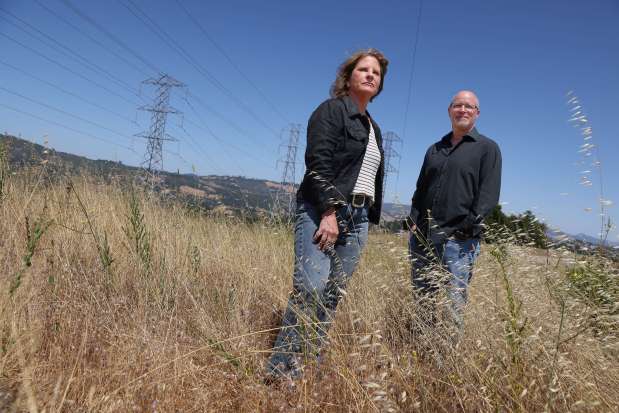
Christopher Chung / The Press Democrat
Natalie Manning and Will Abrams are part of the Utility Wildfire Survivor Coalition. Photo taken along Skyfarm Drive at the site of a burned lot under power lines in Santa Rosa on Monday, June 16, 2025. (Christopher Chung / The Press Democrat)
After PG&E in 2019 declared bankruptcy in the face of mounting liabilities from wildfires tied to their equipment, some 70,000 survivors of record-setting blazes across the North Bay and Butte County were forced to vie for compensation in court with other heavy-hitter creditors.
They eventually agreed in 2020 to a $13.5 billion settlement, half in cash and half in PG&E stock, even as insurers secured $11 billion in cash, and hedge funds holding PG&E bonds ensured they would be paid back $21.5 billion by securing debt against the company’s assets.
Payments have come piecemeal over years as the Fire Victim Trust, tasked with managing the settlement, sold off chunks of stock as the utility’s share prices slowly rebounded. The fund was eventually able to top $14 billion, but that figure is still $5 to $6 billion short of what was owed — enough to cover 70% of survivors’ claims less significant attorneys’ fees.
Survivors, some of whom still haven’t managed to rebuild, received their last payout in late 2024 and are still waiting for a small final distribution. The trust has distributed $13.72 billion so far.
Gov. Gavin Newsom, who started his tenure just weeks before PG&E filed for bankruptcy, had scrambled with legislative leaders to find a solution to ensure a better path for wildfire victims while staving off utilities’ financial collapse. The fix, a state wildfire fund, funded in equal parts by ratepayers and utility shareholders that could be tapped to pay out damages from utility-sparked blazes, is now at the center of debate again.
After the January 2025 firestorm in Los Angeles threatened to wipe out that fund, last year lawmakers passed another sweeping package under the wire that included an $18 billion stop-gap infusion. It also came with a promise to find a more sustainable long-term solution to a new era of utility-sparked and climate-driven wildfires that have leveled communities and threatened to destabilize the state’s energy and insurance markets.
Now, in the waning days of another legislative session, Newsom is seeking to push through a final attempt at reform. The outline of his initial proposal, which included caps on some victim damages, sparked outcry from wildfire survivor groups as “another utility bailout” and set off a rush of heavy lobbying back and forth by different interests.
A campaign backed by investor-owned utilities but dubbed “Wildfire Victims First” that calls for some of the same reforms as Newsom, has especially outraged wildfire survivor groups.
Newsom has pushed back on criticism, although he’s said his pitch is just a starting point. “The status quo is not going to work,” he said at a recent press conference. “It’s not going to work for victims, who consistently are last in line, and that’s at the core of this reform.”
 Gavin Newsom during a budget presentation on Thursday, May 14, 2026, at the Capitol Swing Space building in Sacramento, Calif. The governor’ s effort to change how the state handles utility-caused wildfires is facing significant pushback. (HECTOR AMEZCUA/The Sacramento Bee/TNS)
The final details continue to shift as Newsom’s office and lawmakers trade counterproposals, even with a looming deadline of Monday, Aug. 31, to pass legislation. Newsom’s proposal has made clear that it is “forward looking” and “will not affect recovery for survivors of prior fires,” however.
Left behind
Meanwhile, many PG&E wildfire survivors have felt left behind.
Over the last year, a contingent have launched a campaign to be made whole. They hearken back to what they see as a bad settlement deal with the utility, agreed to under the pressure and promises of hurried political wrangling to pass Newsom’s original 2019 reforms.
AB 2700 is a result of those efforts.
The legislation was originally introduced by Assembly member James Gallagher, R-Yuba City, whose district includes Paradise, site of the deadly 2018 Camp Fire. After Gallagher took over late Rep. Doug LaMalfa’s vacant Northern California seat in Congress, Assembly member Joe Patterson, R-Rocklin, took up the mantle for the bill. It has several co-sponsors from both sides of the aisle, including Assembly member Chris Rogers, D-Santa Rosa, who was a Santa Rosa council member in 2017 when the Tubbs Fire destroyed roughly 3,000 homes in the city.
“People are still recovering without receiving this money that they deserve,” Gallagher said before the May 28 Assembly floor vote. AB 2700 “strengthens California’s commitment to those who lost everything from those natural disasters.”

Republican Assembly member James Gallagher — here shown in the Capitol on August 21, 2025 — has announced he will run for the U.S. House seat formerly held by Doug LaMalfa. (Photo by Justin Sullivan/Getty Images)

AP Photo/Noah Berger, File
Help Camp Fire survivors and fund fire protection: Gov. Newsom signed two laws Oct. 9 aimed to help Camp Fire survivors rebuild and open up grant funding for fire protection services. AB 556 give residents of the town of Paradise three more years to avoid a property tax increase by transferring the assessed value of their previous home while they rebuild or purchase a new property. AB 570 will make County Service Areas that provide fire protection services, such as the Sutter County Fire Department, eligible for grant funding from the Special District Fire Response Fund. Both bills were authored by Assembly Republican Leader James Gallagher of Yuba City. (AP Photo/Noah Berger, File)

Christopher Chung/The Press Democrat
California State Assembly member Chris Rogers speaks during the previous Sonoma State University Legislative Forum in Rohnert Park on Friday, Feb. 21, 2025. (Christopher Chung/The Press Democrat)
Show Caption
1 of 3
Republican Assembly member James Gallagher — here shown in the Capitol on August 21, 2025 — has announced he will run for the U.S. House seat formerly held by Doug LaMalfa. (Photo by Justin Sullivan/Getty Images)
The restitution mechanisms in the public utilities commission report mandated by the bill would put the burden on utilities to address compensation shortfalls without shifting costs onto ratepayers.
The cost of the study was estimated at $5 million by a state Senate appropriations committee analysis.
On Aug. 7, PG&E and Southern California Edison, whose equipment sparked the 2025 Los Angeles Eaton Fire, according to a recent county and state investigation, submitted a letter to lawmakers opposing AB 2700.
“At a time when California urgently needs to implement sustainable, long-term, solutions to address wildfire risk and improve electric affordability, this bill increases uncertainty, risk, and costs in a manner that is counterproductive to both wildfire victim restitution and reliable, affordable utility service,” the utilities said. “The legislature should not be second-guessing legal processes that fully and voluntarily resolved claims from past fires.”
Citing bankruptcy law and constitutional protections for utilities, the letter warned “AB 2700 attempts to rewrite the outcome of those long-settled federal proceedings and would be subject to significant and protracted legal challenges.”
PG&E declined to provide further comment or respond to written questions.

A San Diego Cal Fire firefighter monitors a flare up on a the head of the Nuns fire (the Southern LNU Complex), Wednesday Oct. 11, 2017 off of High Road above the Sonoma Valley. A wind shift caused flames to move quickly up hill and threaten homes in the area. (Kent Porter / Press Democrat) 2017

Kent Porter / The Press Democrat
Construction of new homes burned by the Tubbs fire takes shape on Dec. 26, 2019 in Fountaingrove. Memories of the 2017 wildfires and 2019’s Kincade fire were on some voters’ minds as they weighed Measure G, a half-cent sales tax to bolster firefighting resources. (Kent Porter / The Press Democrat)

A rebuilt Coffey Park home gets the “Christmas Vacation” treatment in Santa Rosa, Dec. 15, 2020. The home along with thousands of others was razed by the 2017 Tubbs Fire. (Kent Porter / The Press Democrat) 2019

Form Rincon Ridge West, Crown Hill Drive is busy with new construction from the devastation wrought by the 2017 Tubbs fire, Thursday, Jan 9, 2020 as fog hugs Foutnaingrove above the Santa Rosa Plain at sunrise. Memories of the 2017 wildfires and 2019’s Kincade fire were on some voters’ minds as they weighed Measure G, a half-cent sales tax to bolster firefighting resources. (Kent Porter / The Press Democrat) 2020
Show Caption
1 of 4
A San Diego Cal Fire firefighter monitors a flare up on a the head of the Nuns fire (the Southern LNU Complex), Wednesday Oct. 11, 2017 off of High Road above the Sonoma Valley. A wind shift caused flames to move quickly up hill and threaten homes in the area. (Kent Porter / Press Democrat) 2017
Last year, as advocates pressed the state to explore ways to make them whole, the Fire Victim Trust sent an update in November describing itself as “a limited fund that will not receive anything beyond the consideration that PG&E agreed to pay.” Under federal law, the notice said, once PG&E’s bankruptcy plan and negotiated settlements were approved, “PG&E satisfied its legal responsibility for all fire victim claims…The Trust has no legal ability to collect any more from PG&E.”
Now, as AB 2700 advances, the Fire Victim Trust did not respond to a request for its position on the bill or whether there have been further discussions about preserving the trust or its claims data if the state moves to find another way to close the restitution gap.
Abrams criticized PG&E for not joining “good faith discussions” on the bill. “They have not shown up in committee hearings. They have not engaged in the collaborative legislative process,” he said.
Alluding to the company positioning itself as a “reimagined” and “fundamentally improved and transformed” utility, Abrams said, “here’s the opportunity to show it” and “be a good corporate citizen and reach out to address these critical issues.”
A spokesperson for Newsom said the Governor’s Office doesn’t typically comment on pending legislation.
In the North Bay, the bill covers those affected by the Tubbs, Nuns, Atlas, Redwood, Pocket and Sulphur fires that burned across four counties in the October 2017 firestorm, the most destructive and deadly in California at that time.
In May, the bill passed the state Assembly in a 76-0 vote. On Aug. 24, an amended version cleared the state Senate floor vote without any opposition. It will return to the Assembly for a concurrence vote Sunday, and if passed, will head to the governor’s desk.
You can reach senior reporter Marisa Endicott at 707-521-5470 or marisa.endicott@pressdemocrat.com. On X @marisaendicott and Facebook @InYourCornerTPD.