
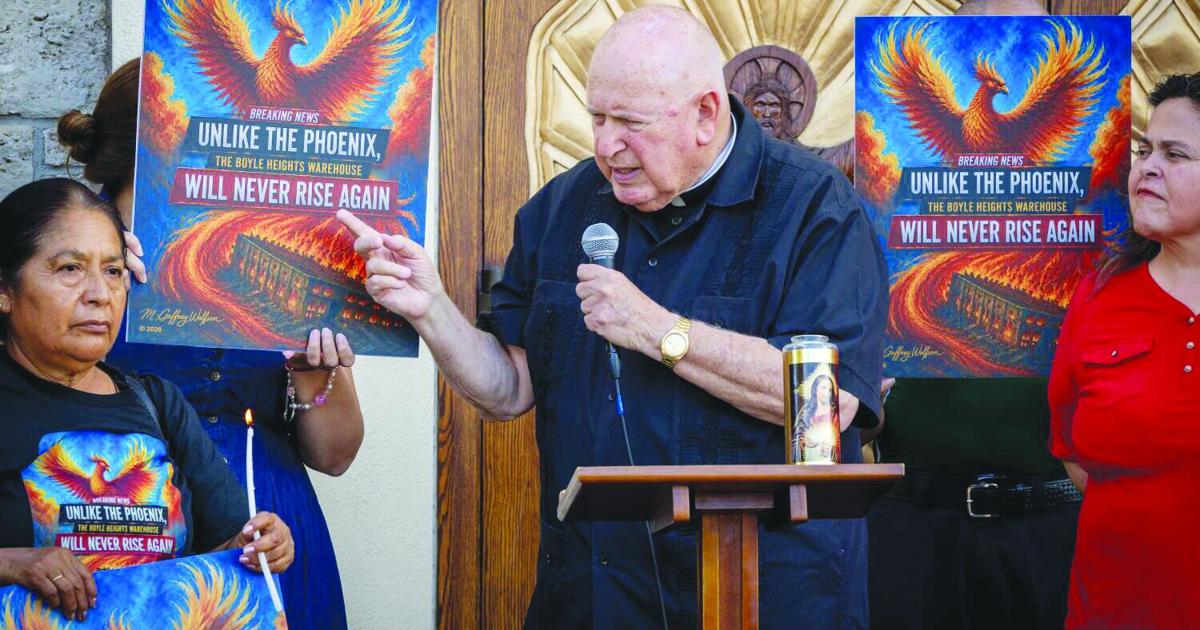
They lit candles, grasped rosaries and passed out poster boards and N-95 masks.
The 50 or so people gathered in front of Resurrection Church in Boyle Heights on the evening of Aug. 6 getting ready to pray and fight for the Eastside once again.
For generations, the 103-year-old Catholic parish has been a beacon of solace and resistance for residents angry about the latest indignity to befall the historic heart of Latino Los Angeles.
The Lineage warehouse fire, which erupted a mile away nearly two months ago, still blankets the church every morning with the fetid stench of millions of pounds of rotting food that have yet to be trucked away.
“We pray because we have suffered for a century due to environmental racism,” said Sofia Quinones from the podium during the vigil. Around her stood people in T-shirts with the same illustration featured on the church’s bulletin that week: a phoenix representing Boyle Heights rising from the flames of a hellish warehouse.
Quinones paused for a few seconds as a loudspeaker crackling from an LAPD helicopter circling a few streets over ordered a shooting suspect to turn themselves in. “We ask that you open the hearts and mind of the powerful,” she continued. “We ask you, Lord, to help us.”
The faithful recited the Lord’s Prayer and a Hail Mary. Then, they marched from the Resurrection entrance to the school’s multipurpose room for a plática, or teach-in, on Lineage, singing in Spanish a song based on the 118th Psalm:
This is the day that the Lord has made
Pueblo of happiness and joy
Let’s walk to the meeting of the Lord
It was a stirring sight — and yet a sad one. If Resurrection Church is famed in Catholic and activist circles across Southern California, it’s because parishioners over the decades have had to deal with afflictions on the level of Job.
A proposed prison off Olympic Boulevard. Lead-spewing plants. Gang violence. Gentrification. The COVID-19 pandemic. ICE raids. Now, a burnt-out putrid warehouse that has devastated businesses and forced residents to remain inside their homes during a sweltering summer, as flies and giant rats infest the neighborhood.
“It’s kinda crazy what this parish has gone through,” said Father Jorge Moncada, who didn’t know about Resurrection’s history until he arrived last year on his first assignment as a priest. “They’ve been through a lot and carried a lot of burden. But they’ve responded, they have risen to fight against injustice again and again.”
The 29-year-old Moncada is quickly learning the ways of Resurrection under the legendary Monsignor John Moretta, better known as Padre Juan. In the rectory dining room before the vigil, the burly 85-year-old priest said he wasn’t fazed that his working-class parish has weathered so much since arriving in 1983.
“Sin never stops,” Moretta said in his distinctive gruff voice, a Roman collar peeking from his black guayabera. Earlier in the day, he and a busload of parishioners had testified at a South Coast Air Quality Management District hearing about how the Lineage fire had impacted their lives.
“Every time I think the problems are done, they start popping up again,” Moretta said. “But I’m an idealist. I can never live all these years in this parish if I weren’t an idealist.”
I scoffed. You really think things have improved in Boyle Heights despite the nonstop procession of problems, Monsignor?
“No,” he replied, “I know so.”
Resurrection’s battles read like a history of modern-day Latino politics in Los Angeles. The Mothers of East Los Angeles — the legendary women’s group that took on Eastside politicos in the 1980s and 1990s — was born in Resurrection’s pews. Members had fought off plans for toxic waste incinerators and power plants. Politicians from the late LA County Supervisor Gloria Molina to former Mayor Antonio Villaraigosa to LA City Councilmember Ysabel Jurado have sought Moretta’s counsel and helped parishioners in their various crusades.
Former Assemblymember Wendy Carrillo remembers being “wowed” when she held a community forum at Resurrection in 2016 that drew hundreds of people. They were outraged about the lack of government accountability surrounding the closure of the Exide battery recycling plant in nearby Vernon that had contaminated thousands of homes.
“It was both inspiring and surprising to see how quickly [the Resurrection] community organized around this issue,” said Carrillo, whose home parish is another historic Boyle Heights progressive powerhouse, Dolores Mission.
She credited Moretta for allowing Resurrection to flower but also noted that what makes the parish more activist than most of its Eastside sister churches is its proximity to unincorporated East Los Angeles, which is governed by the county.