
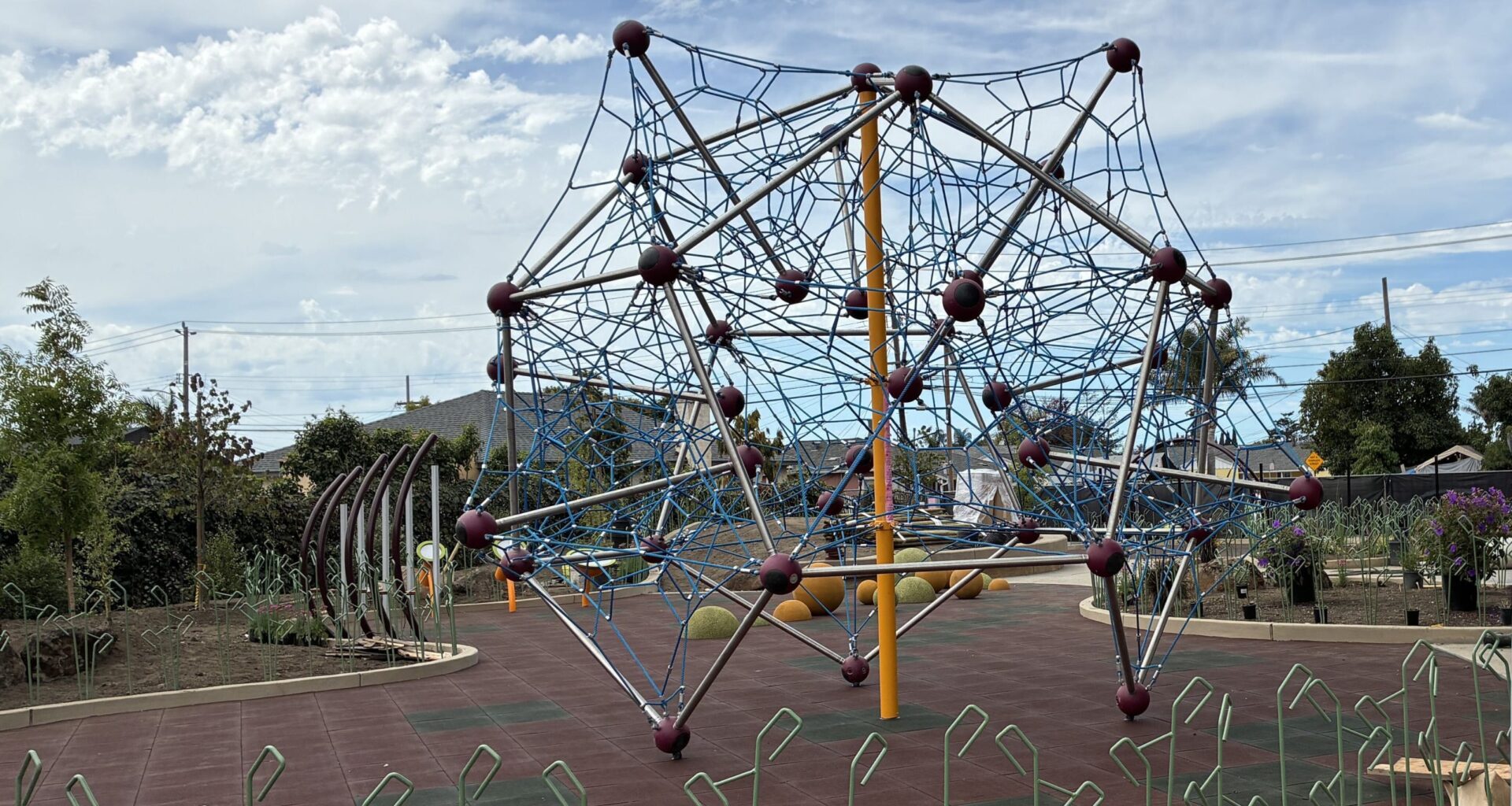
On Saturday, city and community leaders will gather for an official ribbon-cutting ceremony to mark the reopening of Tyrone Carney Park, which has been fenced off since 2002.
The roughly one-acre park at the gateway to the Sobrante Park neighborhood was created in 1968 on an abandoned, weed-strewn lot where a department store had burned to the ground years before. The park was named after a 20-year-old Marine, Tyrone Carney, who’d been killed by grenade shrapnel earlier that year in the Vietnam War, a conflict that many Oaklanders were protesting.
Tyrone Carney Park reopening
Free and open to the public: Sat., Aug. 29, 10501 Acalanes Drive, 11 a.m. to 12 p.m.
Will include Mayor Barbara Lee, Councilmember Ken Houston, Deborah Carney (family member of Tyrone Carney), and community members.
Sylvia Brooks of the Sobrante Park Resident Action Council told The Oaklandside last year that the park was once a vital hub for neighborhood families. “It’s been a long time, and the community is just very excited and happy to see everything moving forward,” Brooks told The Oaklandside.
On Thursday, workers were planting shrubs, spreading mulch, installing lights, and putting other final touches on the park, which sits at the intersection of 105th Avenue and Alcanes Drive. Curious neighbors and kids walking home from three nearby schools peered through the soon-to-come-down fence at the new playground.
Saturday’s ceremony will include live music, remarks from city leaders, and the unveiling of a statue.
In an interview this week, District 7 Councilmember Ken Houston called the park’s revival a major accomplishment and said he plans to attend Saturday’s festivities. Houston said he was working at a construction site near the park in the early 2000s when stray bullets struck materials near him. Fearing for his and others’ safety, he urged the city council to shutter the park.
“It’s symbolic I helped close it, and now I’m helping reopen it,” Houston said.
The history and closure of Tyrone Carney Park symbolize many of Oakland’s struggles
A graduate of Castlemont High School and a Merritt College student, Tyrone Carney was a member of the Community Reformed Church of Oakland and planned to become a minister. He’d grown up one block away from the future park site.
Never miss a story. Sign up for The Oaklandside’s free daily newsletter.
The creation of the park in 1968 was a festive occasion. Volunteers, including neighbors and members of civil rights and community groups, built the playground with donated materials. It featured a geodesic dome children loved to climb, basketball courts, and a picnic area.
But within a few years, the park turned from a point of pride into a problem. Sobrante Park, which began as an all-white suburb, saw white residents pick up and leave rather than live next to Black families who’d fought to desegregate it. Industries packed up and left East Oakland, leaving behind a community suffering from rising unemployment.
By the 1970s, Tyrone Carney Park had gained a reputation as a dangerous place. Young unemployed men took over the playground and basketball courts to deal drugs, a source of income in an otherwise economically anemic city.
Houston said many Black Oaklanders were locked out of the job market due to racism and housing discrimination. “They were forced into that underground economy,” he said about many of the youngsters who either lost their lives in gang wars or were sent to prison.
Oakland Tribune reporter Brenda Payton described the situation in a 1989 story for her newspaper: Tyrone Carney Park served as “a cruel and ironic comment on the plight of young black men. Carney was a neighborhood youngster killed in Vietnam; now young men deal drugs in the park dedicated to his memory.”’
Many who claimed the park as their base of operations referred to themselves as members of “11-5.” It was a defiant reference to OPD’s radio code for drug sales, and city leaders treated them as a gang that needed to be eradicated.
In 1984, things had gotten so bad that neighbors picketed the park, loudly chanting, “Dope dealers must go,” and “Give us back our park” in a desperate attempt to get the city and police to do anything.
 A newspaper story in a 1984 edition of the Oakland Tribune covered Sobrante Park neighbors’ protests drawing attention to violence in Tyrone Carney Park. Credit: Oakland Tribune via Newspapers.com
In 1992, neighbors waged yet another campaign to try to turn the tide on crime and violence. Tyrone Carney Park was the focal point of that effort. Police surged the area for a month, but with no long-term effect.
Things came to a head in 2002 when four men were shot during a barbecue in the park. One of them, Jayway The’son, 38, was killed.
“It’s just insanity [that] it’s happening. People are afraid to live their lives,” said Larry Reid, the city councilmember representing Sobrante Park at the time.
Oakland’s response was harsh, but many accepted it as necessary: City workers put up a six-foot-tall fence. Weeds reclaimed the basketball courts as pavement cracked. The playground fell into disrepair.
For the next 24 years, Tyrone Carney Park was sealed away from the surrounding community. It had reverted to an abandoned lot, a magnet for blight, the very thing the neighborhood had originally sought to get rid of.
Years of community organizing to bring down the fence
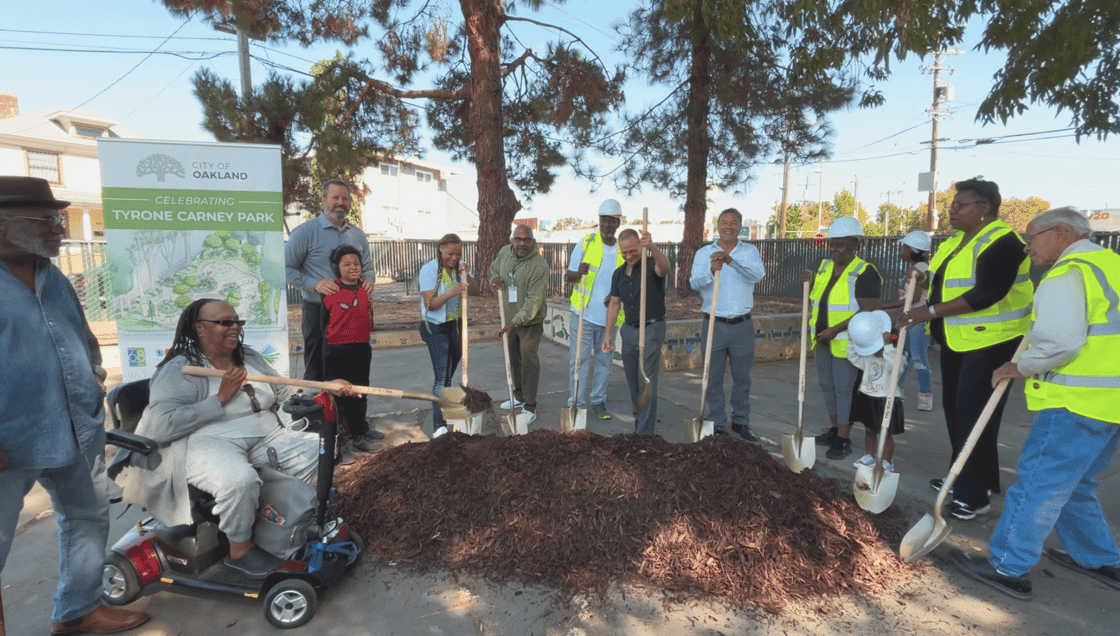 Oakland city officials, including Interim Public Works Director Josh Rowan and Councilmember Ken Houston, and local stakeholders break ground for renovations at East Oakland’s Tyrone Carney Park. Credit: Courtesy of city of Oakland.
Today, city leaders are confident that the reborn park can finally thrive. Council member Ken Houston said that the public safety situation is different today in Sobrante Park. He believes the surrounding community will keep the park clean and safe for families.
Residents living near the park deserve a lot of credit for what’s happening here today. City spokesperson Monica Pelayo Lock said that central to the park’s revitalization are community partnerships with groups like the East Oakland Neighborhood Initiative and the Sobrante Park Resident Action Council.
Nearly a decade ago, the East Oakland Neighborhoods Initiative, a community coalition, drafted a roadmap for improving infrastructure, including parks. They partnered with Oakland’s Public Works Department to rethink Tyrone Carney Park and seek grant funding.
The city obtained a state natural resources agency grant of $2.5 million in 2018 and got another $1 million from the state California Transformative Climate Communities program. Combined with $200,000 in Measure U funds, and other money, the total project cost $5 million.
Brooks, the Sobrante Park Resident Action Council member, credited Cynthia Arrington, the council’s former co-chairwoman, with helping secure the needed funding.
Beginning last year, Oakland installed a playground, added walking paths and landscaping, community-created artwork, and a memorial for the young man for whom the park is named.
The park will be maintained by the Oakland Parks and Recreation Foundation, a nonprofit that runs other city parks and programs.
These grassroots organizations will continue to serve as stewards, ensuring the park remains a safe and welcoming space for residents who value access to green recreational areas.
…We rely on your support
Hey, we know that most readers only scan a headline and a couple of paragraphs. Thank you for reading to the end of our story. Since you clearly appreciate the in-depth approach we take in reporting the stories that matter to Oaklanders, please consider chipping in to supercharge our newsroom.
“*” indicates required fields