
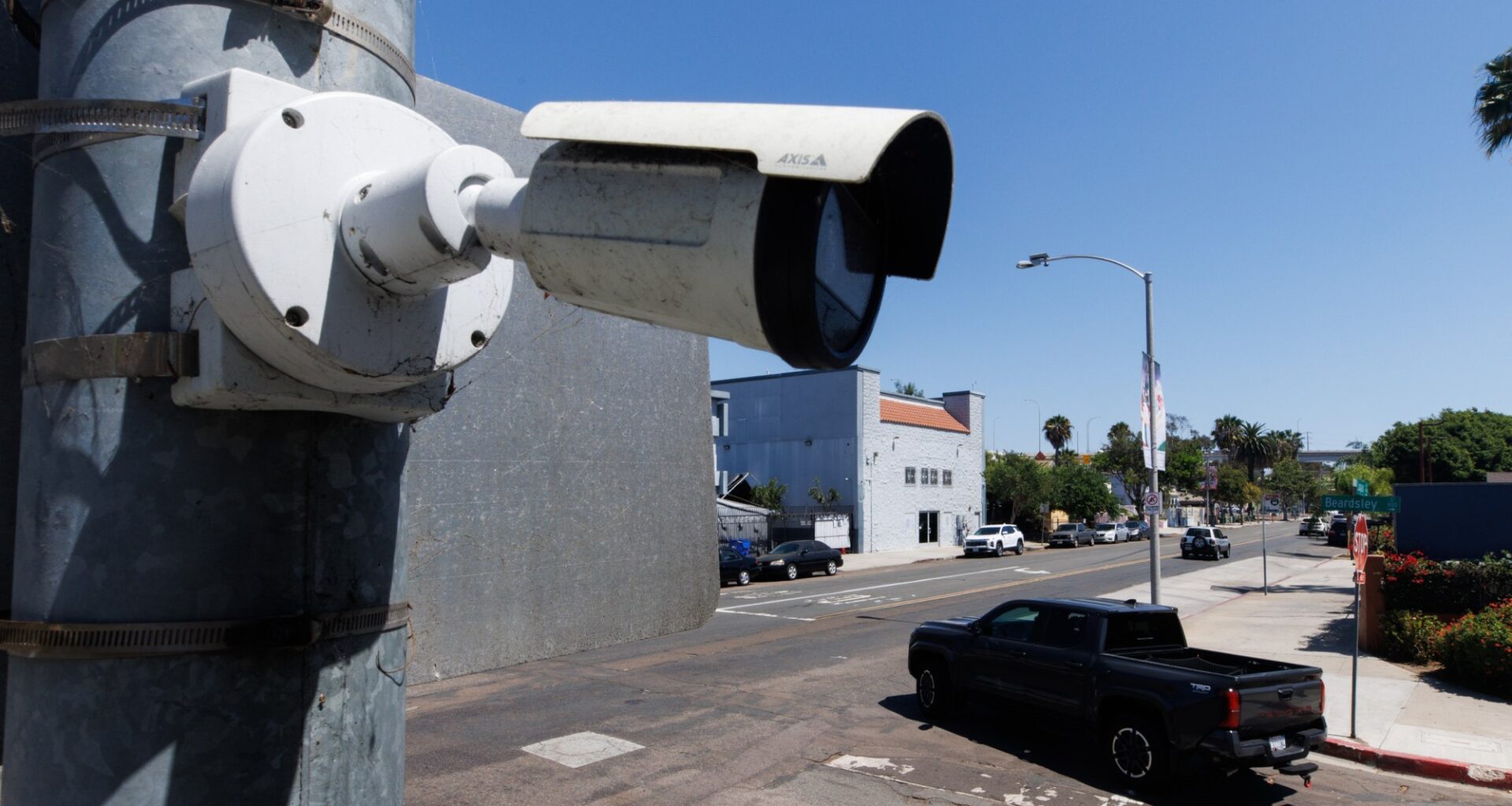
Automated license plate readers aren’t new to San Diego, but the increasingly ubiquitous technology has gotten renewed attention across the country in recent weeks amid increasing backlash from critics who say the cameras — namely, from Flock Safety — are an unblinking eye on the path to a surveillance state and ripe for misuse.
News outlets have reported a growing number of allegations of misuse by police in other parts of the country, as well as instances of people vandalizing the cameras — something also happening here. Earlier this month, several San Diegans turned out for “National Week of Action” events, a push promoted by the activist group DeFlock. Local events included a rally and march in downtown San Diego.
While the technology has been debated in San Diego for years, the city made headlines earlier this month when a man dressed as Darth Vader from “Star Wars” made a satirical endorsement of Flock at a city commission meeting: “The Emperor is a fan.”
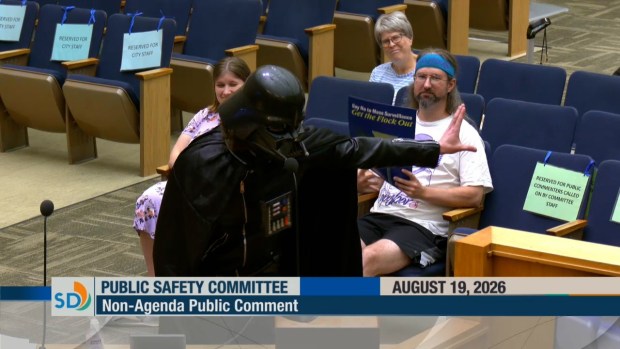 During a San Diego Public Safety Committee meeting in early August, Anthony Ralphs donned a Darth Vader costume to praise the implementation of ALPR technology as a satirical stunt. (City of San Diego)
In some places, the pushback has gotten recent traction, turning some leaders against technology they’d previously embraced. A growing number of cities are canceling their ALPR contracts.
Flock, one of the biggest players in the ALPR market — and the main target of the backlash — recently issued a statement that it is making changes, including shortening the recommended default to retain the data from 30 days to seven and making it tougher to abuse the system.
Here’s the latest on the technology in San Diego County:
Where they are used
There are hundreds of automated license plate readers affixed to poles throughout the region. The city of San Diego alone has 500 surveillance cameras and ALPR technology on streetlights. Chula Vista has 150 ALPRs. La Mesa has 20. Vista has two.
Where they are precisely located is more of a question, with transparency varying by jurisdiction. San Diego posts a map of the locations of its readers. The Sheriff’s Office, which oversees 131 of them in cities it patrols and in unincorporated areas, does not.
Over a recent 30-day stretch, readers in the city of San Diego detected nearly 4 million vehicles. Chula Vista logged 1.25 million vehicles during that same stretch and searched the data roughly 1,200 times. Coronado has 10 cameras and, during a recent 30-day period, logged more than 420,000 vehicles. Coronado police searched that data 98 times.
Cities use varying approaches to cover the camera subscription costs. For example, National City, a city of 9 square miles, uses grant money for its 91 cameras.
ALPRs have also gained popularity in the private sector, such as in shopping center parking lots and business districts, as well as by companies that repossess vehicles.
Data sharing
State law prohibits law enforcement from sharing the data with entities outside of California. Beyond that, each jurisdiction has its own rules governing use of the readers.
The city of San Diego, which has a Privacy Advisory Board, has even stricter rules when it comes to data sharing. Its ALPR network is on a figurative island, and no outside agencies can directly access it. And any California law enforcement agency that wants San Diego police to share information must show it is investigating one of a limited number of types of crimes.
Likewise, the Sheriff’s Office said it turned off direct access for outside agencies. The office has also tightened safeguards for internal access. And no one is proactively monitoring the cameras. The use is “just strictly in response to an investigation — somebody who’s at risk, or a violent crime series or a violent crime that’s occurred and we’re trying to solve it quickly,” Sheriff Kelly Martinez said Thursday.
El Cajon sued over data sharing
The city of El Cajon remains locked in a legal battle with the state of California, after the Attorney General’s Office sued last fall. The state is accusing the police department of illegally sharing access to data from the city’s 90 cameras with other states. The fight centers on the interpretation of the 2015 state Senate Bill 34, which governs ALPR use.
The Attorney General’s Office argues that state law bars sharing ALPR data with out-of-state or federal law enforcement agencies. An ongoing battle over a subpoena that El Cajon is pursuing has slowed the suit.
In April, the city sued the state, asking a court “to declare what laws govern in El Cajon” and find state laws such as the California Values Act to be invalid under the federal Supremacy Clause. The city is working with the America First Policy Institute, a conservative think tank. The Attorney General’s Office countered in court documents that challenges to the state laws by the federal government have failed.
Both lawsuits are in relatively early stages.
Privacy concerns
Critics argue the technology intrudes on civil rights and fear that the federal government — immigration officials in particular — could muscle in on local surveillance systems despite laws and policies barring access. They also question the financial cost.
ALPR opponents say the data can reveal travel patterns that could be turned against drivers. The Associated Press reported last year that Border Patrol is using plate readers hidden along freeways.
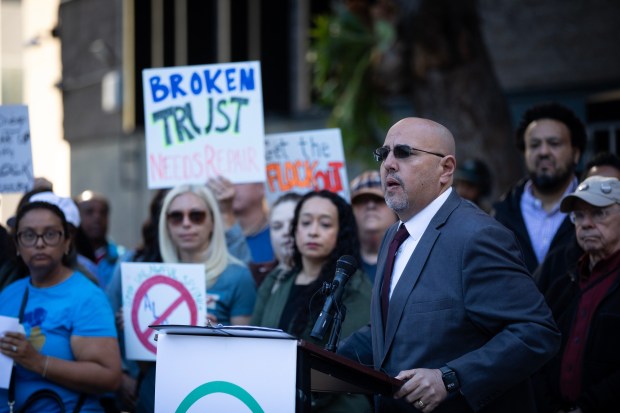 San Diego Councilmember Henry Foster III speaks during a press conference against the use of automated license plate readers on Dec. 4, 2025, in San Diego. (Ana Ramirez / U-T file)
There have been reports of police misuse of the technology, including those accused of searching the database to surveil their intimate partners or exes. The Washington Post reported earlier this month that its analysis of police and court records found at least 50 law enforcement officers have been charged with unauthorized use of the readers.
Those headlines don’t surprise Seth Hall of Transparent and Responsible Use of Surveillance Technology San Diego, or TRUST SD, Coalition, which has lobbied against the surveillance. “This was just the inevitable result of unacceptable and unprofessional mass surveillance,” he said.
“People are becoming more aware of the presence of these systems across the country,” Hall said. “I think that is driving a lot of the modern attention at the moment.”
Cases solved
Local law enforcement hail ALPRs as a force multiplier, and officials routinely tout successes in solving cases using ALPRs, including the recent arrest of a 15-year-old boy accused of firing a gun into a Vista restaurant from a passing car. The bullet pierced the restaurant glass and left a diner with a minor injury.
Chula Vista police say the technology helped them identify a suspect in a fatal December shooting and arrest a suspect in a fatal hit-and-run the following month.
In 2024, after a man tried to snatch two young girls in Mission Valley days apart, San Diego police use of license plate readers led to a suspect’s arrest.
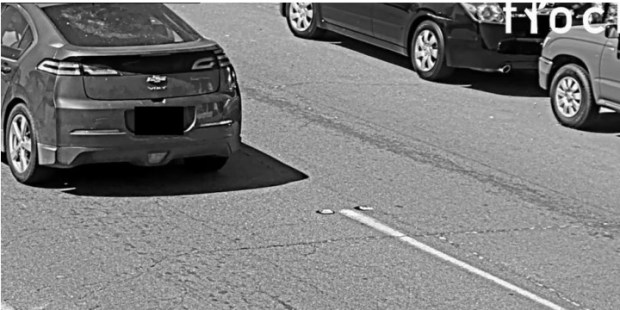 San Diego police provided this image taken by an automated license plate reader in downtown San Diego. Investigators believe the car seen on the left side of the image is linked to attempts to kidnap two young girls at Mission Valley mall on separate days in late June 2024. (Courtesy San Diego Police Department)
That same year, El Cajon police used ALPR images to identify the vehicle used by a suspect in a deadly shooting rampage in a dental office. The suspect was arrested within hours. Other cities have also used the cameras to make homicide arrests.
Authorities emphasize that plate readers are just a tool. They may help zero in on a suspect, but no case is made solely on a plate reader hit. They also note that the cameras are focused on cars, not people.
Flock rule changes
Flock Safety, the vendor used by all local jurisdictions except for Carlsbad, responded to the recent growing backlash by announcing a series of steps to curb potential abuse. It is now shortening the recommended default amount of time that the collected data is kept, from 30 days to seven, although that retention decision is up to each customer. The company is also requiring a case or incident number for every search and use of Flock’s Audit Assistance tool to flag abnormal activity.
 An automated license plate reader at the intersection of Beardsley Street and Logan Avenue in Barrio Logan on Saturday. (Kristian Carreon / The San Diego Union-Tribune)
In a video published Aug. 13, Flock CEO Garrett Langley said the company has listened to law enforcement and to communities. “We will keep listening, we’ll keep improving and building a better standard for public safety technology,” he said.
Most of the local law enforcement agencies keep the data for 30 days, but longer if it’s tied to an investigation. Carlsbad and Coronado each keep the data for 365 days, although Coronado police said the department is reviewing that policy given Flock’s recent reduction recommendation and the rising public concern.
The San Diego Police Department said it already uses some of the company’s safeguards but that it has opted to maintain its current 30-day retention period.
“A shorter retention period may work for smaller agencies with lower crime volumes or less complex investigations, but SDPD serves a large city and investigates cases that can take time to develop,” department spokesperson Ashley Nicholes said. “Thirty days is already on the low end of ALPR retention periods, and we believe it is the shortest period we can responsibly maintain without reducing the effectiveness of the technology as an investigative tool.”
Local departments say they strictly and routinely audit who can access the data, as well as why officers are accessing it.
Vandalism
There have been increasing reports of people vandalizing mounted ALPR cameras nationwide. It’s happening locally, too.
Last month, for example, someone removed one of Coronado’s cameras, then ditched it nearby. Earlier this year, in February and again in March, Flock cameras were vandalized in La Mesa.
The Sheriff’s Office says this year it’s had four cameras vandalized, such as being spray-painted or rotated away from the street. And Chula Vista says it has had several of the cameras vandalized or stolen in the last two years.
Last week, in the Riverside County city of Palm Desert, a man reportedly threatened a Flock contractor, destroyed the camera the contractor was installing (it was a replacement for a vandalized camera), and slashed all four of the contractor’s truck tires. A suspect was arrested.