
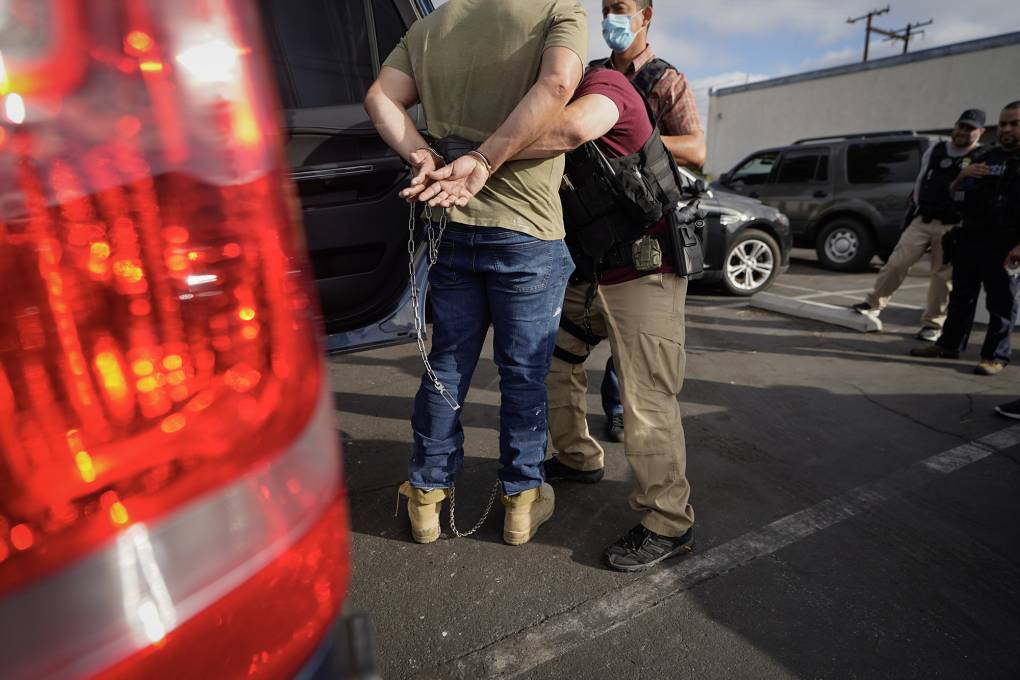
Immigration agents arrested more people in Northern California in July than at any point since President Donald Trump returned to office in January 2025. That’s according to a KQED analysis of newly released data compiled by UC Berkeley’s Deportation Data Project.
Arrests by U.S. Immigration and Customs Enforcement across California and nationally have likewise surged to new levels, the data shows, even as the Trump administration has backed off the high-profile raids it launched last year in cities from Los Angeles to Minneapolis, where ICE agents fatally shot two protesters.
Nationwide, ICE recorded nearly 50,000 arrests in July. Close to 4,300 of them were in California, making it the state with the third-highest number of arrests — though it was dwarfed by the scale of arrests in Texas and Florida, which together accounted for nearly 20,000 of the month’s immigration arrests.
In California, in ICE’s San Francisco “area of responsibility,” which includes all of the state north of Bakersfield, ICE made 890 arrests in July. That’s more than a 60% increase since February, the last month for which this data was previously available.
Bay Area immigration lawyers say they’ve seen the increase reflected in a jump in calls to rapid response hotlines this summer.
Most of the arrests are taking place at ICE check-in appointments, for which people are often summoned abruptly, they said. Typically, immigrants required to check in are people who lack a visa but have some type of provisional permission to remain in the country, including a pending asylum case.
Lourdes Martinez, an attorney at Centro Legal de la Raza in Oakland, said her nonprofit recommends that people who are called into an ICE office “out of the blue” contact their county’s rapid response network before they go.
“Not because we can prevent a detention, but we can help you assess your risk,” said Martinez, who co-directs the Alameda County Immigration Legal and Education Partnership, the county’s rapid response network. “In particular, parents with small children…. We want them to [go to the appointment] having made a plan with their family: What is Plan B if the parent doesn’t get to come home to the children?”
ICE has also been arresting people catching domestic flights at airports and attending green card interviews in Northern California in recent months, Martinez and others said. They called those practices unprecedented.
“The numbers are not very high, but it’s very alarming. It really should not be happening. It’s very much a violation of how the process is supposed to work,” Martinez said. She noted that immigration arrests are civil, not criminal, and added that federal judges have been ordering many of these individuals released from detention.
Milli Atkinson, who runs the Immigrant Legal Defense Program at the San Francisco Bar Association, said she is cautioning immigrants, even those who are here lawfully, to avoid air travel.
“I know a lot of people who’ve been in the United States for a long time, they have work authorization, and they’ve traveled domestically in the past without a problem — who are very much blindsided when they’re detained by ICE at the airport,” she said. “It’s really not a safe time to travel if you’re an immigrant. If you’re a lawful permanent resident and you have any type of criminal history, I would really consult with an immigration attorney before choosing to travel.”
One place where arrests are no longer happening in Northern California is at courthouses. A federal judge in San Jose blocked the practice after ICE began making arrests at the San Francisco and Concord immigration courts last year. In addition, the judge ordered the agency to improve conditions in its short-term holding cells at its San Francisco headquarters at 630 Sansome St. Advocates say that requirement led to fewer arrests in the region last winter.
 A federal agent wears an Immigration and Customs Enforcement badge on June 10, 2025. (AP Photo/Yuki Iwamura, File)
“We started this year with a low number of arrests,” Martinez said. “But we heard with the big appropriations bill last year that they were hiring 10,000-plus new agents. And so we were expecting that things were going to pick up.”
The number of people arrested has risen sharply this spring across California, but it remains lower in the San Francisco area of responsibility than in ICE’s two other subdivisions in the state. The San Diego border region saw 1,955 arrests in July, and the Los Angeles office arrested 1,406 people.
Despite the statewide increase, there are still far fewer immigration arrests here than in Texas and Florida. That’s largely because of California laws passed during the first Trump administration that restrict the ability of local law enforcement to cooperate with ICE, according to Angela Chan, an assistant chief attorney at the San Francisco Public Defender’s Office.
“California has the highest number of immigrants compared to any other state. And we’re not leading in terms of the number of ICE arrests. That’s likely largely due to our sanctuary laws,” said Chan, who helped author the laws.
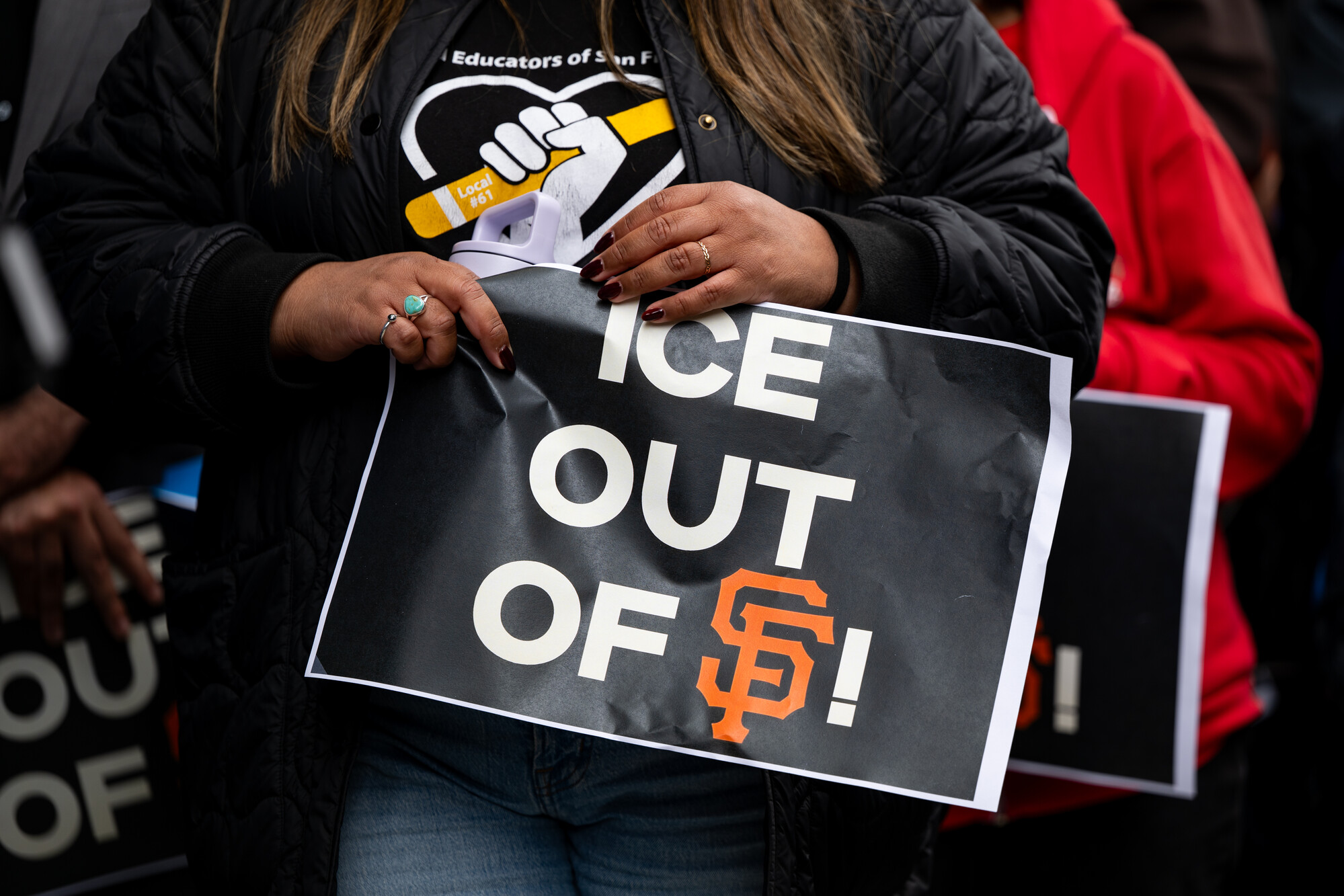 Demonstrators rally outside the California State Building in San Francisco on June 9, 2025. (Beth LaBerge/KQED)
She said in 2018, after California barred participation in a federal program known by its code section, 287(g), that delegates police and sheriff’s deputies to take on some duties of ICE agents, immigration arrests dropped by nearly 25%.
“By contrast, when a state like Texas or Florida allows 287(g), that increases ICE arrests overall,” Chan said. “If local law enforcement is engaged in immigration enforcement, that’s going to drive up ICE arrests. Any contact with police can turn into an immigration enforcement action.”
The Deportation Data Project obtained the government data from ICE under a Freedom of Information Act lawsuit. The new numbers run from October 2022 through Aug. 6 of this year.
In a statement in response to questions from KQED, a U.S. Department of Homeland Security spokesperson who declined to be identified said the information released by the Deportation Data Project “relies on information releases that have not been reviewed, audited or given context,” and alleged that the organization had “cherry-picked” the data “to peddle a false narrative.”
But as enforcement increases, those arrested are less likely to be dangerous criminals and more apt to be people who lack a secure immigration status, Ruiz Soto said.
“We know that when there have been more arrests, the share of people who have no criminal conviction or charge aside from being in the country without status has continued to increase,” he said. “Most people who are being arrested are not the worst of the worst.”
California Newsroom data reporter Emily Zentner contributed to this report. The California Newsroom is a collaboration between NPR stations and nonprofit newsrooms throughout the state.