
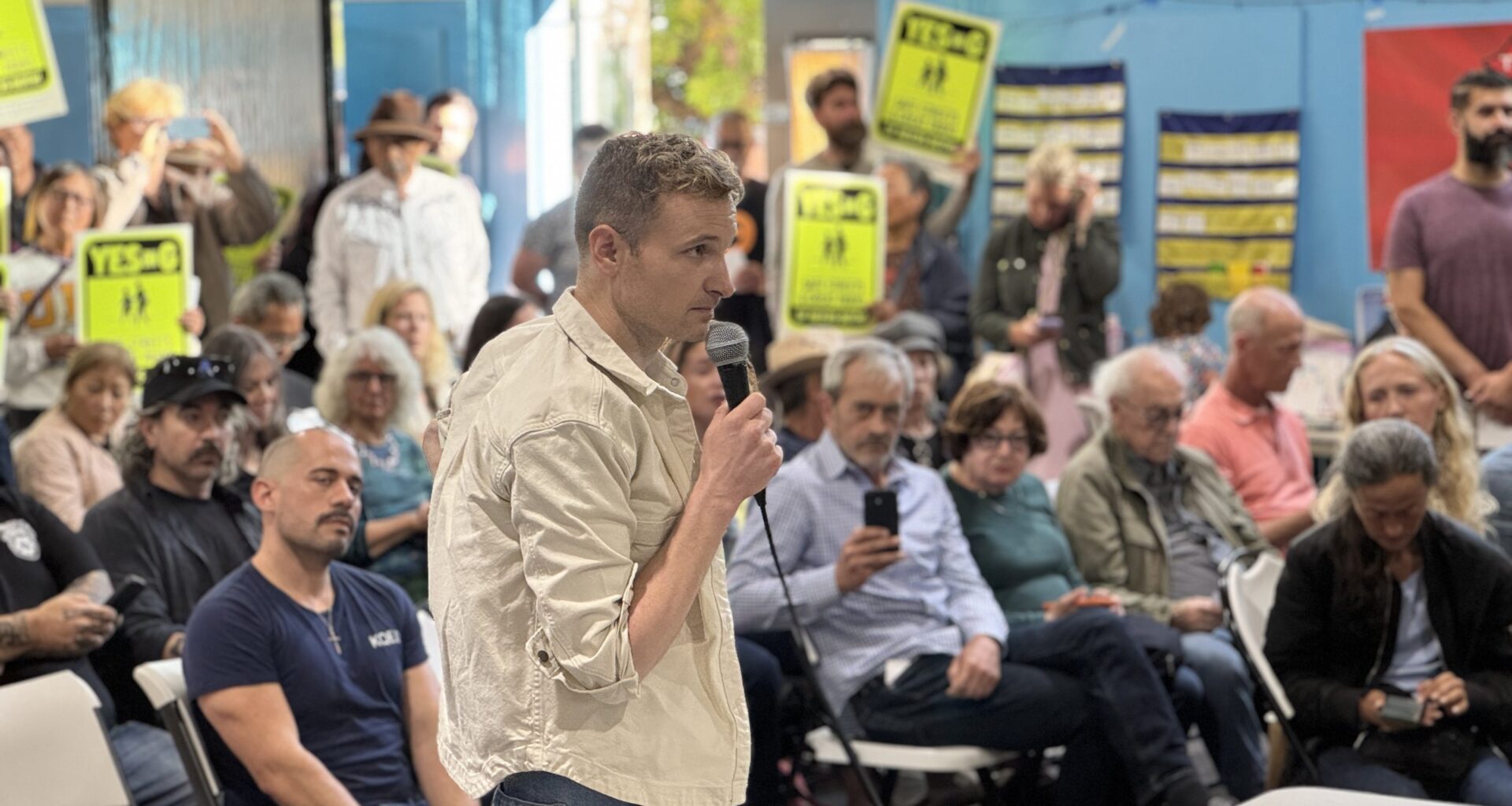
Brad Chapin alleges that aspirational District 8 supervisor Manny Yekutiel sexually assaulted him six years ago. Yekutiel denies this. Mission Local did not publish articles about Chapin’s claim against Yekutiel, which would be our procedure with most any single-sourced claim against any candidate.
But when Chapin on Wednesday stood before the members of San Francisco’s Democratic Party during an endorsement meeting and described the process it used to “investigate” his allegation as a sham, that was a far less controversial claim. This process was a sham.
We’ve spoken to half a dozen members of the local Democratic Party, across the spectrum of local political ideology, and that’s how they feel, too.
San Francisco’s Democratic Party in 2024 created its own “Code of Conduct and Policies for Sexual Assault and Harassment” in the wake of disturbing allegations being leveled at local Democratic politicos — most notably Mission District leader Jon Jacobo, who is presently being prosecuted on rape charges.
Members of the local Democratic Party risked repetitive stress injuries over the level of back-patting they self-applied over creating that code of conduct: The party’s website lists more than a dozen articles documenting its professed campaign to take on alleged political malefactors.
A 2024 letter from party chair Nancy Tung unmistakably refers to Jacobo and former Latinx Democratic Club president Kevin Ortiz as the impetus for this action. The Code of Conduct was expediently spun up and enacted, to great fanfare. At last, we were led to believe, the scourge of alleged predators and harassers lurking within San Francisco political circles would be addressed.
Not since the America’s Cup have San Francisco officials so overpromised and underdelivered.
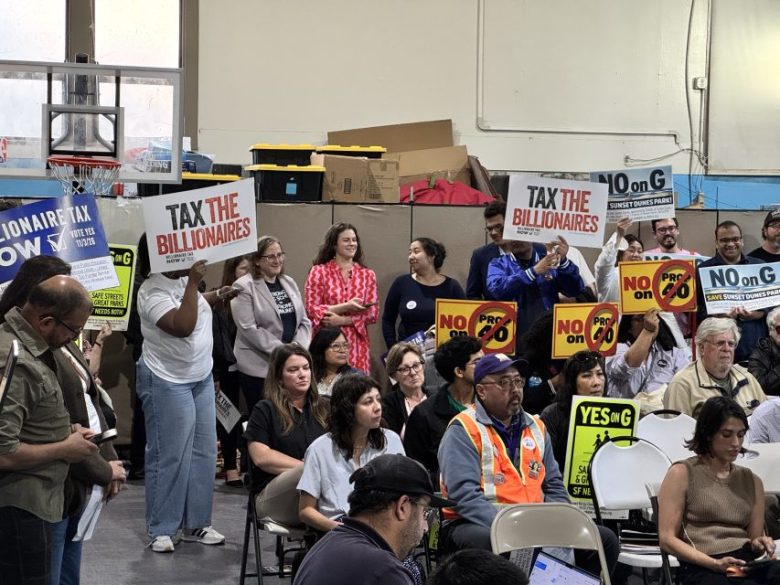 San Francisco residents gathered on Aug. 26 at the Asian Pacific American Community Center in Bayshore to deliver public comment on issues like the District 8 endorsement, Prop. G and Prop. 40, as the San Francisco Democratic Party voted on its endorsements. Photo by Junyao Yang.
The Democratic Party’s much-vaunted code of conduct, it turns out, is narrowly applicable. Not only did it not cover whatever did or didn’t happen between Chapin and Yekutiel, it wouldn’t even have applied to Jacobo — who, again, has been charged with rape by the district attorney and is being criminally prosecuted.
“If Jon was seeking an endorsement and I went to the Democratic Party and reported what happened to me, they would say that was also outside their jurisdiction,” said Sasha Perigo, one of Jacobo’s accusers.
Ortiz, meanwhile, was never prosecuted nor were any of the accusations of alleged unwanted behavior officially substantiated. Regardless, these, too, would not have come under the aegis of the Democratic Party’s new dictum.
That’s because the local Democratic Party Code of Conduct governing inappropriate sexual conduct only covers what happens at official party or chartered Democratic club meetings or connected official events. Blessedly, most meetings do not feature this manner of behavior. Most official events don’t either, though this would seem to cover someone misbehaving at, say, a club holiday gathering or a symposium.
The Code of Conduct is certainly not applicable to Chapin’s allegation that he was assaulted in someone’s private home, years before Yekutiel was an office-seeker. The much-ballyhooed policy does not cover people working in City Hall, on campaigns, at nonprofits or pretty much anywhere that isn’t under the umbrella of the local Democratic Party and its chartered clubs.
And, as Perigo notes, that’s not how sexual assault and harassment typically work. Even if people meet at official clubs or events, the Democratic Party’s reach does not extend to time they spend in bars, in taxis, in homes — or anywhere that isn’t somehow tied to an official meeting or event.
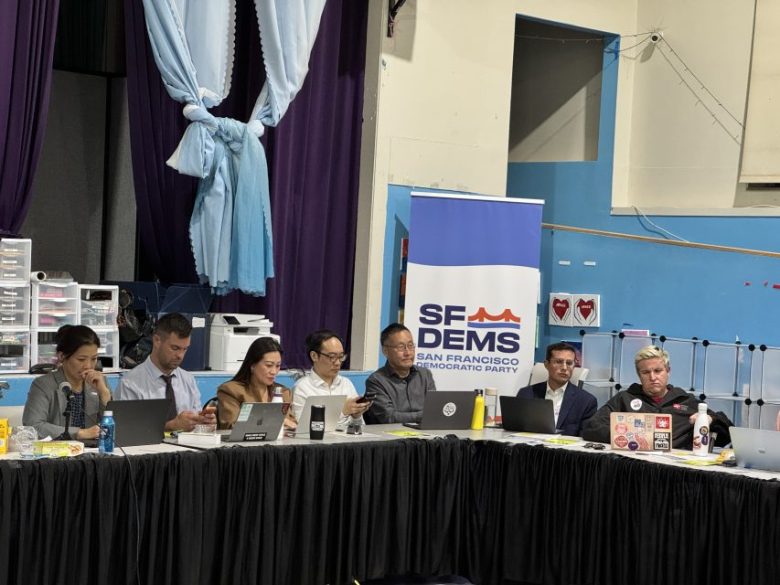 Members of the San Francisco Democratic Party on Aug. 26 endorsed Manny Yekutiel in the District 8 supervisor’s race. Photo by Junyao Yang
So we’ve established that if you disobey Roberts Rules of Order and sexually assault someone in plain view of multiple witnesses at a Democratic Club meeting or official event — the Code of Conduct has you dead to rights. Do not pass Go, do not collect $200.
In less straightforward cases, it’s of little use. So, that’s a problem. But there were also problems in not just the conception and formulation of the Code of Conduct, but how its application unfolded.
To wit, when Chapin first registered a complaint with the Democratic Party in early 2026, nothing happened. For months.
At this point, we need to briefly outline how this works, or is at least supposed to work. The investigatory process for charges of sexual misconduct has, by intention, been separated from the actual Democratic Party, and is carried out by volunteers. The Democratic Party seems to feel that, given the chance, its members couldn’t help but interfere with such a sensitive matter — so it must, by design, sequester the people responsible for overseeing sexual assault complaints.
That may be true. But it also leads to opacity. Even members of the Democratic Party’s own Committee on Sexual Assault and Harassment say they do not know who actually carried out the investigation of Chapin’s accusations. In the event of trouble — like not contacting a complainant for months — there’s no way to demand accountability. And we’ve got trouble.
Here’s how things ought to go, according to the Code of Conduct.
A complaint to the Democratic Party is first fielded by a volunteer/pro bono ombudsperson. This individual determines if the complaint falls under the (very narrow) scope of the Code of Conduct. If so, an investigation is launched. And, finally, the investigator’s report is submitted to the volunteer/pro bono judicial committee, which creates a three-member adjudication panel.
We know the chair of the judicial committee is a woman named Gina M. Roccanova, because she signed her name to the one-page summation disseminated to Democratic Party members on Aug. 26, only hours before the District 8 endorsement vote. But nobody seems to know who the ombudsperson was — again, not even members of the Democratic Party’s own Committee on Sexual Assault and Harassment. And when they asked, we hear they were told it was not their business to know.
Our messages to party chair Nancy Tung and executive director Bobak Esfandari asking that question were not returned.
Here’s why that matters: Remember, it’s the ombudsperson’s job to determine if a complaint falls within the purview of the Code of Conduct. Since Chapin’s complaint is so clearly outside the code’s narrow scope, this is a determination that should’ve been made quickly — within days, maybe hours. But that didn’t happen.
The Democratic Party made its supervisor endorsements in mid-July. But not in District 8, because of the outstanding complaint. Instead, in mid-July, Chapin was contacted for an interview about his allegations by an attorney with the firm Gibson Dunn. And Roccanova’s Aug. 26 letter mentions that “an Adjudication Panel convened on August 25, 2026 to review the investigator’s findings of fact and make a determination about whether a violation of the Code of Conduct occurred.”
We don’t know who the ombudsperson was and we certainly don’t know what the hell he or she was thinking initiating a five-week process to determine what should’ve been evident in moments — this complaint doesn’t fall under the Code of Conduct, because almost nothing does.
Instead, one day before the delayed endorsement vote, the panel reached that belated conclusion. Its terse writeup noted that, since the Code was not applicable, “the accusation cannot be substantiated.” But, also: “This is not a determination on the merits of whether a sexual assault occurred.”
This memo was neither damning nor exonerating. It was nothing: Voting members of the Democratic Party were, after all that time, given absolutely zero new or useful information.
It is mystifying why this delay was allowed to occur and just what the hell was being done over those many weeks. Members of a parliamentary body, on the day of a vote, were handed a half-page letter announcing that an investigation determined only that there needn’t be an investigation — and they then buttressed that vote based upon the outcome of “the investigation.”
This is something you’d expect to see in “Death of Stalin,” not a Viz Valley community center.
Chapin, on Wednesday, was dumbfounded. “I went to your attorneys,” he told the party. “I asked him explicitly if this was a waste of my time because none of this happened at a Democratic Party event. And you knew that.”

The Democratic Party ultimately endorsed Manny Yekutiel. And that is its prerogative.
It would have been fanciful to posit that any investigation by the Democratic Party would’ve truly gotten to the bottom of a six-year-old accusation with no independent witnesses that the police could not crack using a wire. Was the Democratic Party going to fire up the Mystery Machine and hunt for clues? Everyone should’ve been clear-headed about that.
But the process the party undertook was indefensible — and not just useless but worse than useless. Whether or not you believe the claims of Brad Chapin, he was, clearly, in public agony during the course of Wednesday’s meeting. The Democratic Party sent a clear message to him and to anyone who’d think to come forward with a complaint. And it is emphatically not the message it triumphally proclaimed just two years ago.
“It is reckless to design a system so poorly, because the evidence will be used to invalidate survivors,” says Perigo. “I think the Democratic Party should’ve been honest about its capacity to fact-find in a situation in which, very likely, there were no facts to be found. Especially after police had already investigated.”
“At best, it was a waste of the survivor’s time,” she continued. “And, at worst, it does more damage than doing nothing at all.”