
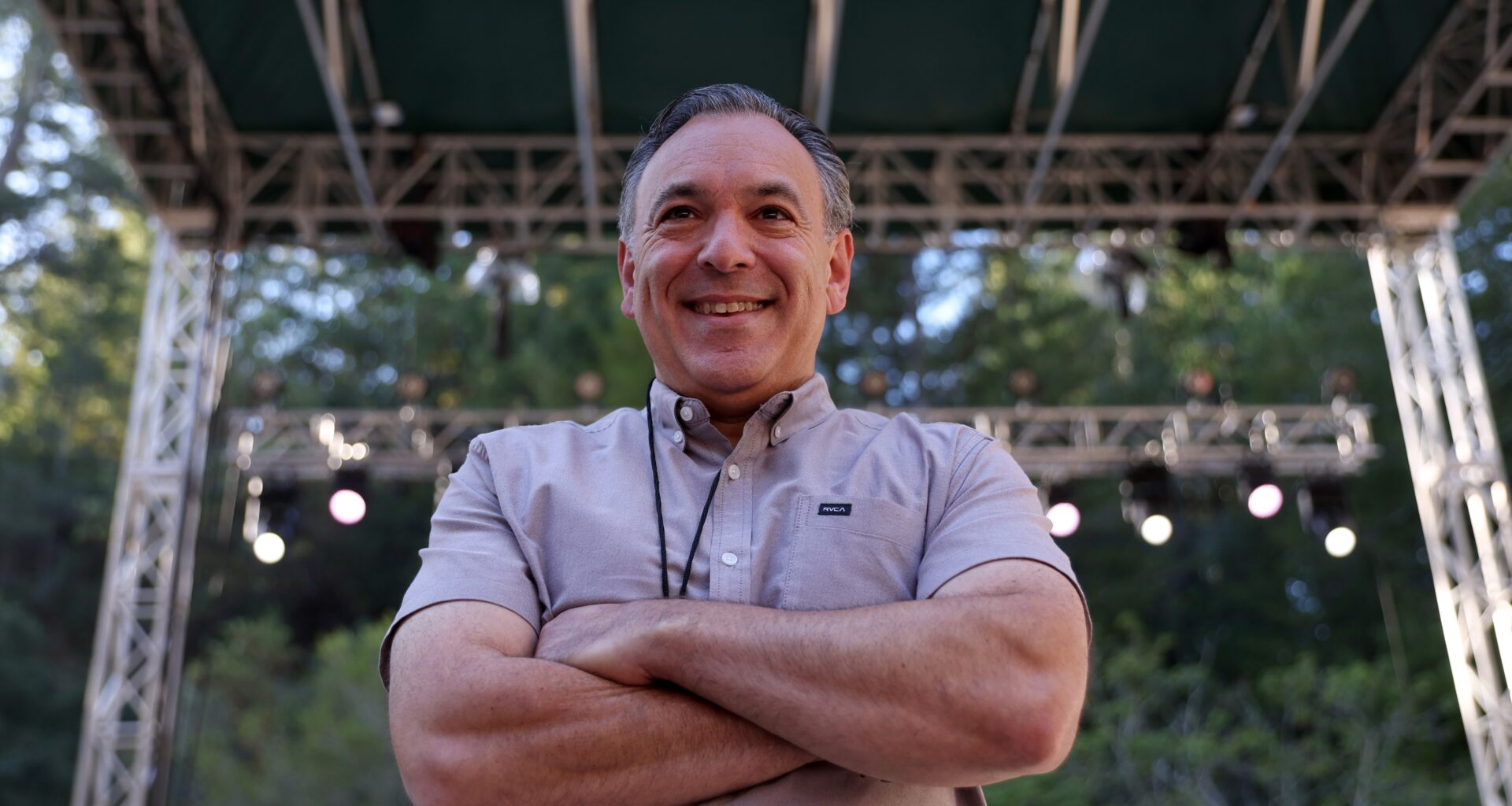
It was the summer of 1985 and David Lefkowitz, then a student at Duke University had come to the Bay Area for an internship in a lab at UCSF.
His senior year would start in the fall, but – as a pre-med student – he knew he had many more years of schooling to go. His goal was to follow in the footsteps of his Nobel Prize-winning father – Dr. Robert Lefkowitz – and get his MD.
But Lefkowitz – already a major music-head — would use that summer to get immersed in the Bay Area concert scene. One particular Saturday, he had to make a choice that would help define the career he’d eventually pursue.
“I was taking the Stanley Kaplan preparation class every Saturday morning to prepare for the MCAT exam,” Lefkowitz remembers. “I knew that Santana was playing for free in Golden Gate Park, but I would miss it if I stayed in class to take the sample test.
“So, I got up in the middle of the class and got on the Muni and went to see the show.”
He’s never really looked back. Lefkowitz has spent much of his life working in the music business. He’s managed bands (including Primus, Galactic and Melvins), as well as worked for Live Nation and Goldenvoice/AEG.
These days, Lefkowitz is the senior VP of talent for the Blue Note Entertainment Group. Blue Note has continued to grow in the greater Bay Area. Now, he books shows at Siesta Valley Bowl in Orinda, the Quarry Amphitheater and Catalyst in Santa Cruz and the Blue Note Summer Sessions at the Meritage Resort and Spa in Napa, as well as other venues.
I recently had the chance to get to know Lefkowitz a bit better, learning more about his background and what’s going on with the venues that he books.
Q: What were some of your truly formative musical moments as a kid? Did you have certain artists that really captured your imagination?
A: For some reason at age 11, I started to realize the vast wonder of The Beatles. And for my 12th birthday, my Russian grandfather gave me almost the entire Beatles catalog on vinyl. It wasn’t long before I was playing guitar, and ultimately digesting everything that is now called classic rock.
Q: You initially tried to follow in your father’s footsteps – a doctor who won a Nobel Prize in chemistry. That must have been a bit intimidating.
A: It was. But as the oldest of five kids, there was a sense that I should do the right thing. And since I was pretty good at school through high school, it just seemed like an admirable pursuit. But I wasn’t passionate about it.
But when I came back from San Francisco to finish my senior year, he had recently written an essay on success in some major magazine. That gave me the best piece of advice of my life — in order to be successful professionally, I would need to figure out what I was most passionate about in life and figure out a way to make a career out of it. Well, I knew what that was, but the fact that it was going to be OK with him to do that made all the difference.
Q: And that, of course, was the music business. But how does the son of a Nobel Prize winner at Duke end up working with bands in San Francisco?
A: As luck would have it, a family friend knew a veteran manager/producer named David Rubinson. I was given the opportunity for what would now be called an internship, to move to San Francisco after college graduation and work in his office.
Q: That sounds like a great opportunity for you.
A: It was an invaluable opportunity to see artist management at the highest level that it could be done from San Francisco. When I was in the office, he managed jazz sax legend Wayne Shorter and Narada Michael Walden as a songwriter/producer, who actually won the Grammy for producer of the year during the time I was in the office for his work with Whitney Houston and Aretha Franklin.
Q: How did the gig of managing Primus come about?
A: I knew that I wanted to be an artist manager, and during the time I worked in David’s office, I met (Primus vocalist-bassist) Les Claypool, who had done a little roadie-ing for the world beat bands. He was ready for a manager. I was able to start working with him when we were both around 23 years old. That partnership lasted for 20 years, more than half my career at this point.
Q: Primus then scored a record deal with Interscope. I’m guessing that led to some really exciting years, as you helped shepherd Les Claypool and Primus in becoming one of the top alt-rock acts of the era.
A: With financial support from Interscope, the band was able to spend two years on the road, mostly opening for bigger and bigger headliners, which included a co-headline tour with Fishbone, then a small arena tour supporting the Anthrax/Public Enemy tour, then opening for their heroes Rush.
We figured that would be it, and the band was getting ready to record their next album when Jimmy Iovine got them the opportunity to be the middle act on the U2 tour in stadiums. They were selling 1,000-2,000 records a week, so when the second record came out on Interscope, “Pork Soda,” it sold enough in the first week to debut in the top 10 albums.
Ultimately, the band sold over 5 million albums and played on major festival tours, like Lollapalooza, HORDE, Ozzfest and others.
Q: And you stayed with Claypool even after Primus went on hiatus, which led to some pretty cool projects.
A: He wanted to pursue a new solo band project. I encouraged him to get into the jam band scene. Being one of the greatest bass players, it was easy for him to extend the songs and play more covers. We restarted our label to self-release his solo albums. He ended up doing multiple band projects, including the all-star band Oysterhead with Trey Anastasio from Phish and Stewart Copeland from the Police.
Q: You’d later transition from band management to working in the concert promoter biz with Goldenvoice/AEG. How satisfying was it to help that organization establish a sizeable presence in the Bay Area?
A: It was incredibly satisfying. Especially since I was hired for the job with virtually no experience as a promoter. I had a pretty broad understanding of different kinds of music and the industry. As part of a big company like that, there were enough resources and information to figure out everything happening in live music.
Q: You then jumped ship and moved to Philadelphia to work with the biggest concert promoter in the world – Live Nation.
A: Live Nation was similar in some ways. The Philadelphia market I was in was completely dominated by our office with countless venues, festivals, and almost all of the arena and stadium traffic. It was like working for the mayor’s office and having the keys to the city. But as far as support from the company on a national level, it was really quite the opposite from what I’d experienced at AEG.
Q: Tell us about your current Blue Note gig, which has brought you back out to the Bay Area.
A: Coming out of the pandemic in late 2021, while I still dreamed of moving back to the Bay Area, I wanted to work for a more supportive and music-oriented company. Luckily, I’d gotten to know Steven Bensusan, who’s my boss and a co-owner of the company with his brother Tsion. He was staffing up in the New York City office. I took a VP position that included contributing to booking at Sony Hall, our other venue in NYC besides the Blue Note, as well as booking shows in Napa for an outdoor concert series.
I immediately shook things up there, which has ultimately led to our now fourth year at the Meritage Resort in Napa.
After commuting from Philly to New York twice a week for three years, Steve let me move the job back here, which has allowed me to pursue new venue partnerships and booking deals in the Bay Area.
Q: Let’s talk about some of the venues, starting with The Quarry. It’s a relatively new spot for major concerts.
A: The Quarry is a really unique concert-going experience. It’s set in the middle of a redwood grove, right on UC Santa Cruz. It’s 2,600 capacity, so it’s more intimate than places like the Greek or the Frost. Audiences are very responsive there. The artists really appreciate that.
Q: You’re also now booking the Siesta Valley Bowl – which most East Bay folks still know as the old Cal Shakes home, Bruns Amphitheater.
A: On relatively short notice, I was able to book 25 shows so far for the first season, which will end on Nov. 1.
Next year, we will probably double the number of shows, and as varied as it’s been so far, it will only get even more so next year. At less than 1,000 capacity outdoors, there’s nothing like it in the Bay Area.
Q: What are some challenges that you face in your job that concert-goers might not realize?
A: Well, certainly not every show is going to sell a lot of tickets. There can be hard moments when you have to figure out whether to cancel a show, lower the ticket prices or renegotiate the deal with the artist, all of which can be painstaking and difficult to get through.
Q: What are some of the new things you are working on?
A: One of the biggest things right now is that I’m promoting one-third of a particular artist’s entire national tour this fall. The band is called BEAT — sort of a spinoff of one of my favorite bands, King Crimson — specifically paying tribute to their 1980s period. The band includes original members Adrian Belew and Tony Levin.
The other band members are guitar legend Steve Vai and one of the greatest drummers of all time — Terry Bozzio. It’s actually more alumni of Frank Zappa’s band than King Crimson at this point. (BEAT has two local dates – Oct. 9 at the Quarry in Santa Cruz and Oct. 10 at Meritage in Napa.)
Q: OK, desert island disc time: Give me 5 records that you treasure pretty much above all others.
A: I have to put King Crimson “Discipline” (1981) in there. For The Beatles, I’ll go with the “White Album” (aka, “The Beatles,” 1968) since it’s double the length of any other one.
To cover the George Clinton/Parliament Funkadelic catalog, I’ll go with “Live at the Beverly Theater” by George Clinton and the P-Funk All-Stars recorded in 1983.
I’m going to cheat and include two compilations — Stevie Wonder’s “At the Close of a Century” (1999) and “Funkify Your Life: The Meters Anthology” (1995).
David Lefkowitz
Hometown: Durham, NC
Job Title: Senior VP, Talent
Company: Blue Note Entertainment Group
Education: BS Psychology, Duke University
Previous Job: VP, AEG Live
David Lefkowitz 5 Things:
1. His father won the Nobel Prize in Chemistry in 2012 for his groundbreaking work on receptors, the way drugs and hormones interact with the body on a molecular level: “Over 40 percent of all prescription medications operate through these structures on the surface of every cell,” Lefkowitz explains.
2. “My favorite subgenre of music is funk, with R&B, prog rock, jazz and jazz fusion close behind.”
3. Hoop it up: “My main sports obsession is college basketball, specifically the Duke Blue Devils.”
4. “I’m a news junkie, even these days.”
5. On the move: “I lived in New York (the Bronx, Cooperstown, and Yonkers), Washington, DC, and Boston all before moving to North Carolina at age nine.”