
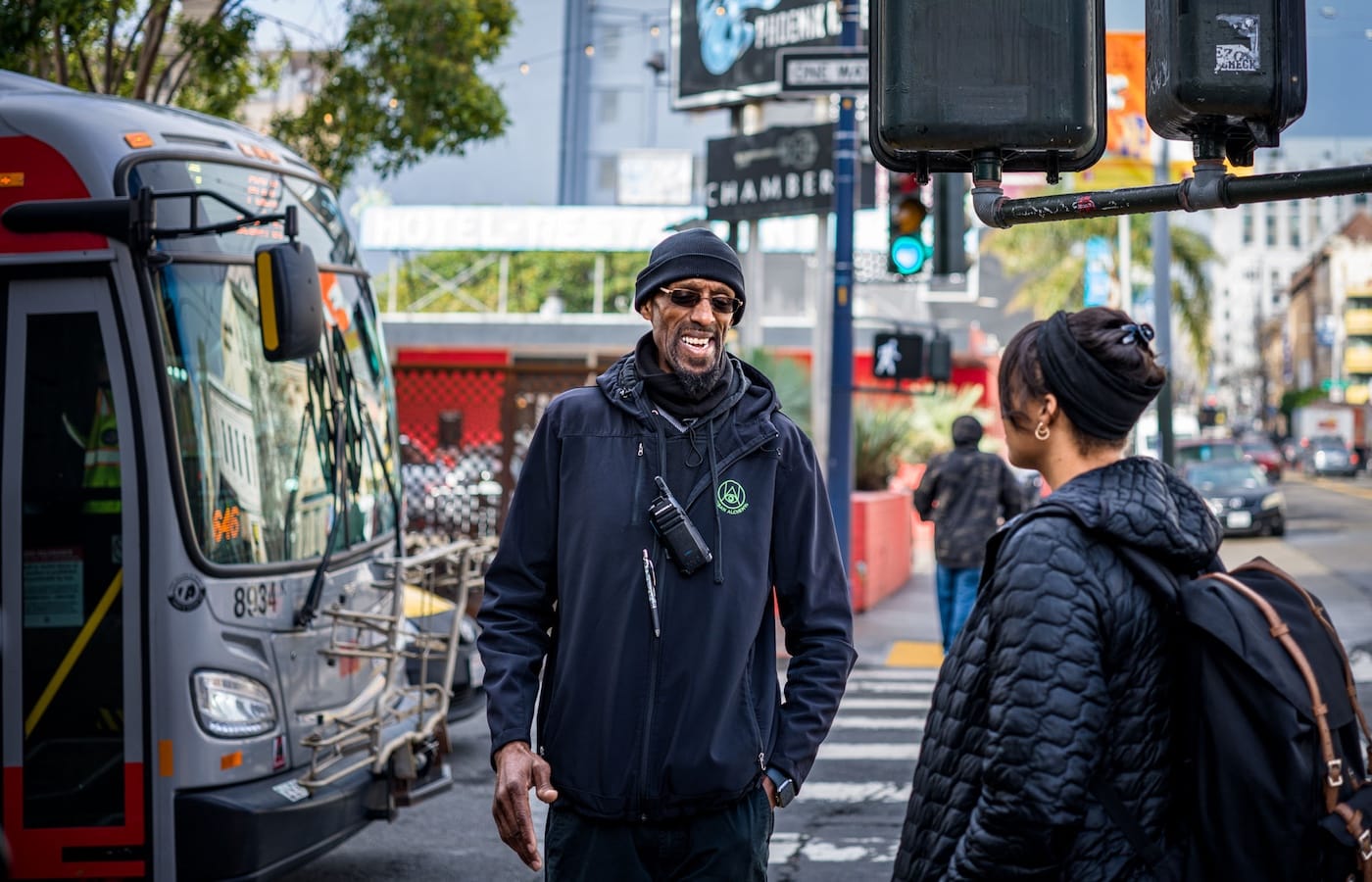
After analyzing SF crime data from 2018 to 2023, researchers at Stanford and two other universities found that crime was 20% lower at intersections where Urban Alchemy street ambassadors were present.
Researchers from Stanford University, Pennsylvania State University, and Northwestern University found significant reductions in overall crime at 41 San Francisco intersections where Urban Alchemy practitioners were deployed compared to nearly 600 other intersections that did not have the program. As the Chronicle reports, the study is being hailed by Urban Alchemy as long-sought evidence that its unarmed street ambassadors can reduce crime and provide an alternative to traditional policing, particularly in addressing drug- and behavioral health-related crime.
Urban Alchemy launched in San Francisco in 2018 as a project of Hunters Point Family, eventually becoming an independent nonprofit whose practitioners work on some of the city’s most troubled blocks. The program has expanded to several cities and received tens of millions of dollars via City of San Francisco contracts.
In 2023, Urban Alchemy reported 34 overdoses reversed, 41,575 trash bags filled, 78,494 needles safely cleaned up, 2,010 responses to 311 calls, 45,000 “de-escalation interventions,” and more than 300,000 “inviting space interventions” in a 12-month period.
But the nonprofit has faced controversies involving its workers, shelter operations, shootings, and finances.
Last year, San Francisco Controller Greg Wagner placed Urban Alchemy on a watch list and moved it to “tier 2” contract status over employee-hour tracking and other fiscal concerns. The nonprofit was accused of $800,000 in unauthorized pay-related overspending, though it disputed the figure, saying the actual amount was $336,000.
Crews typically work from 7 a.m. to 7 p.m., greeting people, cleaning streets, responding to conflicts, asking people involved in drug use or disruptive behavior to move, and carrying naloxone. Many practitioners have been incarcerated themselves.
According to the Chronicle, critics have accused Urban Alchemy of shuffling drug users and the homeless “from block to block” with effecting real change, while others have characterized its ambassadors as an intimidating, unarmed police force.
Those questions reportedly helped prompt Stanford sociology professor Forrest Stuart’s study, which followed the program for two years and compared 41 treatment intersections with similar locations without practitioner coverage. Researchers found reductions in total and behavioral health-related crime, along with significant declines in drug and violent crime. Property crime was reportedly unchanged.
The researchers said the effects appeared to build over time rather than immediately after practitioners arrived, per the Chronicle. Stuart said this was consistent with Urban Alchemy’s relationship-based approach, since practitioners first have to learn the people, businesses, service providers, and recurring conflicts on a particular block before they can effectively intervene.
However, at least one outside expert reportedly questioned whether the study could establish that Urban Alchemy itself caused the reductions. Crime economics researcher Jennifer Doleac of Arnold Ventures noted that the study’s effects did not emerge until 20 to 24 months after deployment, which means other changes could have potentially contributed to the decline.
Urban Alchemy co-founder and CEO Lena Miller sees the study as long-sought independent evidence for a model it has argued can improve public safety without relying primarily on police.
“There is no scam,” argues Miller, speaking to the Chronicle. “This is legit transformation.”
The study’s authors also said the findings provide evidence that visible, noncoercive practitioners can reduce crime in high-need public spaces, while emphasizing that the model is intended as a complement to policing rather than a replacement for it.