
In the early 1900s when legendary Oakland-bred author Jack London was sailing out to the Oakland Estuary and off the shores of Bay Farm Island to rob oysters from their beds he was, of course, breaking the law. However, he was also taking something that could actually be grown in the then-still-unpolluted San Francisco Bay waters: edible oysters.
Today, London and his motley crew would have to travel to Marin County’s Tomales Bay to steal any oysters that could be served in a restaurant. Simply put, today’s bay waters are too polluted to produce oysters that are safe to eat. Other factors in the decline of bay oysters include over-harvesting, lower salt water levels and runoff from high-pressure water cannon, Gold Rush-era mining operations that brought a buildup of sediment.
To address this decline, the San Francisco-based Wild Oyster Project since 2016 has created environments for oysters to grow in bay waters — but not for human consumption. Instead, working with Alameda’s REAP Climate Center, the organization’s goal for the habitats they create for the native Olympia oyster is for it to help clean the water — oysters can filter up to 50 gallons of water daily, create habitat for local fish and crabs and help restore marshes.
“In order to restore this natural pollution sink of the bay, we’re needing to restore the wild oyster population of, in particular native oysters,” says Giulio Salerno, the Wild Oyster Project’s executive director.
Those native oysters are the Olympia. Due to strict regulations specific to the Bay Area, Salerno says the Olympia is the only species “you can even think about restoring in the bay. All the other ones would be considered invasive.”
While these restrictions apply to non-native oyster species in the bay, they don’t apply to the method being used help cultivate the Olympia — the introduction of oyster shells that baby Olympia oysters cling to. Those can be from Miyagi, Kumamotos, Bluepoints or any other kind of oyster.
That’s because “the shells are all the same in terms of what they’re made of, which is calcium carbonate,” says Salerno. “That’s why we’re able to recycle the shells of all the oysters as sort of a seed for a reef for any oyster because it’s more about the chemistry of it.”
Research has found that baby oysters prefer growing on the calcium carbonate of other oyster shells, he says. The Wild Oyster Project gets its oyster shells from where just about everyone else does — Bay Area restaurants that serve oysters.
Through their “Save Your Shucks” program, the Wild Oyster Project sends out volunteer “shell runners” who gather about two 20-pound buckets full of oyster shells from five restaurants in San Francisco and five in the East Bay once a week. Each bucket holds about 700 shells.
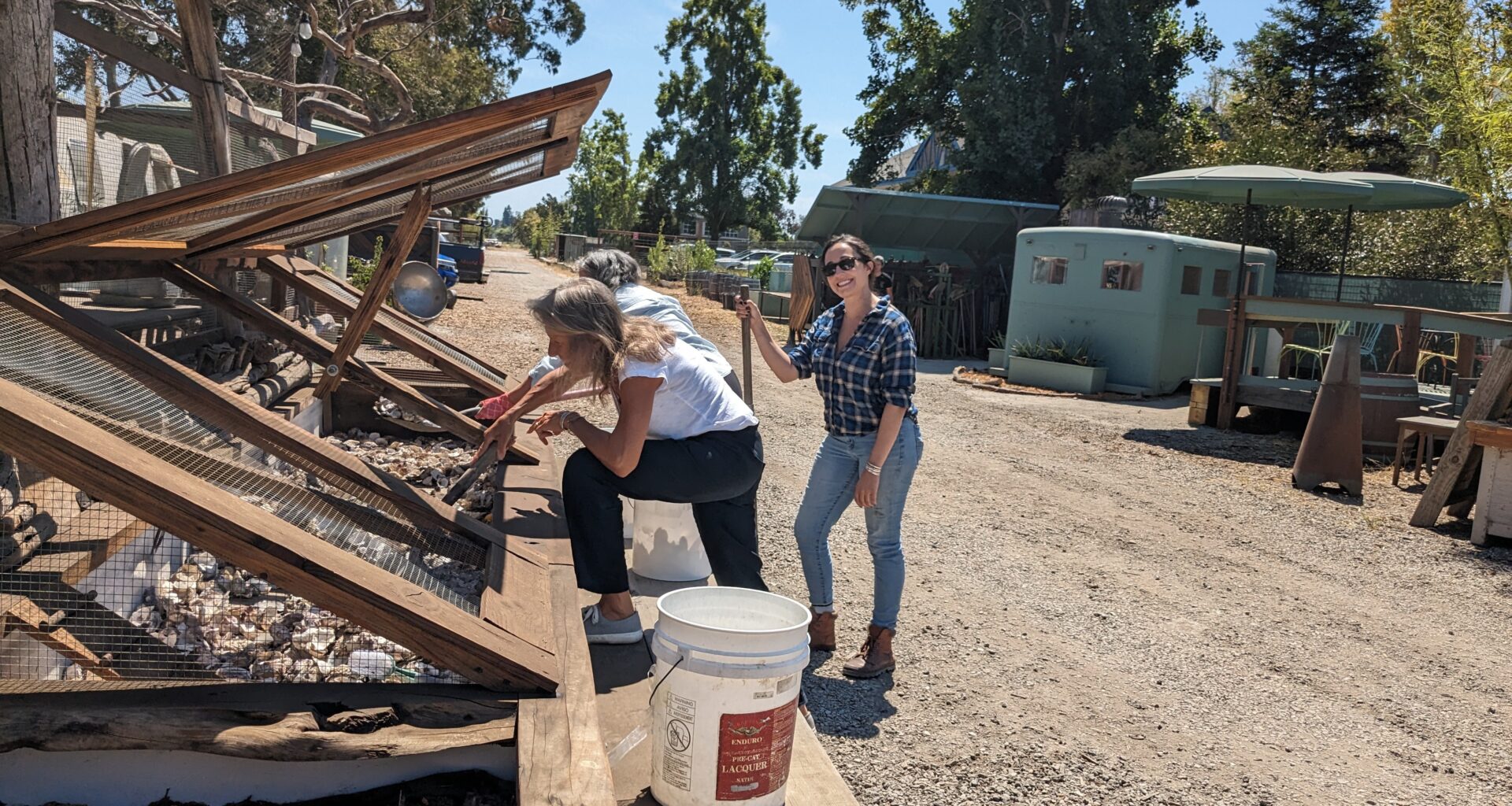
The collection of the shells is just the beginning of the process. After being unloaded at Alameda’s REAP Climate Center (reapcenter.org), an organization billed as devoted to increasing “access to climate change mitigation by providing ecological experiences and climate job pathways,” the shells still have oyster residue on them.
This is where the “chicken lounge” part of the process comes in. At the lounge, located on the REAP (Regeneration, Education, Aquaculture and Permaculture) campus, chickens peck away at what were once perhaps Oysters Rockefeller, cleaning them to the bone. Individuals can also donate their shells as long as they’re frozen.
After being pecked at, the shells are taken to sites — usually on top of shipping containers like one at Alameda’s Historical Radio Society site — where they “solar-cure” in the sun for two years to remove any harmful bacteria or pathogens. The organization’s other collection and cleaning station is near Heron’s Head park in San Francisco’s Bayview district.
Afterward, some of the shells end up in the bay covering large “waffle balls” that attract baby oysters. Another way oyster shells are being used to attract baby oysters is being done at San Francisco’s Embarcadero waterfront, where they’re placed on textured tiles armoring the sea wall. The cured shells from the REAP Climate Center are used to help shore up reefs throughout the bay.
Alex Maciel, the Wild Oyster Project’s shell recycling program manager, says the organization is always looking for volunteers but that everyone can help the ecology of the bay by doing one simple thing: eating locally grown oysters.
“It’s really important to eat local oysters, especially from Tomales Bay, because oyster farms are the most sustainable fishery. They actually give back to the surrounding water they’re in,” says Maciel.
For more information on the restaurants that participate in “Save Your Shucks” or volunteering for the Wild Oyster Project at Alameda’s REAP Climate Center, visit wildoysters.org.
Paul Kilduff is a San Francisco-based writer who also draws cartoons. He can be reached at pkilduff350@gmail.com.