
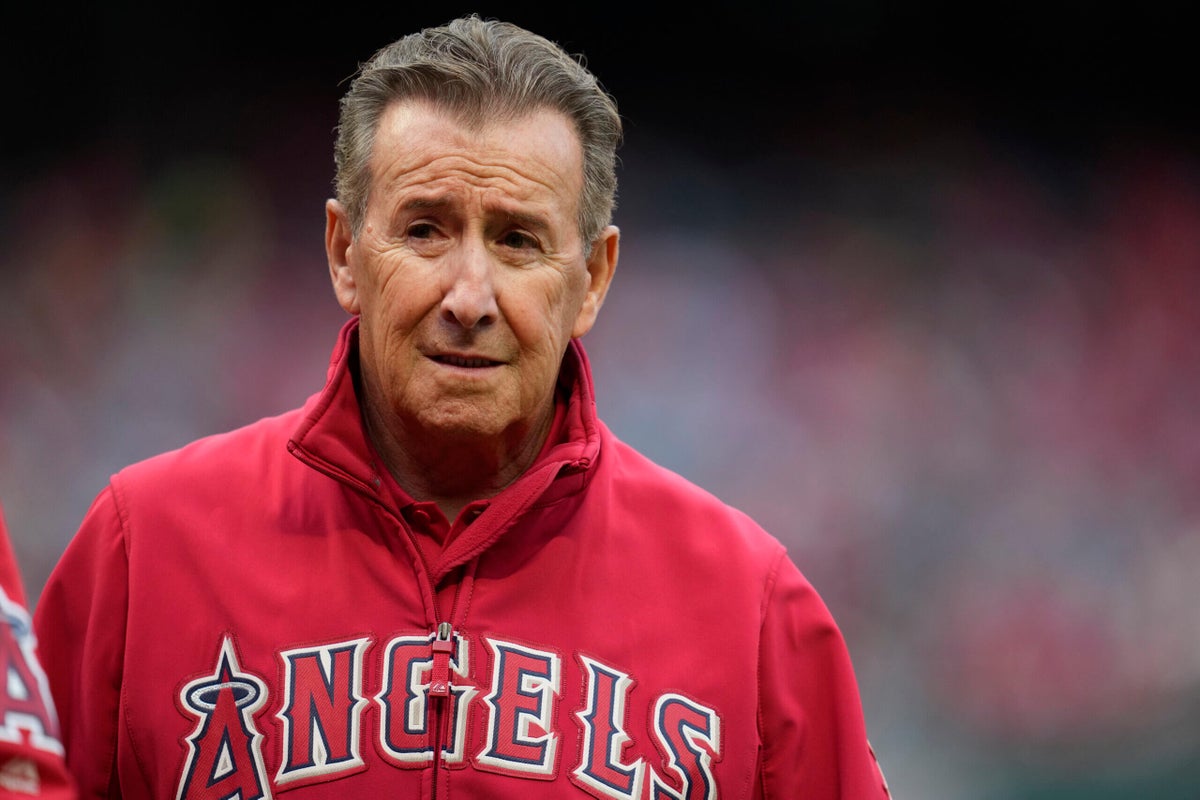
After 23 years of largely unfulfilling ownership, Arte Moreno agreed to sell his Los Angeles Angels to Stan Kroenke. A billionaire real estate magnate who owns teams in nearly every major sports league, Kroenke is now the game’s richest owner, and his announced purchase sent joyous shockwaves through a beaten-down fanbase, even as the team is poised to finish off the worst season in its 65-year history.
Much about what this $4 billion sale means for the Angels remains to be seen. But as the transition to new ownership begins, here are 10 pressing questions, and what to consider in answering them.
Will the Angels spend?
You don’t pay a record price for a baseball franchise to pinch pennies. Under Moreno, in recent years the Angels have operated as a small-market club. Moreno signed Anthony Rendon to a seven-year, $245 million deal in late 2019, with disastrous results. Since then, the largest Angels contract has been $63 million over three years to Yusei Kikuchi. The Angels should be a destination team for free agents — look no further than the likes of Paul Skenes, Freddie Freeman and Gerrit Cole, all of whom grew up as Angels fans. Players of that caliber could and should be fair game under new ownership.
Ultimately, the next collective bargaining agreement will determine the state of play. But in lieu of those answers, it’s to be expected that the sport’s richest owner will spend. Spend on free agents. Spend on extending young players. Spend on infrastructure, development, facilities, the works. All are areas where the Angels have been woefully and noticeably deficient for many years.
Say what you want about Moreno. And boy, there is a lot to say. But at the very least, he seems to have left his team in good hands.
Why now?
This will be one of the most fascinating questions to be answered in the coming months, because the timing doesn’t make a ton of sense on its face. The Angels just elevated Molly Jolly to team president, and just appointed a new interim general manager in John Mozeliak. There was a foundation of change being laid, and it seemed there was optimism about a more viable path forward under the new internal leadership.
Moreover, a new CBA, and a salary cap, could have helped raise franchise values writ large. More predictability could translate to higher values. So selling before that was litigated is surprising. But $4 billion is $4 billion. And at age 80, with his children uninterested in operating the team, Moreno’s sale was only a matter of time.
This sale also came just nine months after the Angels settled a landmark wrongful death civil lawsuit. They paid out an undisclosed amount to the family of Tyler Skaggs, a pitcher who died of a fentanyl overdose in 2019 while with the team in Texas. MLB commissioner Rob Manfred said his staff would review testimony from the three-month trial, but hasn’t commented on the matter since.
What does this mean for the stadium?
Potentially quite a bit. The current iteration of Angel Stadium is in need of significant upgrades, and Kroenke has a proven track record in this area. Look no further than SoFi Stadium in Los Angeles, a beautiful facility that’s home to his Los Angeles Rams and a top venue for major LA-based events. He developed and owns the venue.
The big question here is what form that takes. Might he look to upgrade the stadium, built in 1966? With the lease set to expire in 2032, could he purchase the venue, surrounding land, and build an entirely new stadium?
It’s hard to imagine Kroenke purchasing the Angels without an eye toward acquiring the stadium and the area around it. Moreno’s hope of doing so fell through in 2022, and haven’t been revisited since.
What does this mean for team leadership?
Kroenke’s track record does not necessarily spell immediate sweeping changes. However, given the Angels’ long-running failures, it’s hard to say how this situation will be viewed. It’s also worth noting that manager Kurt Suzuki is on an expiring contract, and Mozeliak’s deal will run out in December.
The timing of the deal becoming official, expected in early 2027, makes this more interesting. Might the timeline increase the odds that Suzuki is brought back? Perhaps. Why would the Angels sign a new manager on a longer contract with the expectation of a new owner, who would want to implement his own vision? The lockout potentially delaying the 2027 season only complicates things further.
Mozeliak has stated his charge is to hire a new general manager. Is that now on hold? And what happens to Jolly, the new team president who has only started to enact her vision for the club?
The current iteration of Angels baseball has failed to deliver results. Changes will be made. And in the long term, they will likely be significant.
What does this mean for Mike Trout?
Probably not much. He made it pretty clear on Tuesday that he is happy with this change, and it doesn’t impact his desire to remain with the team.
It’s obvious that Moreno had no desire to trade his franchise centerpiece. It would have required paying down a large portion of his contract. And it’s borderline impossible to imagine Moreno effectively paying Trout to play elsewhere. A new owner does, at least, change that part of the calculation.
But with Trout owning a no-trade clause, he holds every card in the deck. If he wants to stay, he’s staying. And why would he want to go? After all these years of losing, there’s finally hope for him to reach the playoffs again while wearing an Angels uniform.
What does this mean for the alumni?
In 2022, ex-players had to pay their own way to attend the 2002 championship reunion. It wasn’t a good way to treat the only title-winning team in franchise history.
In recent years, the Angels have been better about welcoming back former players to spring training and instructional camps. But this has been a blind spot for Moreno throughout his entire ownership. He hasn’t retired the numbers of any former players, a mistake which led to two of the franchise’s all-time great players — Vladimir Guerrero Sr. and Trout — both wearing No. 27.
When Steve Cohen took over the Mets, he understood the quickest way to the fans’ hearts was through celebrating nostalgia. It will be interesting to see if Kroenke looks to retire the No. 15 of Tim Salmon and the No. 16 of the late Garret Anderson. They represent the two most significant omissions.
What happens to ABTV and AM830?
Both properties were reportedly included in the deal. The Angels recently launched Angels Baseball TV earlier this season, operating their own network after FanDuel Sports shut down amid financial problems with its parent company, Main Street Sports Group. The Angels have long owned their radio network.
That means production and on-air talent are under the Angels umbrella. After several years of mixing and matching, the team has found a cohesive and popular broadcasting group in Wayne Randazzo (fourth season), Erica Weston (fifth season) and Mark Gubicza (20th season).
The radio broadcasting tandem of Mark Langston (14th season) and Terry Smith (25th season) has been in place for a long time. The biggest question is travel. In order to cut costs, Angels radio broadcasters haven’t traveled since before the 2020 season, instead airing road games from Angel Stadium. That could change under new ownership.
Will they be called the Anaheim Angels again?
Moreno was obsessed with marketing. After all, his wealth was amassed in billboards. He liked the Los Angeles branding, even though his team, of course, did not play in Los Angeles.
Perhaps it was a mistake. Perhaps it was an Easter egg. But the Kroenke press release referred to the team as the Los Angeles Angels of Anaheim, a name the club held from 2005 to 2015 in order to comply with the terms of its stadium lease.
While it’s certainly possible that a new owner will drop the Los Angeles facade, it remains to be seen. The same is true for larger questions of branding, color scheme and logo; under Disney ownership, the Angels utilized periwinkle blue. Under Gene Autry’s ownership, they were called the California Angels.
A new owner could mean significant changes on this front.
Why did the Angels sell for a record price?
The first answer is that franchise values have generally increased over time. The Mets, for example, sold at about $2.4 billion and are likely worth way more today. The Padres’ $3.9 billion valuation in their sale is further evidence of those rising values.
The other element to consider is that the Angels, despite their woes, are a sleeping giant. They play in the nation’s second-largest media market, with a dense population center in a baseball-crazed region. Their TV deal is very valuable. There’s no reason the Angels shouldn’t be on par with the Dodgers, the Yankees or Cubs. This is a big market club that has yet to act like one.
That should change.
What is Arte Moreno’s legacy?
Disastrous. He ran the team into the ground, plain and simple. For the last four months, fans have been chanting from the upper deck for him to sell. Before the season, he suggested winning wasn’t a top priority for those fans.
He’s been an unaccountable force, feared by employees, and unpopular with fans to an extent that stood out even in a league full of less-than-beloved owners. He purchased the team for around $183 million and sold it for $4 billion, and he will reportedly remain as a minority owner. He will make out like the proverbial bandit, and that’s exactly how this fanbase will view him — someone who personally profited off their collective misery.
The only saving grace is that he sold to an owner able to operate in direct contrast to him. And if someday soon the Angels turn it around, at the very least, he will not have hurt the team’s future as much as he did its present.