
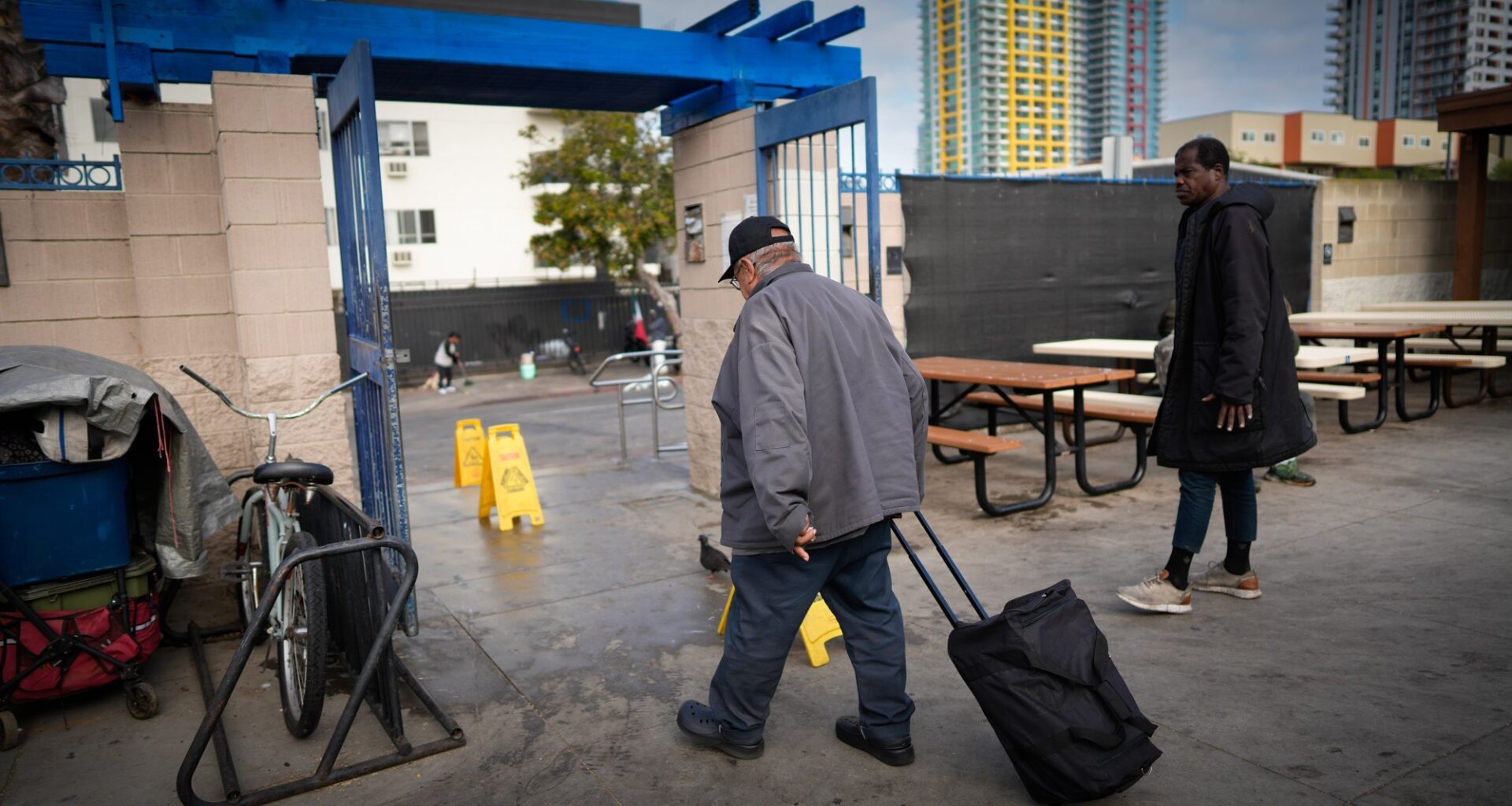
Amid dwindling federal support, uncertainty at the state level and a structural deficit locally, the city of San Diego was advised to rethink how it approaches funding its efforts to combat homelessness in a recent report from the Office of the Independent Budget Analyst.
Starting in Fiscal Year 2026, the city pivoted from expanding programs to maintaining what it already had. For years, San Diego relied on one-time grants, mainly from the state, to pay for it all, according to the report.
The report, published Aug. 13, stated that during the city’s budget discussions earlier this year, the council looked at available funding first and then decided what services to fund. But some state grants — a major source of funding — are received after the budget is finalized.
This way of approaching the issue meant that some decisions related to homelessness were “preempted by assumptions already embedded in the adopted budget,” the report read.
The report specifically used the state’s Homeless Housing, Assistance and Prevention (HHAP) program as an example HHAP accounts for 8.3% of San Diego’s $234.5 million effort to address homelessness this fiscal year.
Amy Li, a senior policy analyst for the IBA and co-author of its annual report, said the city should figure out what services, and at what levels, are needed first before making policy decisions based purely on guessing whether funds will come in or not.
“We’re trying to reiterate that you can choose to look at HHAP funding alone… but that only represents a piece of the story,” Li said.
In late 2018, the City Council approved a series of one-time grants including HHAP. These grants funded emergency shelter, outreach, safe parking, prevention and more. But relying on the grants put the city at risk and created a deficit in homelessness spending, the report says.
A looming general fund deficit earlier this year resulted in a months-long volley between the City Council and Mayor Todd Gloria, some of which was over funding tied to homelessness services and programs. Gloria proposed increased cuts to homelessness efforts while the council tried to salvage what it could.
Eventually, a compromise was struck, but several services ended and funding was transferred to other city departments. This included planned closures of the Neil Good Day Center, Rosecrans Shelter, Aero Drive and Central Elementary safe parking sites; and the closure of downtown public restrooms. While not completely shuttered, funding for Alpha Project’s safe camping site at 16th Street and Newton Avenue was reduced by $1.5 million.
Just after the budget was finalized, the city was made aware that it received a seventh round of funding totalling $25.9 million, which will likely be spent during the 2028 fiscal year. The fifth and sixth rounds of funding — about $56 million — are planned to be fully spent by the end of this fiscal year.
In a June 26 statement, Gloria thanked Gov. Gavin Newsom and California’s Legislature for reaching a last-minute agreement, saying, “HHAP funding has been instrumental in helping San Diego expand shelter, outreach, and housing programs that have contributed to one of California’s largest reductions in unsheltered homelessness over the past two years.”
But the report warns that bailouts such as this should not be counted on, stating that “uncertainty remains over future HHAP funds, which could have implications for the City General Fund.”
This uncertainty has implications at the ground level as well. Jennifer Nations, managing director for the Homelessness Hub at UC San Diego, said inconsistent funding affects how organizations receiving money through the city can plan their future. One of the most critical decisions for such organizations are its staffing levels, which determine if they can continue, she said.
Nations applauded the city’s increased use of funds from Measure C — a hotel room tax passed in 2020 used to pay for homelessness programs and services — to stabilize spending on homelessness. But if funding were to destabilize, she said, the ones that funding is meant to serve would feel its effects.
When a program or resource ends, is reallocated, moved or its capacity to help is altered, homeless people are often left confused or are given outdated information, a frustration that adds to the challenges of being homeless.
“The burden of finding a resource is often on the individual,” Nations said.
For this fiscal year, San Diego has identified the following funds to address homelessness: general fund (15.0%, $35.2 million), Measure C (13.6%, $32.0 million), HHAP funds (8.3%, $19.4 million), federal grant funds (0.6%, $1.4 million) and “other” funds (62.5%, $146.5 million).
The General Fund includes $25 million from hotel tax revenue separate from Measure C, $5.2 million in unrestricted funds for the San Diego Police Department’s Homelessness Outreach Team and $4.9 million from opioid settlement funds.
“Other” funds largely consist of federal support for housing vouchers and permanent supportive housing services, as well as funds allocated towards homelessness by the San Diego Housing Commission.