

Escondido Mayor Dane White and challenger Elias Velazquez laid out opposing philosophies on homelessness Tuesday during a debate at the Grand Ritz Theater in downtown. Velazquez is one of three candidates running to unseat White in the Nov. 3 election.
The debate was hosted by San Diego Rescue Mission and moderated by its president and CEO, Donnie Dee.
Homelessness is a top issue this election season.
The number of homeless people who are sheltered in Escondido has decreased from 307 in 2025 to 271 in 2026. Since 2023, the beginning of White’s term, the total number of homeless people, both sheltered and unsheltered, has increased from 488 to 552. However, the percentage of homeless people who are unsheltered has decreased from 62% to 40% during that same time period.
White has largely implemented treatment- and public safety-first policies since his term began. Velazquez is running on a more housing-first platform. On some issues, though, the lines blur for both candidates.
“I’m not necessarily somebody that’s 100% housing first. I’m not somebody who’s necessarily 100% treatment first, but I’m somebody who believes that right now the city of Escondido has extremely narrowed its ability to address this issue,” Velazquez said.
White touted his creation of a homelessness subcommittee and criticized his predecessor — Mayor Paul McNamara — saying there “was no policy” or strategy before he took office. His platform is that his policies work and others don’t.
“I think when you look outside, it’s pretty obvious there’s an epidemic of people who have simply lost the ability to manage their lives because of an addiction and providing the pathway to get past that I think is a critical first step,” White said.
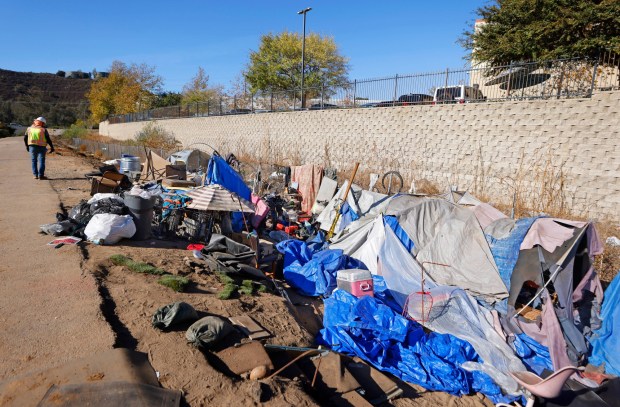 A homeless encampment lines the side of the Escondido Creek near Citracado Parkway in Escondido on Monday, Dec. 16, 2024. Escondido declared a local emergency over impacts from homeless encampments in the area after recent water quality tests showed elevated bacteria levels. (K.C. Alfred / The San Diego Union-Tribune)
Velazquez said getting the city back to a housing-first strategy will save money and that Escondido is “paying out of pocket” for homelessness services due to an approach preventing it from applying for state, and some federal, funds.
Grants from the state typically require recipients to have a housing-first model. In June, Encinitas declined to request $3.9 million in funding from the state over concerns “strings attached” related to housing-first mandates.
El Cajon also rejected state funding for its HomeStart program. It had previously received about $1 million a year from California’s Permanent Local Housing Allocation Program. The city instead opted to spend more than $700,000 of its PLHA funds from the state on treatment-first programs, including Rescue Mission’s South County Lighthouse.
While the Trump administration continues its attempts to block federal funding for housing-first programs and advise local governments to decline state funds that mandate it, both Velazquez and White agreed the city should do everything it could to get as much funding as possible to fund homelessness services, regardless of the source.
White referenced his own experience of homelessness and drug addiction as an example of why mandated treatment works. White said that a lack of action from the Legislature enables people to sleep on the streets and so they can continue to use drugs. If this changes, he believes, the issue can be alleviated.
“Instead of mandating treatment in this state, we’ve settled on handing out needles and crack pipes until an affordable housing unit opens up and I think you’re seeing the results of that,” White said.
In June 2024, Escondido’s City Council passed an ordinance that White authored that banned sleeping outside, including on sidewalks. White said the ordinance has helped public safety and curbed the spread of disease.
Velazquez supported this ordinance, but thinks enforcement is tricky. With no outreach abilities, the Police Department’s interactions with homeless people are only with an intent to enforce the law. Velazeuz believes this doesn’t solve the problem.
“The issue doesn’t go away just when you shift somebody, and I think that the city needs to have a much more comprehensive, wrap-around approach, to get these people out of homelessness, not just out of our parks and out of in front of our businesses,” Velazquez said.
Velazquez is a volunteer coordinator at the Oceanside-based Brother Benno’s Foundation and a former intern for McNamara. He is endorsed by the San Diego County Democratic Party and San Diego and Imperial Counties Labor Council.
White is endorsed by the city firefighters association, state Sen. Brian Jones, county Supervisors Jim Desmond and Joel Anderson and the mayors of Vista, Poway and Santee, all of whom are Republicans.
Rescue Mission is a faith-based nonprofit that runs shelters and programs in San Diego County through a treatment-first approach.
At the end of the debate, Dee said Rescue Mission “does not believe that homelessness is a government problem to fix. We think it’s a community problem to fix. … We can’t wait for the government to figure this out.”