
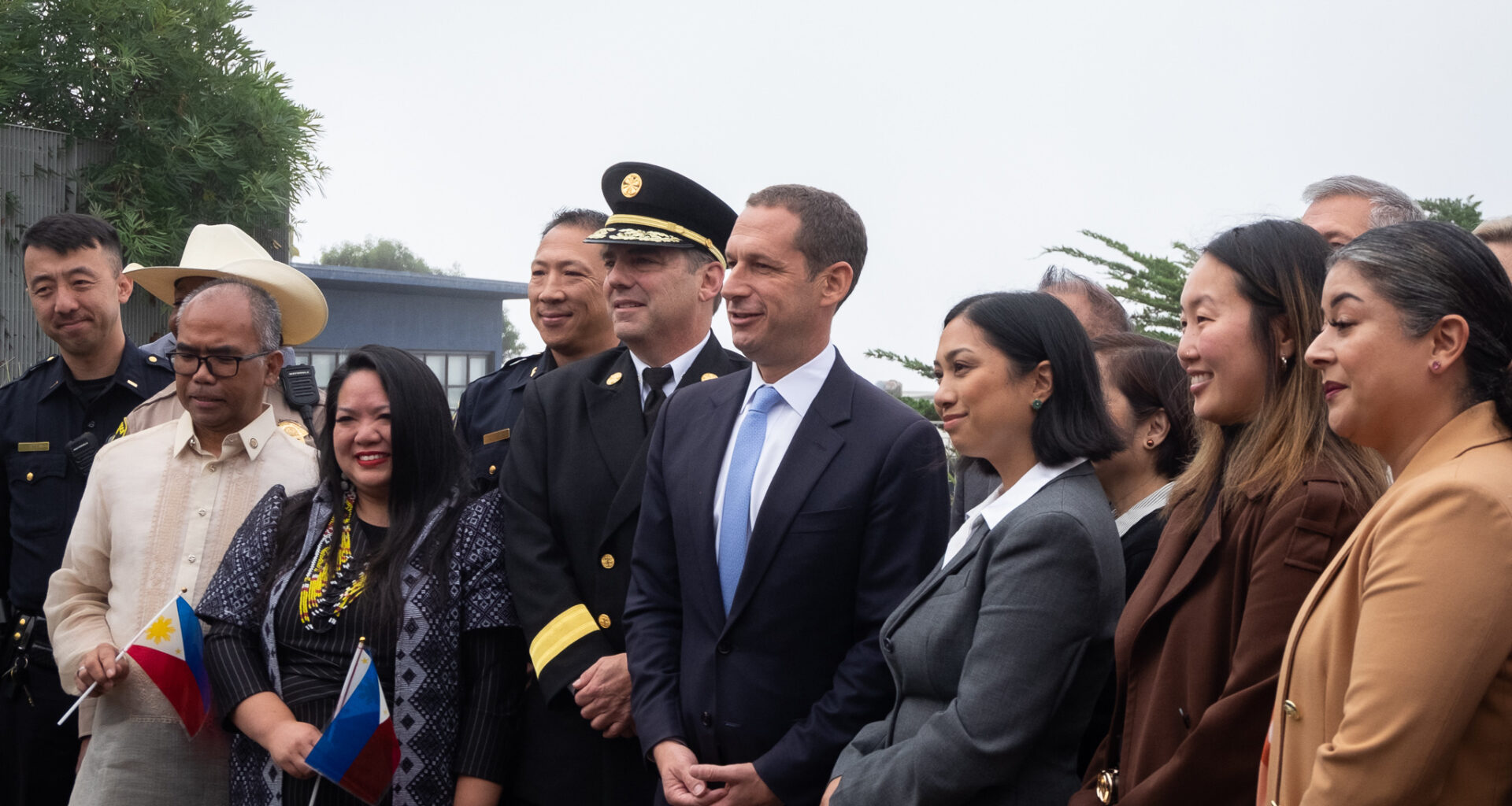
The nascent District 4 supervisor, Isabella “Beya” Alcaraz, has become the first person of Filipino descent ever to serve on the San Francisco Board of Supervisors.
And San Francisco’s Filipinos, who make up about 4.2 percent of the city, are celebrating.
“It was a moment of pride for the Filipino community,” said Juslyn C. Manalo, a Filipina councilmember and former mayor in Daly City who was raised in SoMa, a stronghold of the Filipino community, until she was eight. “It’s reverberating throughout not only the Bay Area but also out of the state.”
The Filipino community, which numbers around 34,000 people, is woven into every neighborhood of the city, from longtime hubs in SoMa and the Excelsior to the Richmond the Sunset and more.
Yet until Alcaraz was appointed to the vacant District 4 seat by Mayor Daniel Lurie on Thursday, Filipinos had never been represented on the city’s Board of Supervisors.
For many, the announcement was a joyous moment that marked the end of a long wait. None of the Filipino community leaders contacted by Mission Local had known of Alcaraz before, but many have already pledged to rally behind her bid to win the job in her own right when she must run for her seat in June 2026.
“It’s a historic moment,” said Mick Del Rosario, a Filipino American from the SoMa and a legislative aide to Supervisor Stephen Sherrill. “For a community that’s been part of this city for over a century, it’s heartening to finally see that representation in City Hall.”
Rosario is currently one of four legislative aides of Filipino descent in the city. “Thankfully not the only one!” he said. Filipino representation at San Francisco City Hall is “getting there,” he noted. The annual rotunda photo of Filipino city workers taken every October for Filipino American History Month keeps expanding.
But leadership positions still remain limited, Rosario said, which is why the appointment of Alcaraz carries so much weight.
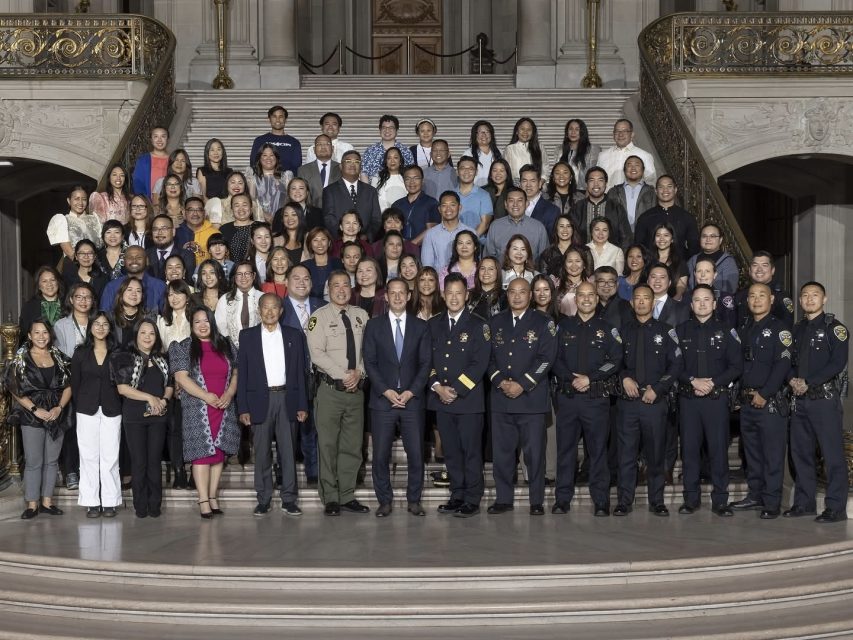 Filipino city workers pose for an annual rotunda photo with San Francisco Mayor Daniel Lurie in 2025. Photo courtesy of Mick Del Rosario.
“I know we were very close to having a Filipino supervisor in District 1. And it hasn’t been for lack of trying. There have been so many qualified and strong Filipino leaders,” Alcaraz said in a call, referencing Marjan Philhour, who ran for District 1 supervisor three times but came in second each time. She was beaten by incumbent Connie Chan last November.
Manalo, the first Filipina mayor of Daly City, was one of a group of Filipino community leaders whom the San Francisco mayor’s office invited to witness Alcaraz’s swearing-in on Thursday. It was beautiful to see her family members, parents, sister, cousin and a grand-aunt filled with joy, said Manalo.
“It’s a very proud moment for me,” said Franco Finn, 48, a Filipino American who serves on the San Francisco Film Commission and has lived in the Sunset nearly his entire life. “Being around here, looking at the leaders in our area, I never saw anyone that looked like me.”
Finn rearranged his schedule to be at Alcaraz’s swearing in, wearing the flag of the Philippines “displayed proudly” on his chest. “Hopefully this will pave the way for many more,” he said.
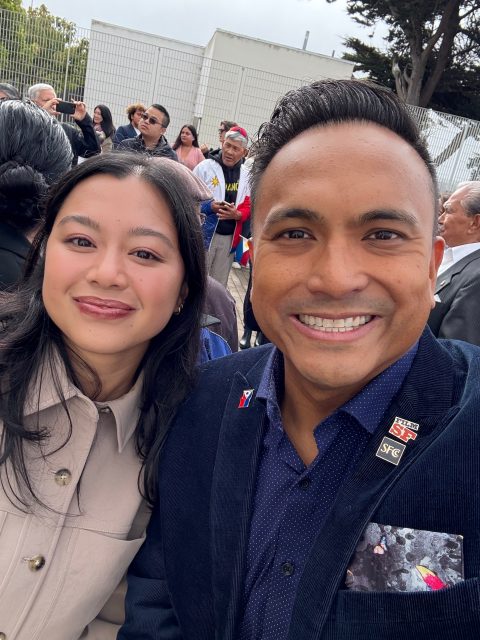 Franco Finn and District 4 supervisor Isabella “Beya” Alcaraz’s sister Kat at Alcaraz’s swearing-in on Nov. 6, 2025. Photo courtesy of Franco Finn.
Finn doesn’t know Alcaraz personally but she already feels like a cousin to him, Finn said. They share a similar path, as both are children to hardworking immigrant parents who moved to San Francisco in the 1970s.
They also crossed paths many times at the Chase Center. The Filipino community is a huge basketball community, and Finn, as the “hype man” for the Warriors, has been “very visible in front of many, many fans every night,” he said. Both Alcaraz’s sister Kat and dad Ron told Finn this week that they had been watching him for years.
“I’m surprised it took this long for a Filipino to be in one of those seats,” said Rudy Corpuz, a first generation Filipino immigrant and executive director of United Playaz, a violence prevention and youth development organization.
Part of the delay, Corpuz suggested, may be that San Francisco isn’t always the final destination for Filipino families. Many come through military service, settle in SoMa, then move to places like Daly City, Pittsburg or Vallejo in search of a better life for their families.
Al Perez, recently appointed by Mayor Daniel Lurie as the first Filipino commissioner on the San Francisco Arts Commission, said the “momentous, historic occasion” motivated him to “make sure she succeeds” when Alcaraz eventually runs for re-election in June. Filipinos had rallied around Philhour, he said, but now Alcaraz will “have even more momentum” from the Filipino community “now that she’s there as the first.”
But “it’s not just about identity,” said Zachary Frial, an environmental justice organizer in SoMa. Given that Alcaraz’s political beliefs remain unknown, “it’s hard to say whether she’ll be an ally to the Filipino community.” For an ally, the community wants someone that stands up for immigrant rights, fights to fund community infrastructure and social safety net, and prioritizes affordable housing.
Alcaraz, for her part, said it was “such an honor” to be appointed. “I’m really excited to get to work and to make Filipinos proud,” she said. “I hope that Filipinos can see a young woman in leadership and know that it is attainable.”
And as the new supervisor of a district that is heavily white and Chinese, and also Latino, Alcaraz reiterated what she said in Thursday’s swearing-in: She is grateful for the support she’s received from all communities.
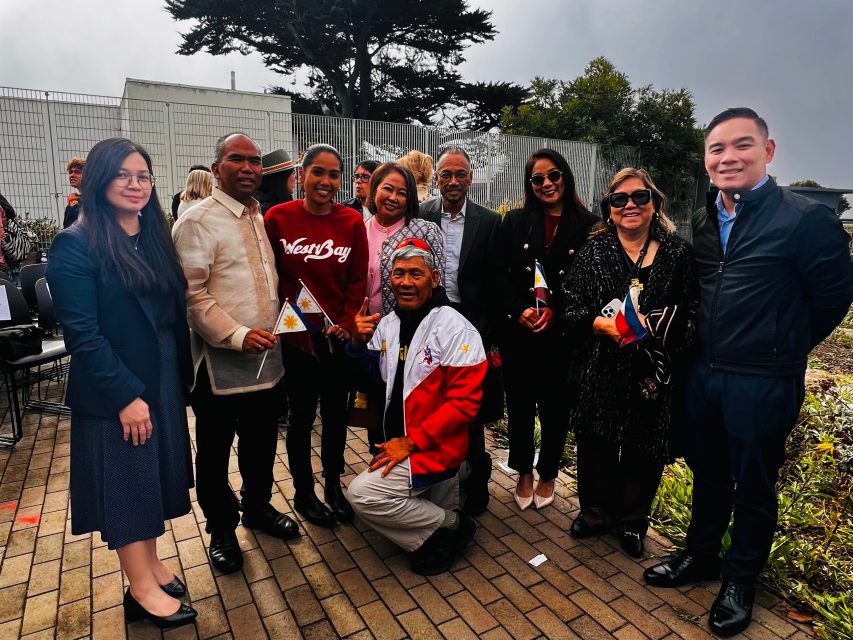 A group of Filipino community leaders at District 4 supervisor Isabella “Beya” Alcaraz’s swearing-in on Nov. 6, 2025. Photo courtesy of Daz Lamparas.