
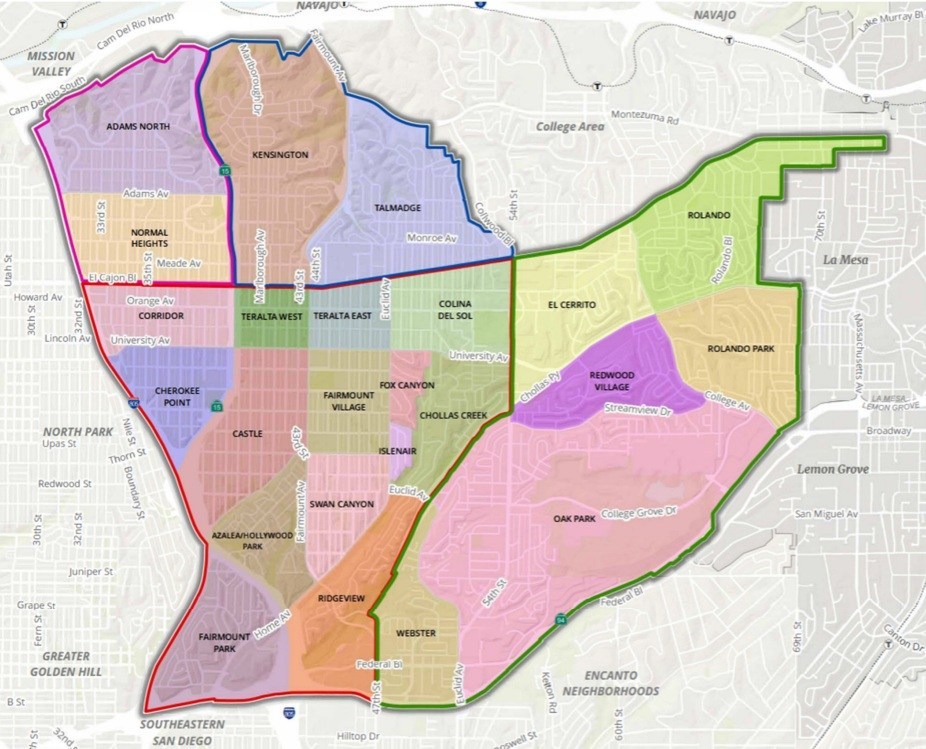
San Diego planners recently released a blueprint plan to rezone large areas of the city to allow for denser development. Some neighborhood leaders aren’t happy.
The proposed plan is for City Heights, Normal Heights, Kensington, Talmadge, Rolando and some nearby areas that could boost the number of homes from 54,000 to 96,000 and the total population from 138,000 to 227,000.
The plan, which city officials hope to finalize next spring, would bring high-rise and mid-rise housing to an area officials are calling Mid-City. Mayor Todd Gloria said the zoning change would create homes that locals could afford, such as townhouses.
While community leaders in City Heights have praised the possibility of increased investments, residents of other neighborhoods, like Talmadge, said the plan does not create enough park space and libraries. They have also voiced concern about a change to their community character and lack of infrastructure that could support the new plan.
Question: Is San Diego on the right track with its Mid-City plan?
Economists
James Hamilton, UC San Diego
YES: The most effective way to control the cost of housing in San Diego is to allow construction of more units. It makes sense to target areas that already have some urban character and transit infrastructure. But we should also plan carefully to provide park space and smooth traffic flow. And some of these areas have some unique historic architecture that deserves to be preserved.
Norm Miller, University of San Diego
YES: We do need to allow for more density and appease state mandates. My primary concern is that we continue to encourage reduced parking minimums, or in some cases zero (see AB 2097), which is unfair to existing residents. Shared parking, bike parking and transit passes are encouraged but these may not suffice until such time as we start to use more autonomous vehicles like Waymo, and the cost of using them comes down.
Kelly Cunningham, San Diego Institute for Economic Research
YES: It is difficult to combine disparate neighborhoods under one overarching plan when varied needs of individual circumstances should be considered. Significantly increasing the area’s density with multi-unit, mid- and high-rise housing, without the infrastructure and transportation options to support it, is not ideal. The plan would be greatly enhanced if the trolley line ran along El Cajon Boulevard rather than miles away in less accessible Mission Valley, but then La Mesa’s problem would need to be reconciled.
Alan Gin, University of San Diego
YES: San Diego needs more density to deal with the high cost of housing. The Mid-City area is the ideal location for that. It is centrally located, which reduces travel and helps with congestion. The area is rich in terms of restaurants and entertainment, which already makes the area attractive to those who seek a walkable environment. One thing that should be considered is the infrastructure needs of the area, including parks and libraries.
David Ely, San Diego State University
YES: As with plans for other parts of San Diego, increasing housing density in Mid-City will contribute toward addressing the great need for additional affordable housing in the region. The plan is only in draft form. Revised versions can be developed based on additional feedback and narrow the gap between the plan and the expectations of the impacted communities with regard to transportation infrastructure, parks, libraries, recreational facilities and other services.
Ray Major, economist
YES: If one makes an assumption that the region truly needs more housing, then the densification of the Mid-City area makes sense. Mid-City already has extensive existing infrastructure, a strong commercial corridor and existing bus lines that would support San Diego’s transit-oriented development goals. Furthermore, the plan supports overall state-mandated goals to reduce vehicle miles traveled and greenhouse gases. The plan also includes new neighborhood parks and libraries, which will enhance the quality of life for all residents of the Mid-City area.
Executives
Jamie Moraga, Franklin Revere
NO: Mid-City risks declining quality of life, falling home values, and erosion of community character. If implemented, the plan would increase housing and population density, affecting neighborhoods and businesses through overcrowding, limited parking, increased traffic, and strain on vital infrastructure, including schools, roads, utilities and emergency services. The result could be overdevelopment, reduced quality of life, lower property values and a compromised community character. Proper community planning and input must precede aggressive development.
Phil Blair, Manpower
YES: San Diego desperately needs to build workforce-priced housing. And it needs to be available to mass transit options to maximize mass transit use. These neighborhoods meet those criteria perfectly. Keep in mind this growth will be blended in over many years in the future.
Gary London, London Group Realty Advisors
YES: In urban planning, past is not prologue. This 25-year plan is part of the city’s responsibility to set the table for housing, economic growth and infrastructure. These neighborhoods have already experienced dynamic change through infill, immigration and business growth. But it is the developers and businesses that will have to step up, build and take the risks. I believe that they will continue to do so. Its neighborhoods are the harbinger for San Diego’s modernization.
Bob Rauch, R.A. Rauch & Associates
YES: The plan addresses regional growth and housing needs, quality-of-life improvements, community needs, infrastructure demand and environmental impact. The process seems realistic, with an emphasis on mobility corridors, parks,and transit upgrades, but execution risk remains around the transit upgrades needed along El Cajon Boulevard, University Avenue and Fairmount; park and recreation investments; and community resistance. Follow-through with the infrastructure and zoning intensity is required to make it work.
Austin Neudecker, Weave Growth
YES: San Diego’s housing shortage will not improve without increasing density in central neighborhoods and enabling infill. Mid-City is well positioned for more housing, particularly townhomes and mid-rise development that can serve families and younger residents priced out of detached homes. Yet zoning alone is insufficient. The city should pair growth with investments in local infrastructure and underground parking, so existing residents are less impacted and see direct benefit.
Chris Van Gorder, Scripps Health
YES: If what everyone is pushing for is more housing, increasing density is the only way. But I’m deeply concerned about the loss of local control, the loss of parking, an increase in traffic and the loss of community character – once that’s lost, it’s gone for good. The sprawl and traffic in L.A. are so bad these days that I can’t wait to get out of there. I don’t want San Diego to turn into L.A.
Not participating this weekCaroline Freund, UC San Diego School of Global Policy and StrategyMark Kersey, San Diego County Taxpayers Association
Have an idea for an Econometer question? Email me at phillip.molnar@sduniontribune.com. Follow me on Threads: @phillip020