
For the last 23 years (13 with The Hockey News) DobberHockey has reviewed each team from a fantasy-hockey standpoint and graded them.
The 24th annual review will appear here on DobberHockey throughout the summer. This is not a review of the likely performance on the ice or in the standings, but in the realm of fantasy hockey both for the season ahead as well as the foreseeable future. Offensively, will the team perform? Are there plenty of depth options worthy of owning in keeper leagues? What about over the next two or three years? These questions are what we take into consideration when looking at the depth chart and the player potential on that depth chart.
Enjoy!
Pick up the DobberHockey Fantasy Guide here – always updated
Gone
Mason McTavish, Jeffrey Viel, Ross Johnston, Jansen Harkins, Olen Zellweger, John Carlson, Jacob Trouba, Radko Gudas, Petr Mrazek
Incoming
Jeff Malott, A.J. Greer, Nick Jensen, Laurent Brossoit
Impact of Changes
Anaheim drastically overhauled their blue line. They effectively removed four regulars from the roster, even if Gudas was limited last year due to injury. It means that Jackson LaCombe is the unquestioned top defenceman both at even strength and on the power play. LaCombe skated over 44% of the team’s ice time in the playoffs. Even something like 41% in the regular season would mean roughly 25 minutes per game, and with the offensive talent in the top-half of the roster, he can push past the 60-point mark. The Dobber Fantasy Guide projects him for 58 points in 78 games.
It should also mean a much bigger role for Pavel Mintyukov. It is unlikely he supplants LaCombe on the power play, but Mintyukov skated less than 15% of the team’s PP time last season; that number could easily double in 2026-27. He won’t be a big PP producer, but he can post 5-10 PP points, and that matters when talking about secondary fantasy production. Add in a jump in his even-strength role plus his typical PK role, and Mintyukov should cruise past 20 minutes a game. That puts triple-digit blocks and shots on the menu, so his multi-cat value is improving.
Drew Helleson managed 60 regular season games but was in and out of the lineup during Anaheim’s playoff run, and was given the least TOI per game of their postseason blue liners. With all the departures on defence, Helleson is in line to play a full season, but there are play-driving metrics that show him as being quite literally one of the worst defencemen in the league over the last two years. There is a reason why he barely got any ice time in the playoffs, and without a big improvement, the team has prospects who could surpass him.
McTavish being traded to St. Louis should lock Ryan Poehling into the third-line centre role. He is coming off a career-best 36 points and can legitimately threaten 500 face-off wins with 100 shots and 100 blocks. That is solid across-the-board coverage so keep him in mind for depth in multi-cat leagues.
Jensen might be the de facto top right-handed defenceman in Anaheim, which is a big indictment of the Ducks’ blue line. If it is indeed the case, he should see a significant ice time rebound from the drop-off he had last year in Ottawa, and that puts 20 points, 100 blocks, and 60 hits within reach. If he doesn’t rebound from his 2025-26 performance, he could be on the bottom pair by the second half of the season, right-handed or not.
Ready for Full Time: Tim Washe, Tyson Hinds
Washe was a lineup regular in the second half of the 2025-26 season and played in all 12 postseason games. If he stays at centre, he’s stuck behind Leo Carlsson, Mikael Granlund, and Poehling, so there isn’t much fantasy value to be had. However, there is a chance they move Granlund to the wing or use him as some kind of centre/wing hybrid, so keep an eye on Anaheim’s lineup – Washe could move up to the third line, but that’s as far as he’ll go.
All the turnover on defence means an open spot for Hinds. He has more NHL playoff games (9) than he does regular season games (6), which shows the trust the coaching staff had in him late in the season. His problem is he’s a left-handed shot, and so are LaCombe and Mintyukov. Unless Hinds shows the ability to play well on his off-side, he won’t get a lot of ice time.
There are young players who could make an impact as Nikita Nesterenko (42), Ian Moore (37), and Tristan Luneau (35) are all projected for a modest number of games played in the Fantasy Guide. Moore and Luneau are interesting for fantasy managers because they are right-handed shooting defencemen and the Ducks are short on competent right-handed defencemen. If either can really make an impact, they might not only be a lineup regular, but even the second pair.
Fantasy Outlook
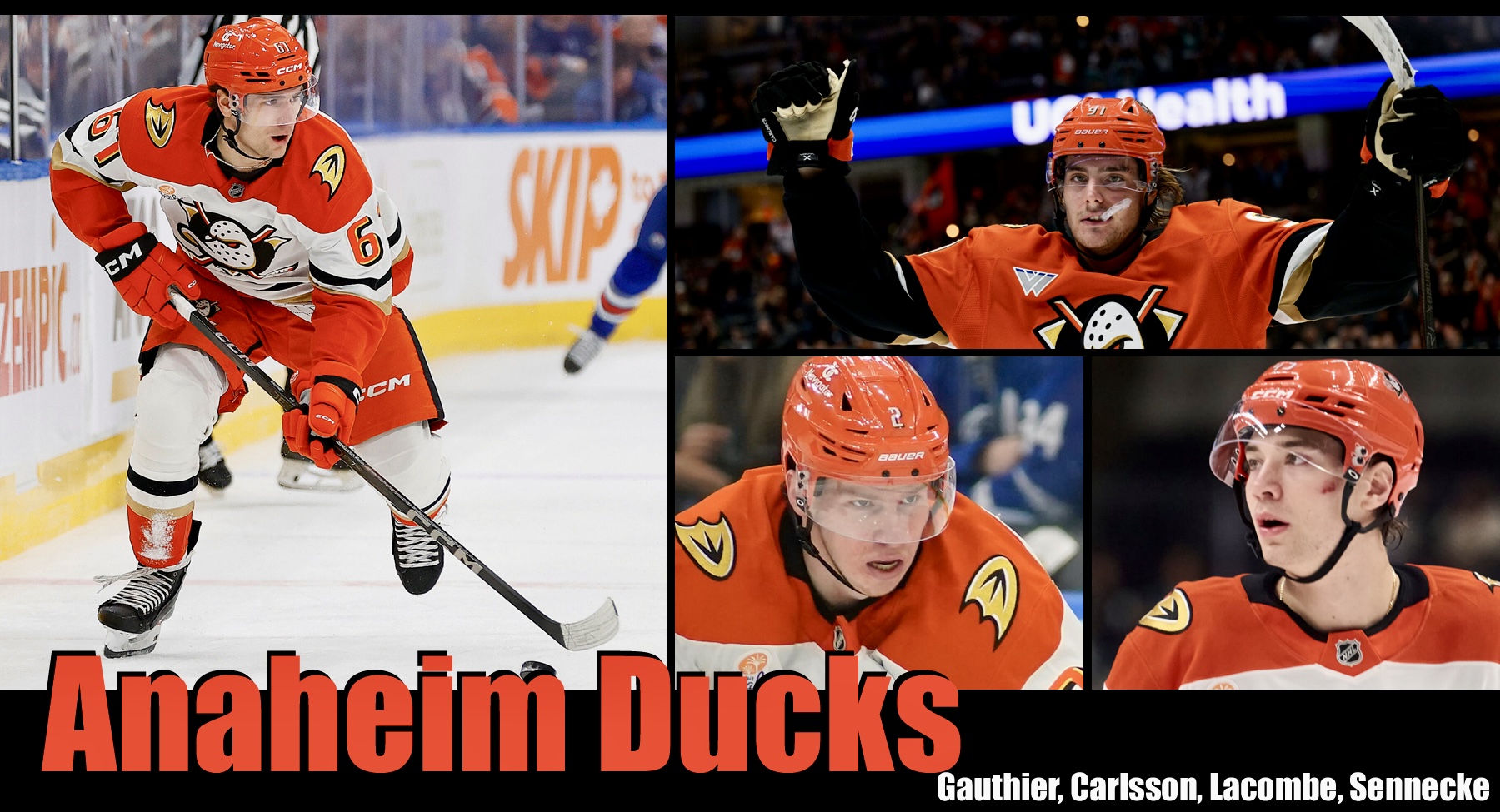
Carlsson is now in his fourth season, he crested the 200-game mark late last season, and turns 22 years old in December. He should be the unquestioned top centre for the Ducks, and if he’s not, something has gone wrong. The Fantasy Guide projects him for 74 points in 72 games, which means he has 90-point potential in a full season. He should be a top 50 pick in most formats, and that is appropriate for what he can bring.
Cutter Gauthier is coming off a 41-goal breakout season, and the Fantasy Guide has him repeating that performance while adding a handful of assists. He wasn’t a top PP staple last season – fifth among their forwards by PPTOI% – but he should be that in 2026-27. There aren’t many players who are realistic threats for 40 goals, 80 points, and 300 shots, and Cutter is among them. He should go even higher than Carlsson, especially on Yahoo! where he has C/LW/RW eligibility. Just keep an eye on his contract situation as he still hasn’t signed his extension.
Beckett Sennecke is a fascinating name because Troy Terry could be out until Christmas thanks to a hip surgery. If Sennecke builds off his stellar rookie campaign, he could very well be the team’s top winger at even strength. The issue is that with Carlsson, Granlund, and LaCombe, there are two spots left on the top PP unit. Once Terry returns, two of Terry, Gauthier, Sennecke, and Chris Kreider will not get top PP time. There will likely be a rotation between those four wingers, and that’s not good for anybody. All the same, the Fantasy Guide has Sennecke projected for a 70-point season.
LaCombe is the team’s clear top defenceman and should be drafted as a top-20 blue liner. Last month, I wrote about how LaCombe has the role, the teammates, and the skills to take a big jump in his fantasy value. Once the top 12 defencemen are off the board, he’s a guy I would target regardless of format.
Goalie Lukas Dostal took a big step back last season, posting an .888 save percentage. For a guy who was above .900 in each season of his career to that point, it’s an aberration that stands out. He should rebound, but it is fair to ask just how much because there isn’t a playoff team with as many question marks on their blue line as Anaheim does. When Nick Jensen is your number-3 and the bottom pair is likely to be two rookies, there is just too much uncertainty for us to expect Dostal to be a top 12 goalie. He can do it if the team is better defensively than expected, but it’s a leap of faith.
The Ducks could have three 30-goal, 70-point forwards (or better), one 10-goal, 60-point defenceman (or better), a top 12 goalie, but the depth is marginal. It is a top-heavy team that will go through more growing pains, so it’s a boom-or-bust mix of fantasy talent.
Fantasy Grade: B (last year was B-)
Check out the rest of the Dobber team previews here.