
Many kids process language in chunks or phrases, not word by
word.
But most AAC (augmentative and alternative communication) tools
on the market aren’t built to recognize this communication style.
This gap makes it hard for nonspeaking or minimally speaking
students to express what they want and harder for speech
therapists, families and others around them to understand.
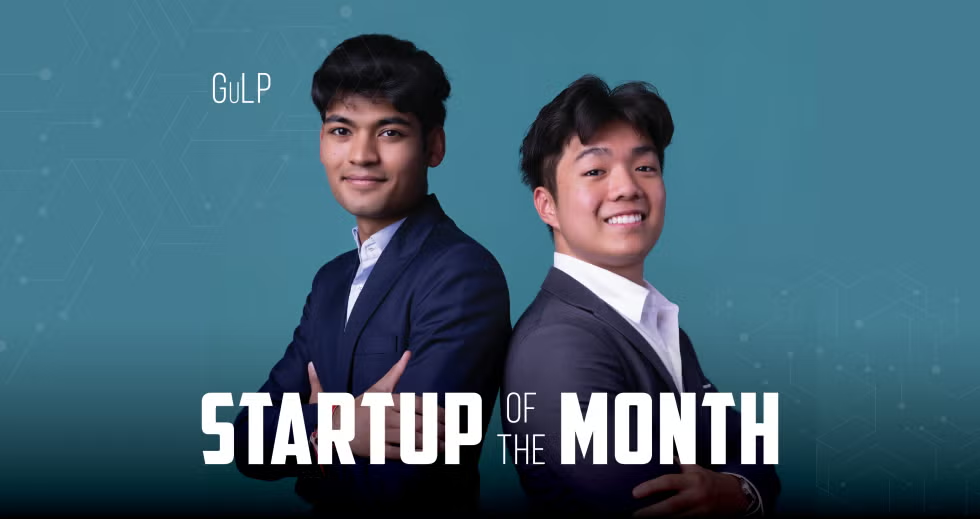
Nine co-founders (six from Sacramento State and three graduates
of University of the Pacific) designed GuLP, an AAC app that lets nonspeaking
and minimally speaking children tap buttons on a screen to speak
out loud.
Designed by speech-language pathologists, the tool allows them to
communicate with whole phrases or build sentences word by word,
based on their communication style and preferences. The team is
also building out features for training and ongoing support, says
GuLP CEO and co-founder Haley Hager.
Hager is a speech therapist who specializes in AAC. It wasn’t
just one incident that inspired the development of the startup.
She has matched, evaluated and implemented communication tools
for more than 200 students and 50 therapists. She saw the
disconnect between children’s communication needs and the tools
available to them play out over and over. “Seeing these
mismatches, seeing these problems within the ecosystem, was
something I experienced on a daily basis,” Hager says.
The expertise of three speech therapists gave the GuLP engineers
a foundation to build on, and feedback from the community also
helped the team determine what would be valuable to users and
speech therapists.
“Right now, we have a backlog of about 200 different things that
need changing,” says co-founder Umang Vadhar. “We have two
meetings per week: One of them is a check-in, the other one is
asking, ‘What do we want to prioritize more? What can we ship out
to people and get feedback?’”
Vadhar says they beta test new features every week to get
feedback fast, and building with the community has been a key
part of the process. For example, in response to feedback, the
team is making sure the voice for GuLP sounds more emotive and
human rather than robotic.
Co-founder Ben Duong noted that an early version of their delete
button required users to hold it down to erase everything. After
receiving feedback, they added a one-click delete button a week
later. Another idea in the pipeline is a chatbot for guidance and
training, especially useful for parents.
The team shows a “tenacity to hustle” and a willingness to “do
the unglamorous part without being asked,” according to Cameron
Law, the executive director of the Carlsen Center for Innovation
& Entrepreneurship at Sacramento State.
“They keep going back to customers, they pay attention to what
people actually do, and they’ll change direction when the
evidence tells them to,” says Law, who worked with the founding
team of GuLP. “Entrepreneurship is vulnerable and hard, and
they’ve kept showing up for it.”
The biggest challenge wasn’t actually building the tool, Duong
says. With such a large team, the hard part was finding the time
to meet and plan next steps while juggling school and work. But
the effort has paid off so far.
The team has earned top honors in several startup competitions,
including winning the 2026
Capitalize: Next Gen startup competition hosted by the
Sacramento Kings, receiving the $10,000 prize. GuLP also won
first place in the Social Impact Track at the
2026 CSU Startup Launch Competition for an additional
$20,000. The team is currently looking to raise a pre-seed SAFE
with angel investors, with an official launch slated for October
20, 2026.
“Something that we’ve realized and learned over time is you
really can’t beat building in community,” Hager says. “I think
when we build in silos, that presents its own challenges, like if
we were just one engineer or one speech therapist, you’re not
building with the community. But to build for all, you need to
build as all.”
–
Stay up to date on business in the Capital Region:
Subscribe to the Comstock’s newsletter
today.