
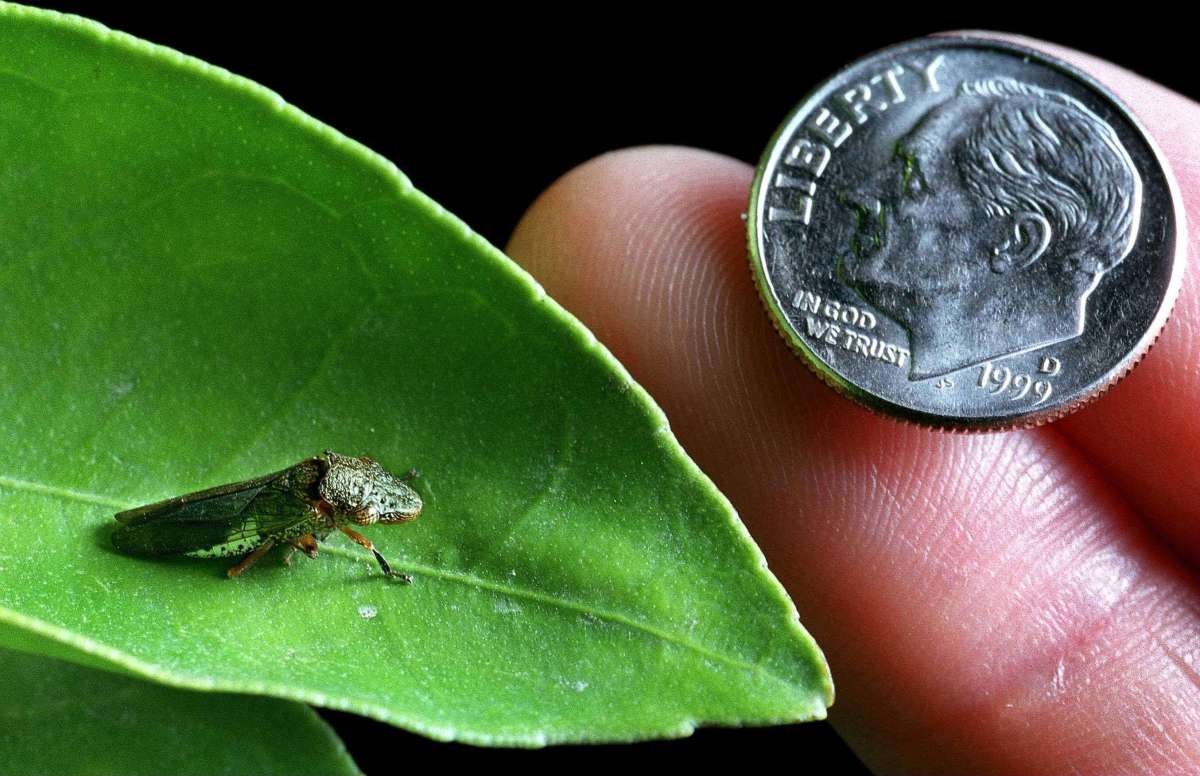
North Bay and state officials say a recent outbreak of an insect plaguing grapevines reveals a threat to not only California’s $73 billion wine industry, but also the state’s agricultural infrastructure.
Officials say the discovery of the glassy-winged sharpshooter in May serves as a bellwether of broad invasive threats to the state’s agriculture, with shrinking budgets to effectively prevent and manage outbreaks of other pests.
The insect spreads a bacterium responsible for Pierce’s disease, which kills plants like grapevines through thirst. The glassy-winged sharpshooter has the longest range and is most voracious among the species which can spread the bacterium.

USDA Agricultural Research Service
The glassy-winged sharpshooter, a major culprit behind the spread of Pierce’s disease among grapevines. The insect infects the plant with the bacterium Xylella fastidiosa when it feeds on the sap from the xylem tissue of a vine. (USDA Agricultural Research Service)
Unchecked, its impacts could be significant for winegrowers, who statewide employ more than 422,000 workers. With limited state funding to support trapping and treatment programs, grape growers could lose tens of millions of dollars each year to declining production and vine replacement, agricultural officials and industry representatives say.
Michael Miiller, director of governmental relations for the California Association of Winegrape Growers, estimates multiple counties need $26.8 million to address the current outbreak.
 Michael Miiller, director of governmental relations for the California Association of Winegrape Growers, speaks to a panel in a screenshot of a hearing held Sept. 3 at University of California, Davis in Davis, California. (Screenshot – California Senate Select Committee on California’s Wine Industry)
Miiller told a panel assembled Sept. 3 at UC Davis by the Senate Select Committee on California’s Wine Industry that some federal support is anticipated. But he said winegrape growers hope to see new funding allocated from the state, starting with $10 million annually to address the threat of sharpshooters.
The state needs more robust systems to deal with threats like the sharpshooter in the future, and will have to “make tough decisions” to find funding to avoid an estimated $11 million in crop loss per year, he said. “The sky is falling. It is really bad, and we need some help.”
The committee’s chair, Sen. Christopher Cabaldon (D-West Sacramento), said the rediscovery of the sharpshooter illustrates the dynamic challenges facing the statewide wine industry, noting the additional ongoing threat of grapevine red blotch disease, which has no cure and can affect entire grapevines quickly. He said state leaders must show “tenacity and investment.”
Dr. Cindy Kron, UC Agriculture and Natural Resources’ integrated pest management advisor for the north coast, told the panel how the current outbreak began in May when a nursery in Fresno delivered grapevines to Costco stores in 24 counties without the proper hold tags. She said such hold tags alert Costco workers to have a shipment inspected before products go out to the floor, which didn’t happen in time.
 Dr. Cindy Kron, UC Agriculture and Natural Resources’ integrated pest management advisor for the North Coast, speaks to a panel in a screenshot of a hearing held Sept. 3 at University of California, Davis in Davis, California. (Screenshot – California Senate Select Committee on California’s Wine Industry)
Kron said when inspectors were alerted, they found sharpshooter insects at all life stages in the inspected grapevines. The outbreak was traced to a shipment of desert willow and elephant ear plants from Texas, which entered the state without hold tags or inspection. Some plants were contaminated with sharpshooter eggs, she said.
There is no cure for the bacterium which the vector can carry, and infected grapevines can also act as pathways for sharpshooters to move to other plants, Kron said. She noted the sharpshooter outbreak from 1998 to 2000 which devastated the Temecula wine region, with up to 60% grapevines destroyed or removed.
The state is overseeing glassy-winged sharpshooter-control projects in five California counties, including in Solano County, where an infestation was discovered in 2021. State officials say there’s a high likelihood the outbreak there has been eradicated, although Kron noted that eradication “is not easy to achieve.”
Impacts beyond Napa
Napa County Agricultural Commissioner Tracy Cleveland told the panel that since the sharpshooter threat was detected, local tracing of the insect found that some grapevines were donated to food banks or moved to adjacent counties.
 Tracy Cleveland, Napa County’s Agricultural Commissioner and sealer of Weights and Measures, speaks to a panel in a screenshot of a hearing held Sept. 3 at University of California, Davis in Davis, California. (Screenshot – California Senate Select Committee on California’s Wine Industry)
Cleveland said that tracing is key to containing the spread between counties, as are inspections of the environment where infected grapevines were found. About 300 hosts could have spread throughout Napa County, she said.
Costco in June sent out three rounds of communication to customers who purchased the Burchell grapevines, Cleveland said. Napa County also posted signs throughout the county, warning residents and visitors of the outbreak.
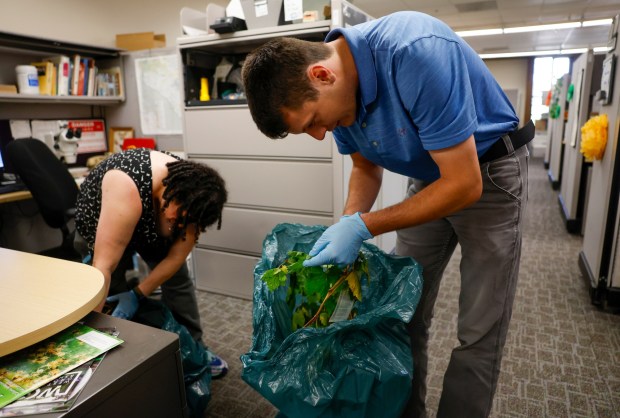 Jennifer Gracy, left, Agricultural Biologist, and John Sorfleet, Deputy Agricultural Commissioner, inspect grapevine plants that were picked up from Gilroy yesterday at the Santa Clara County Division of Agriculture in San Jose, Calif., on Tuesday, July 14, 2026. They did not find any eggs or Glassy-Winged Sharpshooters but did see potential evidence of Pierce’s disease. (Nhat V. Meyer/Bay Area News Group)
Treatments are also taking place in Shasta and Stanislaus counties, and trapping and inspections are underway in Contra Costa, San Mateo and Santa Barbara counties, Cleveland said.
However, the commissioner added “We are looking at a tremendous amount of work … with limited financial resources.” While Napa has the Winegrape Pest and Disease Control District to fund inspection, detection and education around Pierce’s disease, with winegrowers assessing themselves voluntarily, other counties don’t have the same resources.
“I don’t have the option to scale back my efforts to protect agriculture in Napa,” Cleveland said. The wine industry has a $11.7 billion economic impact for Napa, with three out of four jobs connected to winegrapes.
 Josh Rubin, director of sustainable finance, food, agribusiness and clean fuels at BMO Commercial Bank, speaks to a panel in a screenshot of a hearing held Sept. 3 at University of California, Davis in Davis, California. (Screenshot – California Senate Select Committee on California’s Wine Industry)
Josh Rubin, director of sustainable finance at BMO Commercial Bank, said his clients are concerned about another source of economic stress leading to unmanaged vineyards, which counties then see as potential sources of unchecked vectors. “Pest control is always on the chopping block.”
Assembly Majority Leader Cecilia Aguiar-Curry (D-Winters) said “It may be a small bug, but boy, the threat posed is anything but small.” She said her family of farmers knows the cost that the vector can create, and said she recently asked for funding in the state budget to ensure support for farmers to address it.
California’s Department of Food and Agriculture estimated at least $5 million may be needed each year to expand trapping and outreach, she said. “We’ve been saying this for a while, and feel like it falls on deaf ears.”
Cleveland agreed that state funds are lacking in general for proper inspection of all agricultural materials, saying the current approach to attempt eradicating the sharpshooter feels “like whack-a-mole.”
When Cabaldon asked if she could rate the current threat level for vectors affecting the agriculture industry, from cautionary yellow to emergency red, Cleveland said “If red is the worst, I would say red.”
“We know there are pathways we are not covering,” she added. “We have things coming in and out of the state that we are not able to inspect. There’s a lot of things happening that we need better oversight on.”
Staff Writer Natalie Hanson reports on business and agriculture for The Press Democrat. She can be reached at natalie.hanson@pressdemocrat.com or at 619-665-5887.