
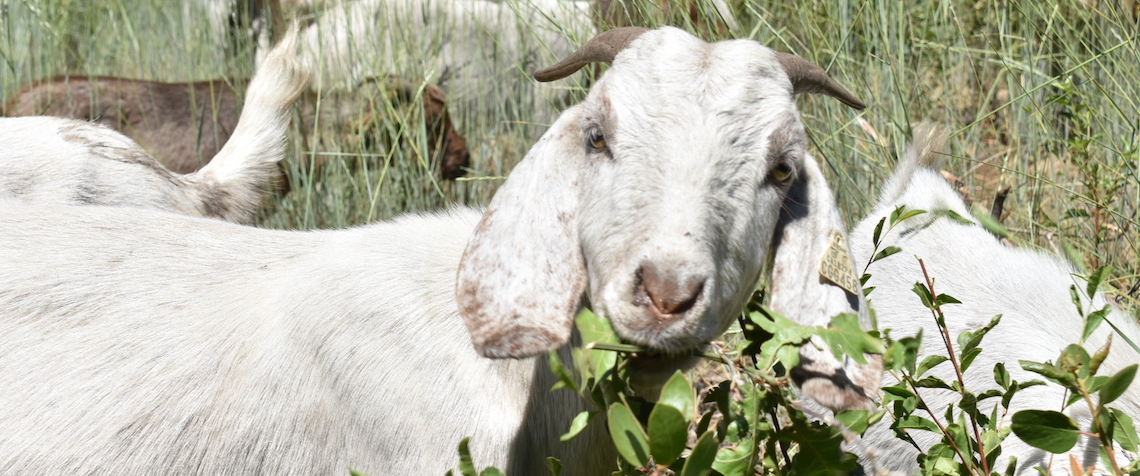
California lawmakers extended a wage provision affecting goat herders as part of late-session budget legislation. File photo
published on September 4, 2026 – 4:30 PM
Written by Frank Lopez
California Farm Bureau is pointing to new funding for wolf management and a legislative fix affecting prescribed grazing as victories from the just-ended legislative session, while saying California farmers remain at a disadvantage when it comes to fully autonomous agricultural equipment.
The California Legislature completed its 2025-26 legislative session in the early hours of Sept. 1 after an Aug. 31 deadline for lawmakers to pass bills. Farm Bureau President Shannon Douglass highlighted the mixed results in a statement following the session.
Douglass offered a special shout out to state Sen. Melissa Hurtado.
“As the legislative session ends, Senator Hurtado deserves our thanks for her work to keep goats available for wildfire fuel reduction. Common sense prevailed there, and we’re grateful for it,” Douglass said.
What happened with goats and wildfire grazing
The issue involved wages for workers who herd goats used for prescribed grazing, a practice in which livestock consume dry grass, brush and other vegetation that can fuel wildfires.
A provision establishing wage parity between sheep and goat herders expired July 1. Without the exception, goat-herding businesses said they faced substantially higher labor costs that could make prescribed-grazing services unaffordable for homeowners associations, park districts, fire safe councils and other customers.
Sen. Hurtado led a bipartisan coalition of 32 legislators that called on Gov. Gavin Newsom and legislative leaders to restore the provision. In an Aug. 10 letter, the lawmakers argued that applying different wage structures to sheep and goat herders threatened agricultural jobs and could reduce the availability of prescribed grazing for wildfire prevention.
The coalition cited a California Department of Industrial Relations study that found ranchers, herders and worker advocates generally agreed that sheep and goat herders should fall under the same alternative monthly minimum-wage structure because their work is similar and frequently overlaps.
Lawmakers ultimately included the extension in AB 187, budget trailer legislation passed Aug. 31. The measure restores the same monthly minimum-wage structure for goat and sheep herders through Jan. 1, 2029.
Hurtado called the extension a temporary solution and said she would continue pursuing a permanent change.
Wolf program receives $5 million
Farm Bureau also praised Assemblymember Heather Hadwick and Sen. Catherine Blakespear for their work on funding related to California’s growing wolf population and its effects on livestock producers.
Late-session budget legislation provides $5 million to the California Department of Fish and Wildlife’s (CDFW) wolf program.
Of that amount, $2.5 million is designated for the Wolf-Livestock Compensation Program and another $2.5 million is available for related activities, including rapid response and wolf management.
That distinction is important because the entire $5 million is not earmarked for payments to ranchers.
California created the Wolf-Livestock Compensation Pilot Program with a $3 million appropriation in 2021. The program was designed around three types of assistance: compensation for livestock killed or injured by wolves, support for nonlethal deterrents and payments intended to address indirect effects associated with wolves being present around livestock.
CDFW currently accepts applications for direct losses involving confirmed or probable wolf depredations occurring on or after July 1, 2024. The department investigates suspected wolf attacks before determining eligibility.
What Farm Bureau means by autonomous equipment
Autonomous and semi-autonomous technology is already used in California agriculture. The unresolved issue involves state workplace-safety regulations governing self-propelled farm equipment operating without a person stationed at the vehicle’s controls.
California Code of Regulations Section 3441 generally requires self-propelled agricultural equipment, when moving under its own power, to have an operator stationed at the controls. There are limited exceptions, including certain slow-moving, furrow-guided equipment.
The Occupational Safety and Health Standards Board has been examining whether the rules should be changed to accommodate newer autonomous agricultural tractors and vehicles.
A proposed late-session compromise would have changed the rules to allow autonomous agricultural equipment more broadly while requiring reporting on its use, incidents, injuries and resulting employee displacement. The provision was not included in the final version of AB 187.
“The Legislature and the administration, however, failed to make autonomous equipment in farming a reality this year,” Douglass said.
Farm Bureau said changing the regulation will be among its highest legislative priorities next year.