
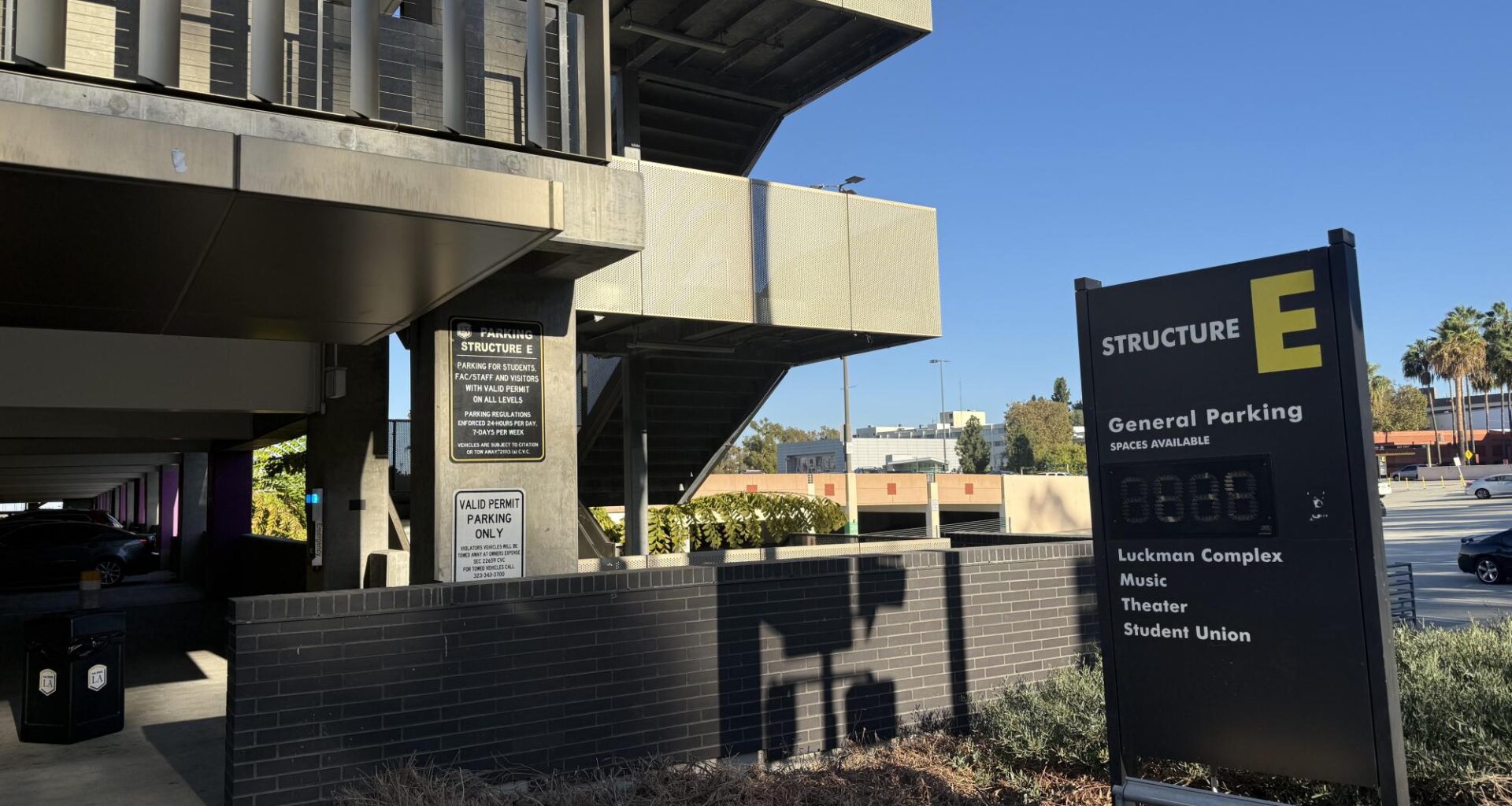
The cost of parking permits at Cal State LA increased this year and will rise again next year, putting more financial stress on students, staff and faculty.
Parking and Transportation is self-supported and receives no additional support from Cal State LA’s general fund or the Cal State System. The agency relies entirely on revenue earned through its sale of parking permits. In the 2025-2026 fiscal year, which ended in July, the agency was projected to end with a $643,033 deficit, according to the agency’s proposed budget document.
The heightened parking pass prices come as Covid-era pauses come to an end, rising maintenance costs at Cal State LA parking facilities and additional employee obligations.
“The University understands that any increase in parking costs can be a concern for students, particularly those commuting to campus regularly,” Cal State LA Spokesperson Erik Hollins said. “We remain committed to communicating clearly about parking rates, the financial needs of the program and how parking revenue is used.”
Fourth-year student Omar Zhari had concerns about the advertised amount versus what he paid, saying that it was advertised at $260, but he paid $280. The increase is because of the 10% Parking Occupancy Tax that is added to all parking transactions at check out.
The parking tax was implemented in 2023, following a ruling in 2019 by the California Supreme Court. The ruling said that charter cities were allowed to require that state universities and colleges “impose the Los Angeles parking occupancy tax,” the University Times reported in late 2022.
However, the total amount that Zhari paid didn’t include the fees associated with paying with a credit card. It only included the tax and original parking payment amount.
“I have my own set of money for school,” Zhari said, “and that money could be textbook money, it could be food, it could be gas if you commute far.”
Zhari has a 30-minute commute with traffic. He’s also carpooling with friends who have opted not to pay for parking this semester.
“The parking program has implemented several cost-saving measures and carefully managed expenses,” Hollins said. “Still, additional revenue is necessary to preserve the quality, safety, reliability and long-term viability of campus parking services and infrastructure.”
Some of the ongoing costs include continued debt service payments for the construction of Parking Lot E, which opened in Fall 2019.
In addition to the costs that parking already pays, the agency is still planning additional improvements to lighting and safety systems across campus parking facilities over the next several years. The agency also plans to use some of the expected revenue increases over the next couple years to help restore their reserves to cover emergencies and unplanned costs.
“I feel like as a student we’re already paying for a lot on campus in itself and 200 is a lot for a student to pay to park on campus,” Nishtha Sethi, third-year public health major said.
Some students who haven’t gotten their parking passes yet, but planned to were unaware of the increased fees.
“It’s about 35 miles from where I live and I would have to pay also for parking, so in total it came out to be 20 dollars a day plus parking,” first-year electrical engineering major Ryan Libna said. “So it’d be about 25 dollars a day just to come here to school. Compared to $7 on the train.”
Libna decided it would be more cost effective to take the train to come to school rather than pay for parking.
Third-year student Matthew Serano said that if the cost ended up being too much for him when he went to get the pass for the semester, he would look into other ways of getting to campus.
First-year psychology major Samira Hernandez also didn’t think it was worth the cost after another student told her that the parking lot was sometimes full and they couldn’t even park on campus despite paying for the pass.
“Honestly, a lot of people don’t get that much financial aid and have to pay out of pocket,” Hernandez said, “So having to pay that much for parking just to never find a parking spot or to park really far, it’s crazy.”
The President of Associated Students Ashley Bellorin said she has heard about the increases, but hasn’t gotten further information on what exactly the new influx of money will fund. However, Bellorin will have “a response for the student body” when she understands what’s going on.
Some students who aren’t on campus every day opt for day passes when the cost of semester-long parking passes doesn’t make as much sense to pay. While the day passes also went up by about $3 per day, student Kobi Vargas didn’t feel like it affected him too much.
Because of the increased costs, some students and others have opted to take public transit or other forms of transit. Cal State LA provides a discounted U-Pass for $99 that allows for students to use dozens of local San Gabriel Valley transit agencies and Metro LA for the entire semester. The U-Pass does not include Metrolink, which offers its own 50% student discount.