
Despite near-universal broadband coverage in one of Michigan’s most affluent counties, affordability, digital literacy and access to devices continue to keep students offline.
The internet may run past nearly every home in Oakland County, but that does not mean every household can afford it or chooses to connect, which can have a long term effect on children.
Of the county’s 524,981 households, 23,597 had no internet subscription in 2024, while 13,520 had no computer, according to U.S. Census Bureau American Community Survey five-year estimates.
Eric Frederick, Michigan’s first chief connectivity officer with the Michigan High-Speed Internet Office, said the latest data show about 30,000 Oakland County households without an internet subscription.
“Oakland County, obviously being one of the more built-up counties in the state, definitely has a lot of internet access available,” he said. “Certainly, there’s pockets where infrastructure may be lacking.”
The statistics illustrate a distinction increasingly important in the effort to close Michigan’s digital divide: availability does not necessarily mean access.
According to the Federal Communications Commission’s National Broadband Map, Oakland County has 100% coverage for mobile broadband and 99.6% coverage for fixed broadband.
Yet thousands of households remain disconnected from a traditional home internet subscription.
Frederick said affordability is the leading reason.
“And so when we look at why that is, it’s usually affordability,” he said. “Affordability is the number one reason people don’t adopt the internet that’s running right down the road in front of their house.”
Other obstacles include digital literacy, access to computers and other devices, and a lack of technical support.
“There’s a whole host of issues that surface, even though the availability challenge might be solved,” Frederick said. “But affordability is that number one reason.”
A problem that follows students home
The consequences of a lack of home internet access can be especially significant for children.
A 2020 report from Michigan State University’s Quello Center examined the relationship between students’ home internet access and educational outcomes.
The report found that 82% of students in grades eight through 11 sometimes or often received homework requiring internet access.
Students without home internet spent an average of 30 additional minutes per night on homework compared with students who had high-speed home internet.
Nearly two-thirds of students without home internet said they often or sometimes left homework unfinished because they lacked internet access or a computer. That compared with 49% of students who relied on cellphones, 39% of students with slow home internet and 17% of students with high-speed home internet.
The differences extended beyond homework.
Students with high-speed home internet were more likely to use the internet outside school to check grades, conduct research, submit assignments, look up class information and work with classmates.
They also had greater opportunities to communicate directly with classmates and teachers.
Among students with fast home internet, 83% reported messaging classmates for help with coursework, 66% video chatted with classmates about schoolwork and 54% emailed teachers.
Students relying on cellphones or slower connections were less likely to participate in activities requiring greater bandwidth.
The report also found a relationship between home connectivity and digital skills.
The gap in digital skills between students with no home access or cellphone-only access and those with fast or slow home internet was comparable to the gap in digital skills between eighth and 11th grade students.
A discrepancy in student grades showed a similar pattern.
Students with fast home internet reported an average GPA of 3.18, compared with 2.81 among students with no home internet access and 2.75 among students with cellphone-only access.
The report found that students without high-speed home internet were also less likely to plan to attend college or a university.
Forty-seven percent of students with no home internet or cellphone-only access planned to complete a postsecondary program, compared with 60% of those with slower home internet and 65% of those with fast home internet.
The Quello Center report concluded that the effects of poor connectivity can extend well beyond a missed assignment, affecting academic achievement, digital skills, college aspirations and future employment opportunities.
“Regardless of socioeconomic status, students who cannot access the Internet from home do worse in school and are less likely to attend college or university,” the report concluded. “The deficit in digital skills also contributes to lower academic success and to these students being less interested in higher-paying STEM careers.”
The digital divide
The challenge extends beyond Oakland County.
Michigan is ranked 16th nationally in the number of homes without internet, with 906,728 households — 22.2% of the state — lacking a home internet connection, according to 2024 ACS five-year estimates analyzed by CompareInternet.com.
Of those households, 536,861 rely exclusively on cellular service.
Nationally, 26,296,558 households, or 20.3% of all U.S. households, have no home internet connection when households with no internet subscription are combined with those whose only connection is a cellular data plan.
The Michigan High-Speed Internet Office, established in 2021, estimates the problem is even broader when affordability and other barriers are considered.
More than 212,000 Michigan households lack the opportunity to access a high-speed internet connection. Another 865,000 face barriers involving affordability, adoption or digital literacy.
Together, those figures mean approximately 31% of Michigan households do not have an affordable, reliable, high-speed internet connection that meets their needs, according to the state office.
A 2024 Michigan Internet Connectivity and Inclusion survey found that 69% of respondents in households covered by internet service identified cost as a substantial barrier to connectivity. Another 65% identified internet availability as a substantial barrier.
That suggests the digital divide is no longer simply a question of whether broadband infrastructure reaches a neighborhood.
For many households, the question is whether they can afford to use it.
The affordability problem
For residents who live in areas where broadband is available, the price of service can still be a deciding factor.
That was evident during the Affordable Connectivity Program, a federal pandemic-era initiative that provided eligible households with at least a $30 monthly subsidy toward internet service.
Michigan had more than 278,000 households receiving the benefit before the program ended after funding ran out.
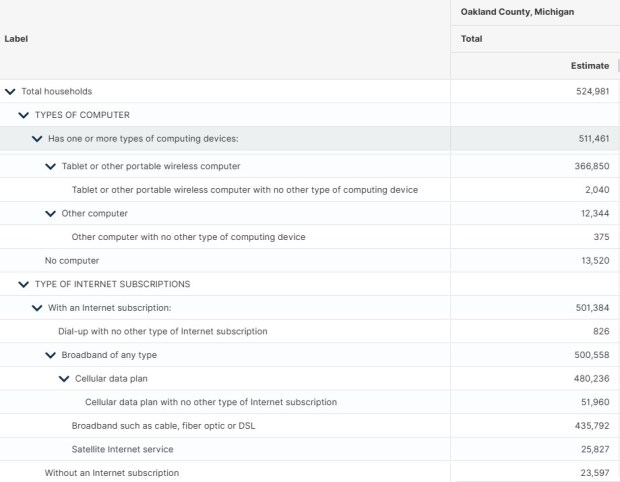 This US Census Bureau chart shows a breakdown of those with and without internet, broadband and cellular service in Oakland County.
file photo
“The ACP was a program that came out of the pandemic and the FCC was granted around $20 billion and they were providing subsidies to low-income households for internet service because we needed it during the pandemic,” Frederick said.
“It was probably one of the most successful broadband affordability tools that’s ever been implemented, but it only lasted two years before the money ran out and Congress didn’t act to re-up the program,” he said. “It was a big blow when that program went away.”
Jeremy Sheets, president of CMS Internet, an internet provider based in Mt. Pleasant said affordability is likely one explanation for why some Oakland County residents remain without traditional home internet despite the county’s extensive broadband coverage.
“I would think that of all the counties in Michigan, Oakland would be at the very bottom as far as non-availability,” Sheets said. “If there are that many people in Oakland County that don’t have internet, it’s either: A, they don’t want it, or they’re just using their cell phones; or B, perhaps the lower income and it’s an affordability issue.”
Sheets said his company’s base plan costs $59.95 a month for 300 megabit fiber service. Under the ACP, eligible customers could have seen that cost cut roughly in half.
“We’ve got about 12,000 subscribers, but I bet you at the peak, we probably had 400 subscribers on the ACP,” Sheets said.
He initially worried the end of the subsidy would cause hundreds of customers to cancel.
“I was pretty concerned when that program stopped that we were going to lose 350 of them,” he said. “And honestly, we didn’t lose hardly any at all; maybe a handful.
The numbers surrounding Michigan’s internet divide can be difficult to reconcile.
A county can report nearly complete broadband coverage while thousands of households have no subscription. A student can technically have internet access through a cellphone, but still lack the bandwidth, device or reliability needed to complete schoolwork effectively.
And a household can have broadband available on their street, but still be unable to afford the monthly bill.
That is why Frederick said Michigan’s ultimate goal cannot simply be to say that broadband infrastructure reaches every address, he said it must be a state where residents can afford and effectively use the technology that reaches them.
“Not having it because it’s not affordable is definitely the biggest issue once the infrastructure’s there,” Frederick said.