
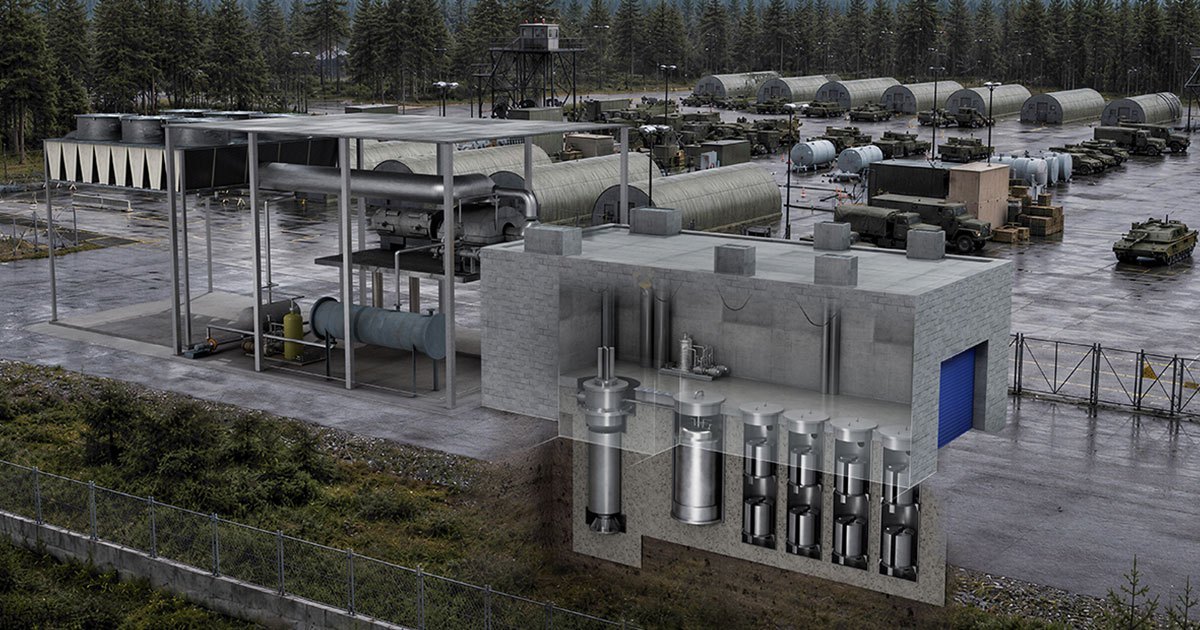
To secure a reliable source of energy in the event of the power grid going down, the U.S. Army is turning to nuclear microreactors to help provide constant, uninterruptible electricity to its military installations.
And a division of San Diego-based defense contractor and long-time nuclear innovator General Atomics has been selected as one of the companies to help make the ambition a reality.
General Atomics Electromagnetic Systems was recently tapped as one of five initial vendors for the Janus Program — the Army’s $2.2 billion effort to deploy commercial microreactors within the next two years.
“The Janus Program is about transitioning from designs and experiments to reliable commercial hardware, which secures our energy independence,” Jeff Waksman, principal deputy assistant secretary of the Army for Installations, Energy and Environment, said in a statement.
The company will deploy its General Atomics Tactical Energy System, or GA-TES, to Fort Hood — a major Army post near Killeen, Texas.
GA-TES is a liquid-cooled microreactor with a baseline net output of about 5 megawatts of electricity that is architecturally scalable to about 20 megawatts. For perspective, the total load at Fort Hood is between 53 and 75 megawatts.
The modular nature of GA-TES allows the system to be transported and deployed by truck or rail and is designed for remote, off-gird and extreme environments. It has a 40-year design life.
“General Atomics draws on more than 70 years of nuclear innovation and reactor expertise to deliver microreactor technologies that provide safe, dependable and independent power for military installations,” said Scott Forney, president of General Atomics Electromagnetic Systems.
The other respective vendors and installation sites are:
Antares Nuclear Inc., at Fort Bragg in North Carolina
BWXT Advanced Technologies, at Fort Campbell in Kentucky
Radiant Industries Inc., at Fort Benning in Georgia, and
Westinghouse Government Services, at Fort Drum in New York.
Like General Atomics, Antares Nuclear and Radiant Industries are companies based in Southern California. Antares is located in Torrance and Radiant in El Segundo.
The five vendors, the Army said, will receive government funding only after they successfully hit specific technical goals. The $2.2 billion runs from fiscal years 2027 through 2031.
Army officials plan to announce additional military sites and contractors at a later date and want to have at least one microreactor up and running by Sept. 30, 2028.
The prototype reactors will be owned and operated by each contractor, while the Army will provide technical oversight and regulatory support.
Launched last year, the Janus Program seeks to provide bases with reliable 24/7 power at a time of heightened concerns about the grid’s ability to respond to cyberattacks, extreme weather and anticipated growth in electricity demand from artificial intelligence.
“We have to be able to meet the Army’s mission if there are any vulnerabilities in the grid,” Brandon Cockrell, deputy assistant secretary of the Army for Energy and Sustainability, said on Aug. 26 when the vendors were announced.
Microreactors are much smaller than traditional nuclear facilities, such as the Diablo Canyon Power Plant near San Luis Obispo that by itself accounts for about 9% California’s generation.
By contrast, the compact microreactors envisioned by Army officials expect to take up fewer than five acres of land. They include safety features such as the ability to automatically shut down in the event of emergencies and require no manual operator action or external backup power.
The Janus Program is part of an executive order issued last year by President Donald Trump to “usher in a nuclear renaissance and expand America’s Energy Dominance agenda.”
The Army says spent nuclear fuel, or waste, from the reactors will not be stored permanently on post. The material will eventually be transported to U.S. Department of Energy or national laboratory facilities for long-term storage or recycling.
The reactors will be licensed by the Army, rather than the U.S. Nuclear Regulatory Commission.
That, and concerns about the costs and potential risks of the project, drew criticism from Alan J. Kuperman, associate professor at the LBJ School of Public Affairs at the University of Texas and coordinator of the Nuclear Proliferation Prevention Project.
Kuperman told The Associated Press that the project is “a dangerous scam on many levels” that is using the military’s “deep pockets to provide a hidden subsidy” to nuclear power companies. No microreactors currently supply power to the commercial electric grid in the U.S.
For now, the Army uses diesel as a backup energy source for its critical infrastructure. But in a conflict, Waksman told reporters on a conference call last month, it may not be able to access fossil fuels wherever they are needed.
“That makes nuclear energy just a natural game changer,” Waksman said, according to AP. “It makes sense for the Army to take the lead here.”