
A century ago, on Sept. 15, 1926, the Berkeley Daily Gazette published an editorial about the prospects for a Civic Center block in downtown Berkeley.
“Some day — no one can say when — the city of Berkeley will purchase for a civic center the property bounded by Grove, Center, Milvia and Allston Way,” the paper editorialized. “It may not be this year or for five years hence, but it is inevitable and the longer it is put off the more we will pay for the land and the greater the cost of its development.
“For many years now and during the regimes of half a dozen administrations under at least two forms of local government, this property has been considered for civic center purposes. … The land is virtually being held in status quo (by private property owners) for eventual purchase by the city.”
The editorial went on to support purchasing the land by “a direct tax of ten cents over three years” without using bonds. The day before, the City Council had unanimously voted to put such a tax on the Nov. 2, 1926, general election ballot.
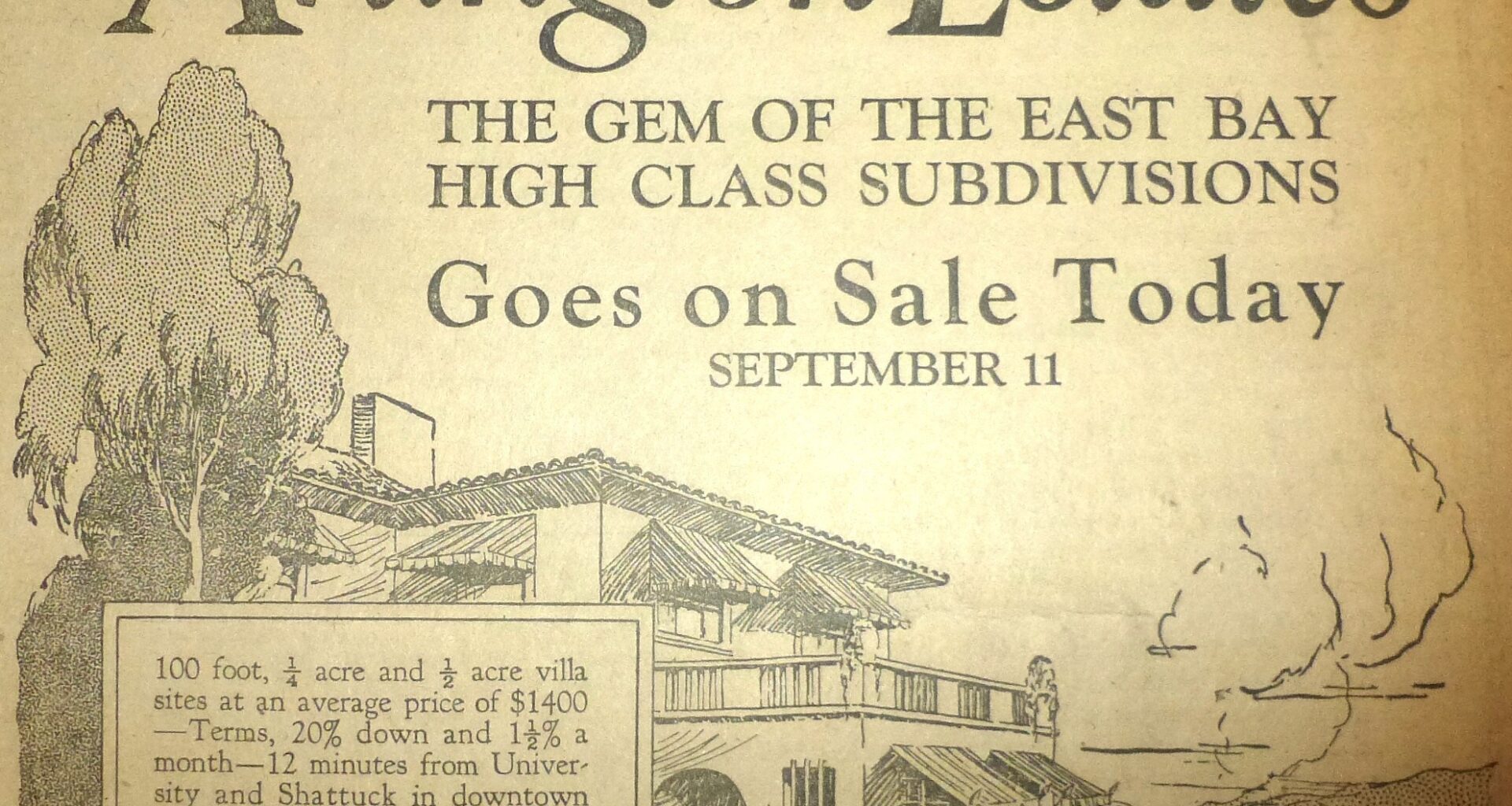
New subdivision: A century ago this week, on Sept. 11, 1926, the new real estate subdivision that I mentioned last week in this column formally opened for purchase.
This was the “Arlington Estates” property in what was then the extreme north of Berkeley’s developed area. Buyers in search of a lot on which to build a home were invited to visit.
“The growth of Berkeley towards Arlington Estates is insured by the natural barriers formed by the hills, Oakland and the bay on the other three sides” publicity material advised. An “average price” for one of the lots was $1,400, and terms of 20% down and 1.5% a month were offered.
Developer George Friend “states that he has personally supervised the division of the property into 100 foot, ¼-acre, and ½-acre villa sites, so arranged that each builder may have the maximum benefit of the view and of the trees and rocks which Nature has taken so many years to provide.”
Romantic problems: “Night riders” were in Berkeley, the Gazette warned on Sept. 13, 1926. These were young couples who drove recklessly, were often intoxicated and got into accidents and other trouble.
“Every night, the outlying hillside streets (of Berkeley) are decorated with the cars of ‘petting parties’ ” (young couples who drove up into the undeveloped hills to make out).
“A great many good people would like to find a solution of this new problem of public morals” the paper noted, adding that preventing people from parking and making out in their cars on city streets then simply moved the problem to country lanes. It also created hazards, as some serious accidents involving reckless drivers had occurred.
Parks: On Sept. 13, 1926, T.M. Grabow, Berkeley’s superintendent of parks, resigned saying that “the appointment (job) in this city offers no future from the viewpoint of a park executive. The lack of any definitive policy for the acquisition of additional sites for parks and the deplorable small existing park acreage in Berkeley offers no inducement to continue” in the job, he wrote in his letter of resignation.
Grabow had held the position since December 1924 with a salary of $260 per month.
More stopping: In mid-September 1926, city staff were proposing that the Berkeley City Council designate four new “boulevard” streets in Berkeley, allowing the placement of boulevard stops — today’s red stop signs — on the adjacent cross streets. The designated streets would be College and Shattuck avenues, parts of Adeline Street and The Alameda north of Hopkins to Solano.
Bay Area native and Berkeley community historian Steven Finacom holds this column’s copyright.