

Francisco, a 52-year-old window installer, couldn’t sleep. He burst into tears during family dinners. The sight of an unfamiliar black Suburban parked near his longtime apartment in Oakland, California, sent him rushing to lock the doors and hide.
His employer threatened to report him to federal immigration authorities this spring, Francisco said, to discourage him from collaborating with state labor officials investigating a co-worker’s complaint against the business. KQED is not using Francisco’s full name or naming their employer because he lacks legal immigration status and fears retaliation.
“I was afraid,” Francisco said. “I tried to not show it to my family so they wouldn’t get nervous or upset. But inside, I was afraid. It’s traumatic.”
Supervisors threatening immigration consequences is nothing new in industries with a large noncitizen workforce and lower-wage jobs, such as construction, hospitality and in-home care. But as President Donald Trump’s administration ramps up immigration arrests to levels not seen in years, bad-faith employers are taking advantage of the political climate to exploit vulnerable workers, who are now more fearful of deportation, according to state officials and employment attorneys.
It’s hard to estimate the extent of this kind of workplace intimidation, which is generally unlawful, because relatively few people report it to labor regulators. Still, state figures point to a spike in immigration-related threats during both the first and current Trump administration.
 Construction workers rebuild a house that was destroyed in the Palisades Fire on June 25, 2026, in Pacific Palisades, California. (Mario Tama/Getty Images)
“I do believe that this is the tip of the iceberg and that there are many, many more of these immigration-related threats,” said Ruth Silver Taube, supervising attorney at the Santa Clara and San Mateo County Legal Advice Line. “These threats are designed to deter workers from coming forward. And I think they’re successful.”
Francisco, who has worked in California for 25 years, mostly in construction, said he had never before faced an Immigration and Customs Enforcement-related threat. Francisco worried his wife and two older children, who also don’t have legal status, could be detained and separated from a younger son, a U.S. citizen by birth.
The father of three became so anxious, imagining that he was being watched or followed, that his wife took him to see a psychiatrist. Francisco eventually found a different job and is seeking legal aid to figure out next steps. A spokesperson for the California Labor Commissioner’s Office, which investigates retaliation complaints, identified two open investigations against Francisco’s former employer.
Francisco knows of other construction workers getting similar threats.
“It makes me angry,” he said, adding that more construction workers he knows are facing similar rhetoric. “Unfortunately, it is the price we pay — those of us who are undocumented here.”
 Middle housing units under construction in Sacramento, California, on Oct. 7, 2025. (Tâm Vũ/KQED)
Trujillo’s team has documented dozens of reports of veiled or explicit threats this year, though most workers decline to pursue the cases or seek redress, she said.
Silver Taube believes just one of dozens of clients has been arrested and deported after reporting immigration threats and wage theft to state regulators during the first Trump term. The Labor Commissioner’s Office recovered unpaid wages for the man and ensured he received them in Mexico, she said.
The state agency also intervenes to stop retaliation from happening or continuing by promptly informing employers that they could be on the hook for up to $10,000 in penalties per violation if the allegations of immigration threats against them are corroborated.
“Counterintuitively, if [workers] speak up, there might be less of a likelihood that it’ll happen because the eyes of the government are on the employer,” said Silver Taube, who recommends workers document the perceived threat in writing, perhaps via text message or email to the same supervisor who made it, as evidence.
“The Labor Commission will prioritize the case … and call the employer to inform them about the civil and criminal penalties for threats to call ICE, which may deter the employer from acting on the threat,” she said. “But that’s part of the calculus for workers who are undocumented. Will the employer call ICE?”
For every person who speaks up about the issue, many others don’t, deciding it’s not worth the risk to complain about wage theft, unsafe conditions, harassment or other workplace issues, worker advocates and labor officials said. The dynamic has been exacerbated by the federal government’s focus on aggressive immigration enforcement, said Jaime Arteaga, a labor compliance investigator with the North Coast States Carpenters Union. Immigration authorities conducted about 100,000 arrests nationwide just over the last two months.
“Somebody might say, ‘We might get deported,’ and that shuts everything down. The workers are not going to come forward,” said Arteaga, who regularly speaks with nonunionized laborers at construction sites in San José. “It doesn’t have to be real, it can just be said, and the people are fearful. It can be a rumor.”
A spokesperson with the U.S. Department of Homeland Security, which oversees ICE, declined to comment on advocates’ concerns about a chilling effect on the reporting of labor abuses, or whether employers are actually identifying current or former employees for arrest.
“Worksite enforcement remains a cornerstone of our efforts to protect public safety, national security and economic stability while rescuing individuals who may be victims of labor trafficking or exploitation,” the DHS spokesperson said in a statement. “These operations target illegal employment networks that undermine American workers, destabilize labor markets, and threaten American communities.”
Employing noncitizens without work authorization also incentivizes “dangerous and illegal practices, including social security fraud,” the spokesperson said, because those immigrants often use stolen, fabricated or expired social security numbers to get jobs.
The U.S. Department of Labor did not immediately respond to a request for comment.
Under federal and state laws, employees have a right to minimum wage, overtime, a safe workplace and other protections, regardless of their immigration status. Punishing a worker for trying to exercise those rights is unlawful.
California lawmakers approved a bill last week that would clarify the law to explicitly say that all immigration-related threats, including preemptive ones to dissuade employees from exercising their rights, are illegal. Gov. Gavin Newsom has until Sept. 30 to sign or veto the measure.
 California Gov. Gavin Newsom speaks about his state budget proposal on May 14, 2026, in Sacramento, California. (Jeff Chiu/AP)
Yet, managers may ignore the rules. Threats can be made in the heat of the moment, and not as a well-thought-out management tool, said Paul DeCamp, who represents employers with the firm Epstein, Becker & Green in Washington, D.C.
“If a supervisor gets annoyed, perhaps because the workers are talking about unionizing or they’re complaining about working conditions, the supervisor, in an attempt to try to take control of the situation, may make a threat like this, which of course is illegal,” said DeCamp, a former administrator of the wage and hour division at the U.S. Department of Labor. “But the supervisor may not understand that or may think that the workers would be afraid to do anything about the threat.”
California Labor Commissioner Lilia Garcia-Brower said her agency anticipated that Trump’s efforts to deport millions of immigrants would have a chilling effect on undocumented and other noncitizen workers. The labor commissioner has expanded its education and outreach efforts, including by partnering closely with advocacy organizations and community leaders who have workers’ trust. An estimated 1.5 million undocumented immigrants make up less than 10% of the state’s workforce.
“We do not collaborate with the federal government. We do not ask about immigration status. We don’t ask for Social Security numbers. And it is safe for them to proceed in cooperating with us,” Garcia-Brower said. “I don’t need a statistic to reiterate that there is a significant amount of fear in the community. What I want to make sure that I am continuously communicating: worker protections.”
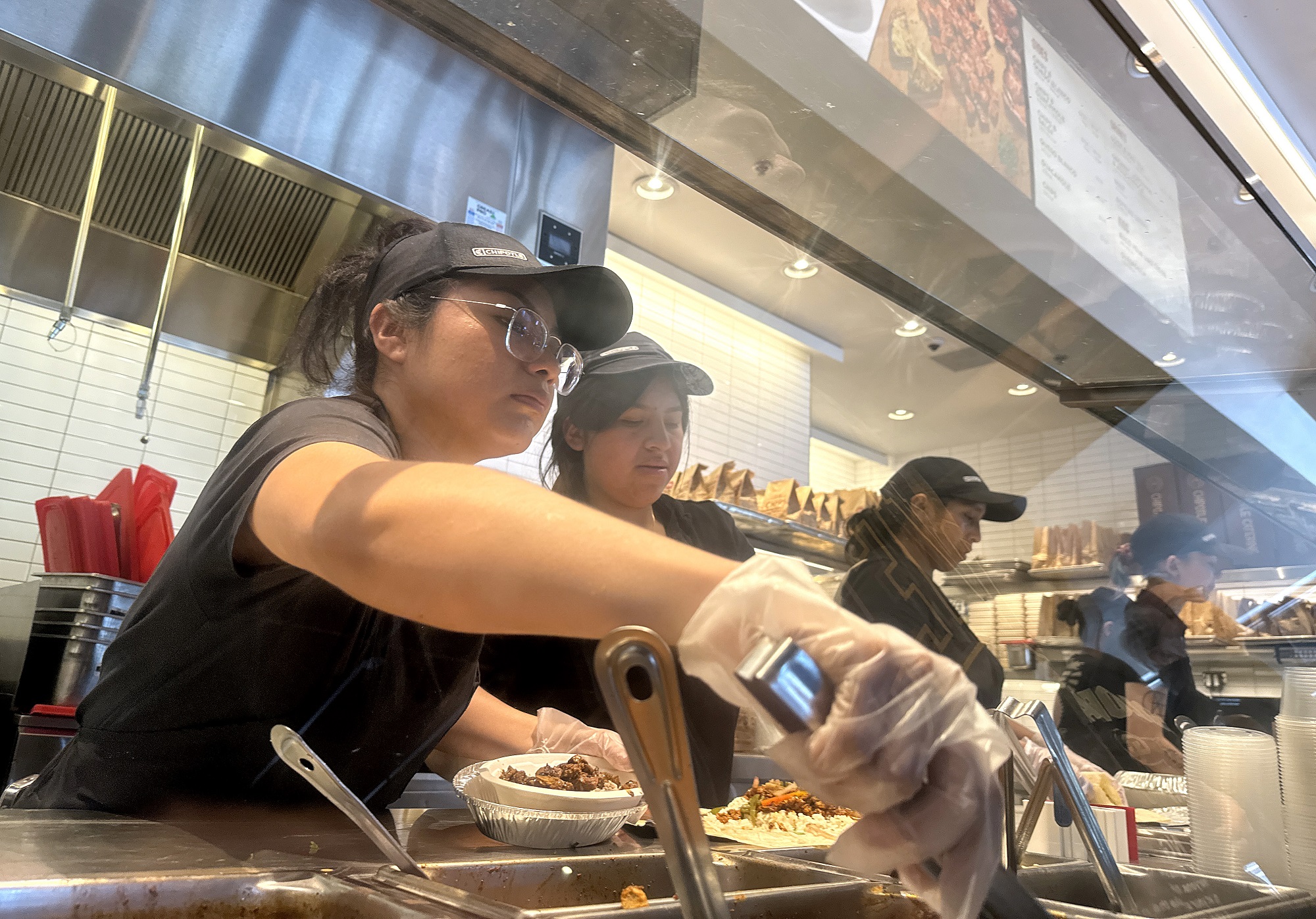 Workers fill food orders at a Chipotle restaurant on April 1, 2024, in San Rafael, California. (Justin Sullivan/Getty Images)
Edith, a fast food worker in the San José area, said she decided to come forward with a complaint because she is desperate for relief. Her manager has discriminated against her and other older employees, unfairly cutting their work hours, she said. Edith said that when she asked the manager about it last summer, they replied that anyone complaining about their schedule would be reported to ICE.
Edith stopped asking questions, even after her work hours were slashed again. KQED is not using Edith’s full name or naming her employer because she fears losing her job.
“We didn’t know that was illegal — what she told us. I was afraid of going to work. But I have to work because I need to,” the 56-year-old said in Spanish. “It has been, and still is, a huge deal. It is something very difficult.”
She had never been threatened with deportation in the 35 years she’s worked in the state cleaning homes and in restaurants, she said. Eventually, Edith and co-workers sought advice from the California Fast Food Workers Union.
By then, the manager had also told employees that they should “hide in the garbage” or “jump out of the window” if ICE agents came to the workplace, according to two age-discrimination complaints against the business with the California Civil Rights Department that were reviewed by KQED. The department also investigates immigration threats.
“You have to do something,” said Edith, referring to her complaint, which she hopes will lead the restaurant owners to ensure employees are treated fairly. “We do have rights, and we shouldn’t be treated this way.”