
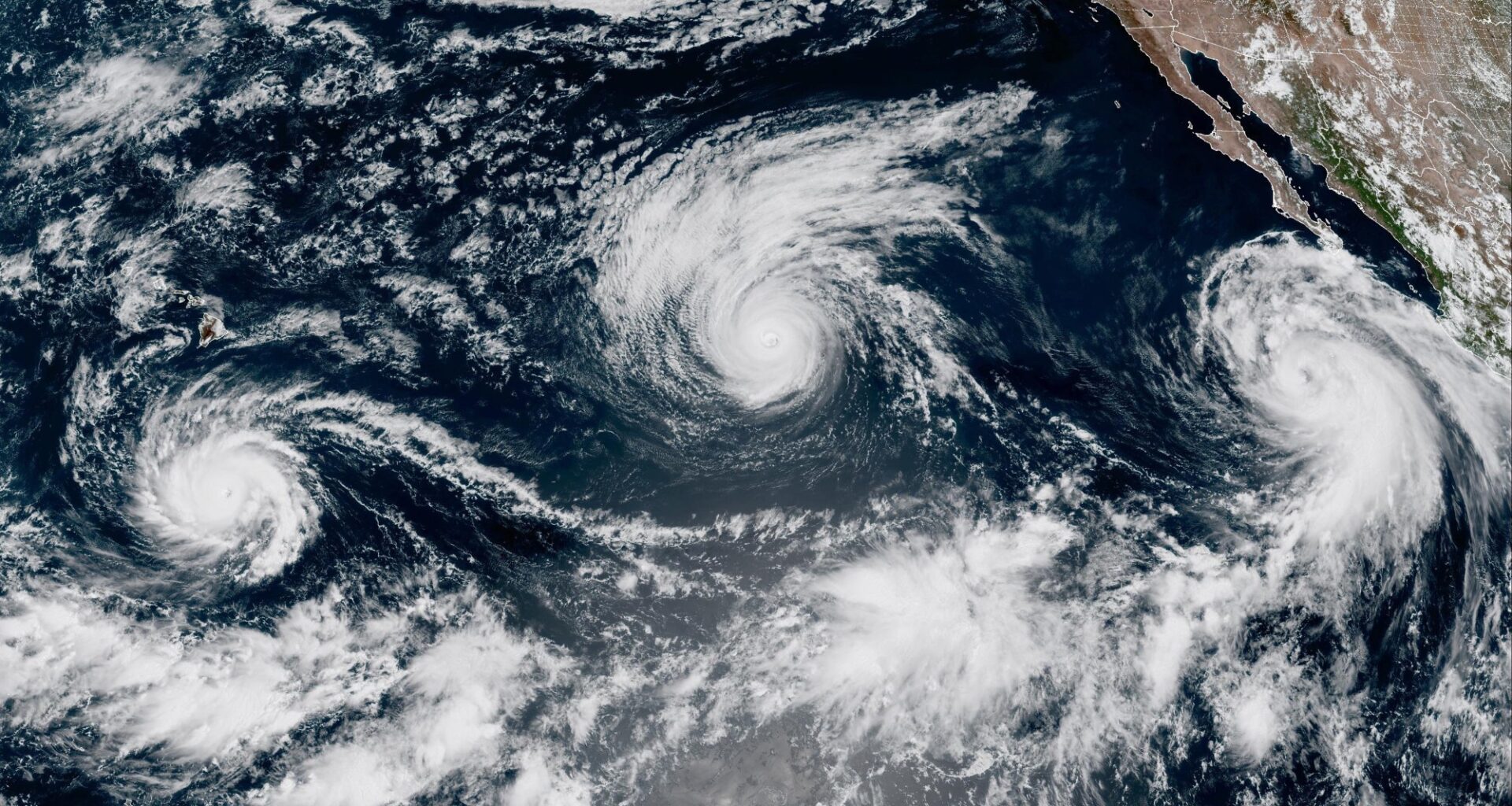
The remnants of Hurricane Marie walloped San Diego County on Tuesday afternoon, sparking majestic thunderstorms in the mountains, wild winds from Oceanside to Alpine, and another day of sizzling temperatures that made people wilt.
“There’s lots of moisture in the air, and it is making the wind blow all over the place,” said Paul Steward, a forecaster at the National Weather Service.
The wind gusted to 59 mph along Interstate 8, east of Alpine, and 29 mph in Oceanside, near Interstate 5. Lightning lit up the sky in many places, notably near Ramona.
Steward said daytime high temperatures reached 106 in the San Pasqual Valley near Julian, 105 in eastern Camp Pendleton, 102 in Ramona and El Cajon, 98 at Marine Corps Air Station Miramar, 97 in Vista, 95 in Oceanside, and 93 at San Diego International Airport.
Marie, which has been downgraded to a post-tropical cyclone, has mostly faded away far out to sea. But its bits and pieces have the county under an extreme heat warning that won’t expire until Wednesday night. A lower-level heat advisory will remain in effect for an additional day, the weather service says.
With the start of autumn less than three weeks away, the region is in need of relief.
Since June 1, San Diego has experienced only 14 days in which the daytime high temperature was below average. The heat was especially bad on Sunday and Monday, when the temperature hit 95 degrees at San Diego International Airport — 17 degrees above normal.
The prolonged heat and humidity have elevated the risk of wildfires countywide. The public will learn on Thursday whether these conditions are broadly causing the region to slip into drought. That’s when the federal government and the University of Nebraska update the U.S. Drought Monitor website.
Thursday is also the day that NOAA will announce whether the powerful El Niño that’s been emerging in the equatorial Pacific will become stronger than originally expected. Scientists say the El Niño has made hurricane season stronger than normal in the eastern Pacific. The storms have included Hurricane Marie, which produced oppressive heat in San Diego County over Labor Day weekend.
The county is nearing the end of the water year, which begins each year on Oct. 1 and ends on Sept. 30 of the following year. Forecasters use this unusual timeframe to fully capture California’s dry and wet periods without splitting the season in half.
San Diego International Airport has recorded 10.09 inches of precipitation during the current season, which is 0.40 inches below normal. The airport recorded only a trace of rain over the holiday weekend. Scattered showers were reported Tuesday along Interstate 8, east of Descanso.