
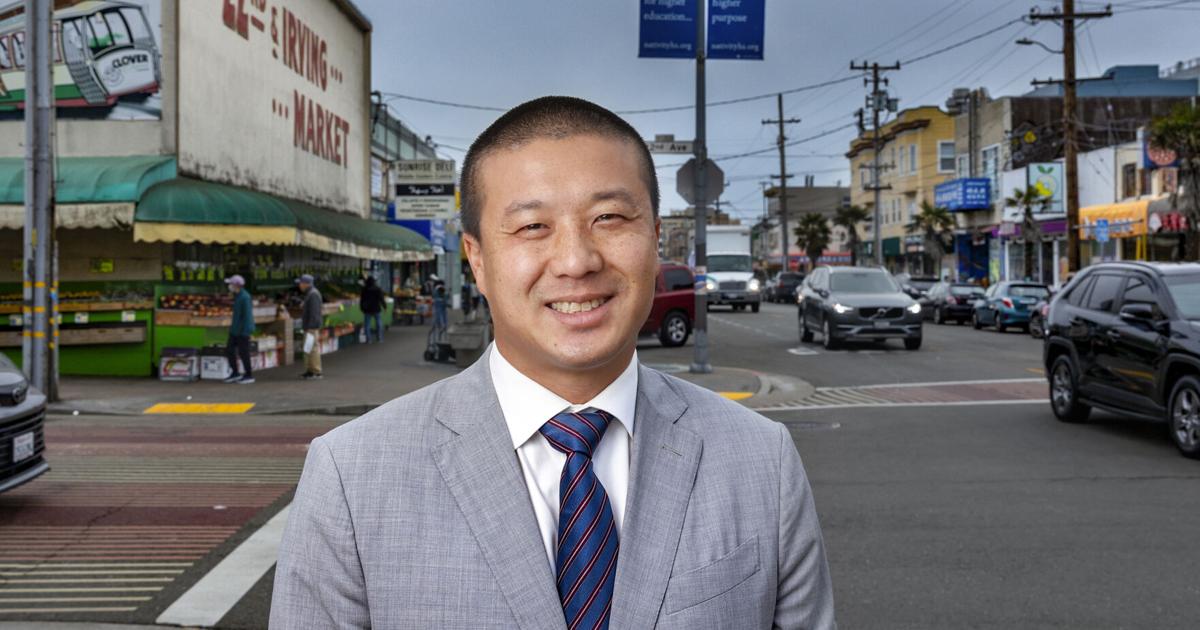
Residents of the Pine Lake Park neighborhood in western San Francisco were unpleasantly surprised when a no-left-turn sign suddenly appeared at the busy intersection of 34th Avenue and Sloat Boulevard.
That’s when District 4 Supervisor Alan Wong — who represents most of the Sunset and Parkside neighborhoods — said he hit the gas.
Within a short time, Wong had prevailed upon the San Francisco Municipal Transportation Agency and Caltrans — which was involved because Sloat Boulevard at that location is also part of State Route 35 — to remove the offending sign, which many residents were ignoring despite the risk of getting traffic tickets.
“This was affecting the daily lives of people trying to get to work,” said Wong, the apparent leader in the race for his seat, which will be contested in the Nov. 3 election. “The government needs to fix these everyday things that are impacting people.”
Wong cited the no-left-turn sign removal — which came after a review found there was no need for it — and the separate installation of a traffic signal that protects left turns from Lincoln Way into Golden Gate Park as two “victories” that illustrate how he has focused on constituent concerns since Dec. 1, when Mayor Daniel Lurie appointed him to fill a vacant seat on the Board of Supervisors.
“For so long, City Hall has been focused on a lot of grandiose pie-in-the-sky ideas, and I just want to bring things back to Earth and focus on the basics of governance,” he said.
He bested second-place finisher Natalie Gee, a relative progressive, who ultimately received 8,427 votes, or 35.63% of votes cast.
Wong’s win meant he could serve the rest of the term of former Supervisor Joel Engardio, who was recalled in September 2025 — largely over his support for a November 2024 ballot measure that closed two miles of Great Highway to make way for Sunset Dunes park.
Wong, a Sunset native whose parents immigrated from Hong Kong, is now running for a full four-year term. Also on the ballot are candidates who finished in third and fourth places in June, respectively: Albert Chow, a Sunset-district hardware-store owner who helped lead the effort to oust Engardio and now says he is not actively campaigning; and Jeremy Greco, a school campus coordinator running a shoestring campaign who has continued his electioneering.
With Wong’s strong electoral showing and Gee out of the race, campaign spending for the Nov. 3 election has dropped dramatically from the primary.
A similar dynamic has been evident in District 2, where Supervisor Stephen Sherrill — another Lurie-backed candidate — had an even more dominant showing in June, winning 69.25% of the vote. Sherrill, who was appointed to an empty seat by former Mayor London Breed, is also vying for a full term.
As of the end of July, Wong had raised just $33,460, while Greco had raised $1,100, according to city campaign-finance disclosure data. There were no reports of third-party spending.
By contrast, candidates for District 4 in the June election spent more than $1.1 million — and third-party groups spent more than $1.5 million — to support and oppose candidates.
Wong’s campaign alone spent about $411,000 for the primary, and Gee’s spent $409,000 — both with public financing.
In addition, SF Believes — an independent committee supporting Wong that had backing from some business figures who also supported Lurie’s 2024 bid for mayor through another committee — spent $580,000. The group GrowSF, which supported Wong, independently spent $293,800.
The union-backed Affordable SF Now committee, supporting Gee, independently spent more than $350,000.
With less than two months until election day, Wong said his priorities remain the same, including public safety, reducing homelessness, making the government more responsive to citizens, and cutting red tape.
In addition, Wong said he wants to influence certain policies of the San Francisco Unified School District — which is run by an independently elected board — such as pushing for zone-based school assignments.
Wong — who attended local public schools and was recently promoted to captain in the California Army National Guard — also sponsored a resolution that was passed by the supervisors in May that recognized “the importance” of the U.S. Army Junior Reserve Officers’ Training Corps program and encouraged the school district to ensure the program is provided to high school students and “preserved as currently constituted.”
A past president of the elected City College of San Francisco board of trustees, Wong was a champion of free tuition at the school. He was one of the supervisors who successfully advocated to protect funding for that program.
On the public-safety front, meanwhile, Wong said The City — which has seen crime numbers drop sharply — is “doing a little bit better,” but there was work to do. He cited the example of a large store at which inventory is kept behind locks, which he said is “not normal.” He also said that “open-air drug market” activity can still be found downtown.
Overall reports of crimes in The City were down just over 18% from Jan. 1 through Aug. 30 when compared with the same time for the period in the prior year, according to San Francisco Police Department statistics.
Burglaries and vehicle thefts were both down more than 23%, while robberies were down nearly 18% and rapes were down almost 13%. That followed a nearly 25% drop in overall crime in 2025.
Wong said he considers it part of his job to be a “cheerleader” for public-safety agencies, which he said have not always enjoyed adequate support.
“I think my No. 1 job in terms of public safety as the elected official is to support the work that they are doing,” he said. “If there are officers that are not doing their job, they should be held accountable. But by and large, our officers are here to protect and serve — and I’m here to support them.”
Wong said that if prospective police officers don’t feel valued, they will not come work for The City. Recruitment has been on the upswing, and Wong said he wants that to continue, with hundreds of police officers hired to bring the agency up to full staffing.

Drawbridge replacement will bring biking and pedestrian access, but not before affecting traffic congestion and public transportation service in the area
Crews will this month install drainage systems, repair pavement and fix damaged, cracked medians along over a mile of road
This week, The City will honor the Grateful Dead, host outdoor markets and festivals, and stage free opera performances in the park
Wong was a co-sponsor of legislation to approve a labor agreement with the San Francisco Police Officers Association covering the period from July 1 through June 30, 2030, that included a cumulative 14% pay increase and pay bumps reflecting the lengths of officers’ tenures.
Wong expressed strong support for law-enforcement use of technology such as drones.
“We do need to balance public safety and technology and surveillance with civil liberties, and that’s a careful balance that we need to maintain,” Wong said. “And I think that we have a lot of protections — a lot more protections in San Francisco than other other cities.”
Some have objected to The City’s use of surveillance technologies, saying among other things that they violate people’s privacy rights, but Wong said supporting police use of technology is “practical and responsible.”
Other positions Wong characterized similarly included his second-day-in-office vote in favor of Lurie’s Family Zoning plan, which increased allowable densities in parts of The City, particularly in northern and western neighborhoods.
Doing so was “practical and responsible” given the threats of state sanctions if the plan was not adopted quickly, Wong said.
He emphasized that San Francisco faced a Jan. 31 state deadline to adopt a plan for 82,069 new housing units by 2031, with the penalty for missing potentially being the “builder’s remedy” — under which projects could be approved by meeting basic standards — as well as the potential loss of more than $100 million per year in state funding.
In the same vein, Wong cited his vote in favor of an ordinance lowering The City’s inclusionary-housing requirements, which require developers of projects above a certain size to build below-market-rate housing units — either as part of a project or at a separate site — or else pay fees.
“You can’t have an exorbitant fee but have no housing built,” Wong said. “That’s one of those pie-in-the-sky ideas that is not practical.”
This month, supervisors gave initial approval to a controversial ordinance sponsored by Wong and Lurie that would allow developers of certain projects to pay fees in lieu of planting sidewalk trees.
Among other things, the ordinance exempted accessory dwelling units from tree-planting requirements — something advocates said could make it easier for small-property owners to add housing units to the local supply.
With tongue in cheek but serious intent, Wong launched a “dumb laws” contest in March that generated more than 200 nominations for laws and regulations that could merit changing.
The winning submission concerned a city rule that generally said habitable rooms must have a ceiling height of 7 feet, 6 inches, while state law requires 7 feet.
Wong is currently sponsoring legislation to bring The City standard in line with the state’s, a move he said could add to The City’s housing stock by making it easier for homeowners to legalize unauthorized living spaces.
Wong also sponsored an ordinance — which the mayor has already signed — that got rid of a health-code provision that prohibited the transporting of bread in open baskets or containers on city streets, as well as a prohibition on selling unsterilized rags and other types of cloth to be used for cleaning in industrial places of employment, or operating a laundry for sterilizing such rags, without a permit.
Greco, who said one of his top goals is to improve elder care in The City, said he and Wong “are completely different in every single way with our positions.”
He criticized the ordinance allowing fee payments instead of planting street trees in certain conditions, for example, and said he wants to keep Sunset Dunes closed to vehicles.
Greco received 1,976 votes in the first round of vote counting before being knocked out after the second round.
Though he acknowledged that Wong “did dominate” the June primary, Greco said he was surprised at how well he himself did. He said he sees a possible route to victory given that Wong only got 11,647 votes in the first round of counting out of 25,275 votes tabulated.
Regarding Great Highway — which Wong called “the most commonly brought up issue in the neighborhood” — Wong says he believes allowing vehicles back on the road on weekdays is the right thing to do, in part to alleviate the effects on commuters.
If citywide voters reject Praffop. G, however, Wong said it will “be hard to justify future efforts to advocate to reopen it.”
Also rooting for Prop. G is Chow, who said he decided against campaigning for supervisor after looking at the June vote totals and determining his chances of winning were slight.
Chow, whose campaign spent more than $272,500 ahead of the June election, said he could not ask people for money given his low probability of success in November. He expressed dismay at the amount of money that went to support Wong.
For the future, Chow said he hoped Wong would seek amendments to the Family Zoning plan and generally be a voice for the Sunset district at City Hall.
“If he moves the ball forward — hey, I can rally around the leader,” Chow said.
But Chow left his name on the ballot in case Wong were to make a bad move — or in case voters might deliver an unexpected verdict.
“If I win, I won’t turn it down, either,” Chow said.