
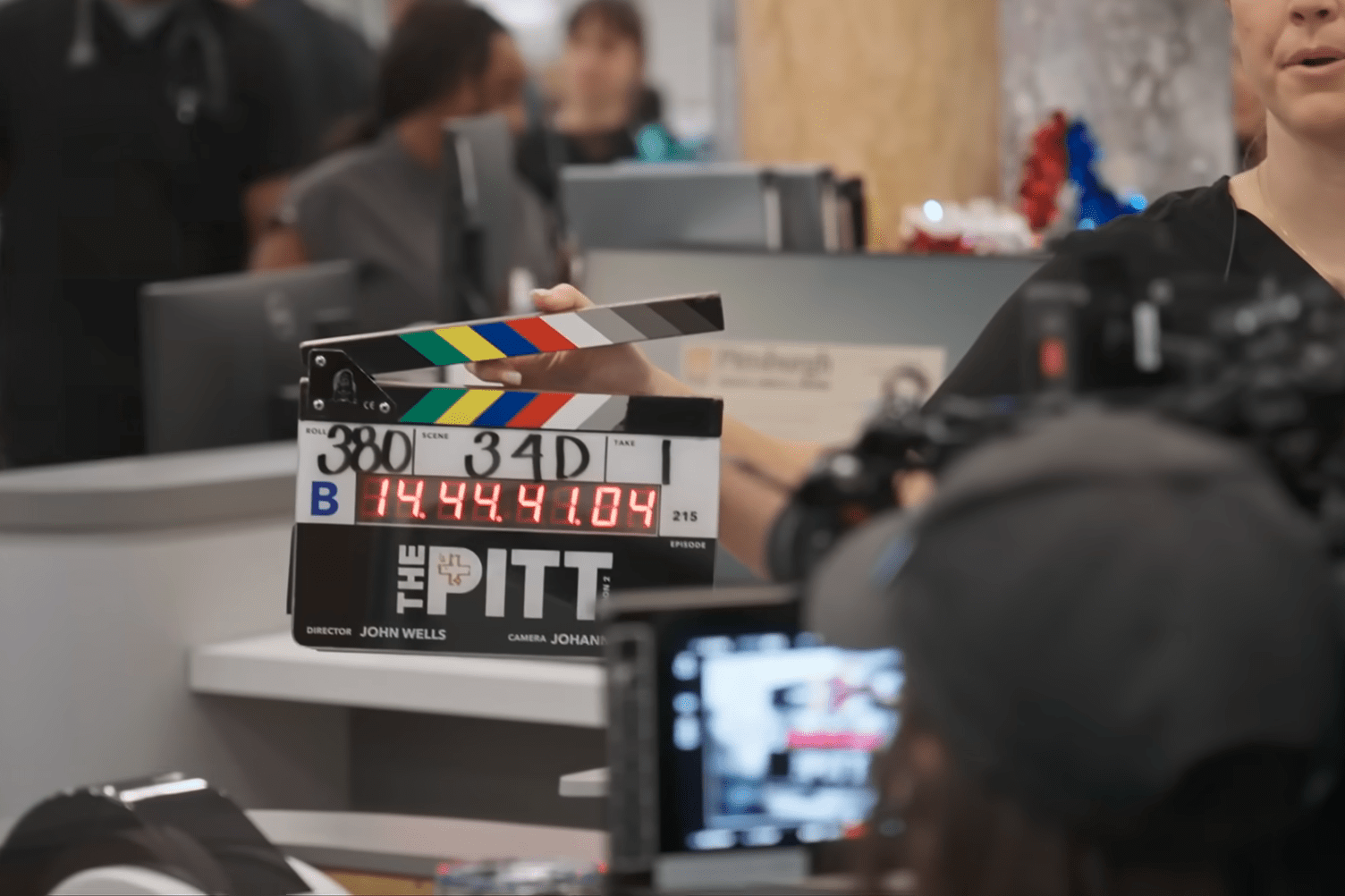
Each episode of HBO Max’s The Pitt represents one hour of a 15-hour shift at the Pittsburg Emergency Department. Its rawness, sharp-edged dialogue, and convincingly real set have made it a critical darling: The Pitt cinched five Emmys last year and has been nominated in a whopping 25 categories this year, including for Outstanding Production Design For A Narrative Contemporary Program.
Behind that design is Berkeley alum Nina Ruscio ’81, who recently joined California for an interview on Zoom.
Straight out of a meeting on set, she wore black scrubs, which all crew members wear in case they mistakenly appear on camera. On the wall behind her are layouts of the set where every episode is filmed.
Ruscio studied English at Berkeley, and, outside of class, immersed herself in the theater department. Though she is now known for creating hyper-realistic worlds for film, at Cal she constructed magical-realistic sets for the stage.
“The high level of the mind of everyone in those times at Berkeley was thrilling to be a part of. We just couldn’t stop creating,” she said. “You couldn’t resist it. Everything had value. Everything was a possible experience.”
This conversation has been edited for length and clarity.
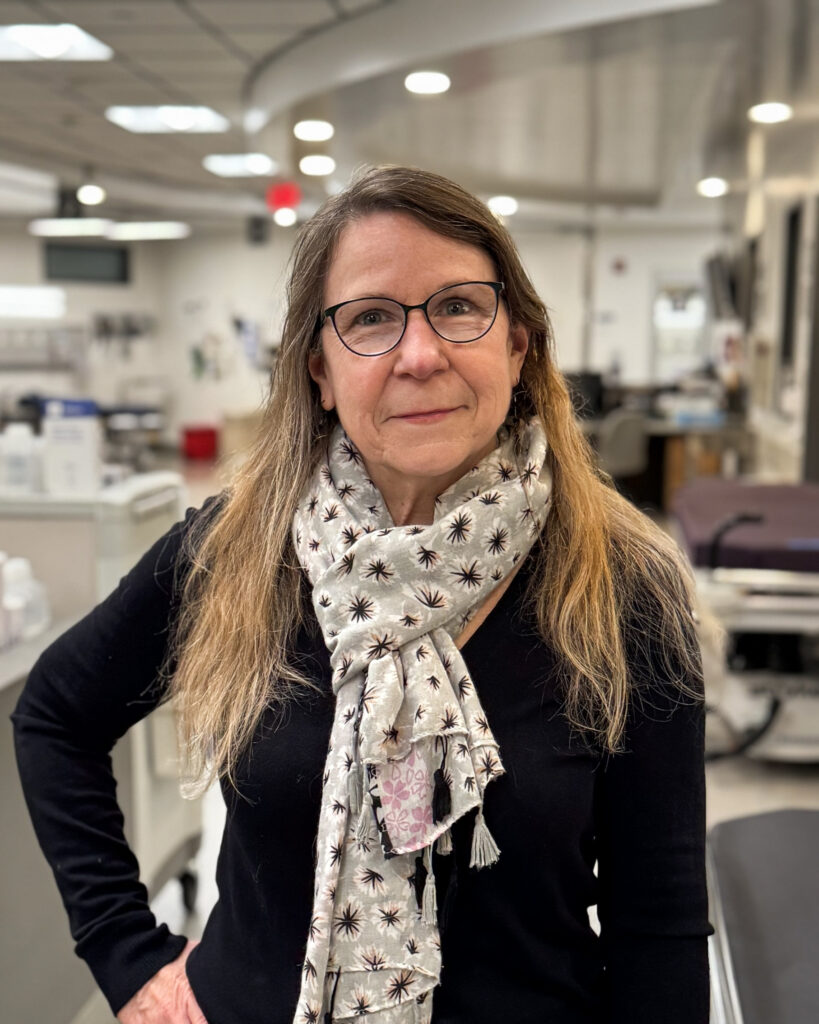 Nina Ruscio on the set of The Pitt (Johanna Coelho)
How did you start working on The Pitt?
I’ve had the pleasure and honor of working with [Director] John Wells on a lot of the productions that I’ve done in the last 15 or more years. I met him when I was working on the television show Shameless and worked on another television series with him called Animal Kingdom.
John Wells, Noah Wiley, Scott Gimmel, and Michael Histrick approached me to design the layout of the emergency department [of The Pitt] before they wrote a single word.
Run us through how a set comes to life. Do you usually start production design before a script is written?
No, it’s usually the opposite. The common way to create a show would be by looking at the written word and coming up with a design that’s based upon that intention. It was extremely prescient for the crew [of The Pitt] to realize that if they were to set multiple writers on a fictitious geography that would be individual to everyone’s minds, I would end up needing to re-engineer and re-jigger everything after it was written. Instead, John wanted to put the same geography in everyone’s minds so they were all writing to the same space.
“I wouldn’t drive to the ER that was five miles away, I would drive to the one that’s 50 miles away.”
Your research included visiting various hospitals and emergency departments. Did you have any unexpected moments on these visits?
One time, I had this very infected bee sting, so I used it as a calling card to visit as many emergency departments as I could. I wouldn’t drive to the ER that was five miles away, I would drive to one that’s 50 miles away so that I could have the experience of going through different emergency departments, because it’s a very, very different experience in each physical space.
For me, the core question is “how does this space make you feel?” How does it provide support for the story in terms of how it makes people feel? So, there is a natural sterility and triggering thing that happens when you go to these emergency departments. I wanted it to feel like everyone could take ownership of it, and everyone could take agency with it, and imagine that The Pitt’s emergency department was also in their town.
What makes The Pitt’s set different from other medical dramas?
There are a lot of tropes and traps that people get into when they’re designing hospitals. They’re overdesigned. They’re overly colored. The lighting is too good. All of these things we wanted to strip away to make the experience more universal and more tangible for people that really are in these spaces all day long. They’re blanched. The palate is very spare. It’s very sterile, the lighting is top lit. It’s very awkward and not necessarily flattering. There aren’t beautiful colors everywhere. Over-art-direction in hospital design was something that was very important for me to avoid because it wasn’t going to serve the story.
You say that The Pitt is not like a traditional set, but instead a fully immersive imitation of an emergency department. What techniques did you use to achieve that?
Because the set has a lot of doors and windows with reflective surfaces, none of those could be mirrors. You couldn’t see the camera during filming. That’s one of the reasons why the entire crew, not just the cast, wears scrubs while we’re working because if you happen to be seen on camera, you really need to look like you fit in.
“The owl is a symbol of passing from life to death, and it’s a symbol of wisdom.”
One of the things about traditional set design in film is that there’s a lot of physical supportive equipment off-camera that bounces light back up into people’s faces and brings some light in. We made the choice to have everything lit by the troffers and the cans in the ceiling, which isn’t necessarily a very full way of lighting people. So we embedded 689 lights in the set, all the way throughout, that would function like traditional grip equipment, which would bounce light back up. The selection of the coloring of the flooring was really critical. The countertop surfaces are all camera-tested to be able to reflect light back up to the face. So, there are all of the functions of traditional grip and lighting equipment, but they’re designed into the actual furnishing elements, like the pods and the workstations.
And then the architectural elements—“the architectural kisses” I call them—that are nods to a slightly more European look of the historical architecture in Pittsburgh. Not like Chicago or New York. It’s really different. The exterior that we use now is shot in Pittsburgh. I’ve incorporated columns inside of the hospital to give you the feeling that you’re in the basement and that the hospital is a hundred years old— that the main emergency department had been remodeled, and underneath that remodel was the original architecture of the physical space that wasn’t an emergency department before. If you look closely, there are these carved capitals on top of the columns. In one of the carvings, there’s this owl. And the owl is a symbol of passing from life to death, and it’s a symbol of wisdom.
You’ve described the set as having a boundless quality. How did you achieve this?
There are all these subtle techniques I’ve used, which you can see by walking through the set. The curves in the floor design and the curves in the ceiling design lead your eye to make it seem as if you could continue on and around the corner even though it would really just take you around the corner and then you could come back again. So these curves have this effect of making the set feel endless, because it is continuous motion. To reflect the emotional experience of being there—that time never stops, that there’s never an end to anything, like you’ve got to just keep on going, keep on going.
Where do you find inspiration for your work?
What I love about my job is that there’s not a minute that’s not a design inspiration for me. I mean, genuinely not a minute. I can go into the diviest gas station bathroom and be soaking up all of what I see, because when you really look at the world—whether you’re looking at the crappiest little edge of some convenience store, or you’re looking at the beautiful, Norwegian landscape, or you’re out in the desert, or you’re in an architectural masterpiece, or you’re in a crappy suburban apartment—all of these things are inspirations to me because all of it is part of the library of my mind.
What I’ve learned the most about my life is that even the ugly is beautiful.