
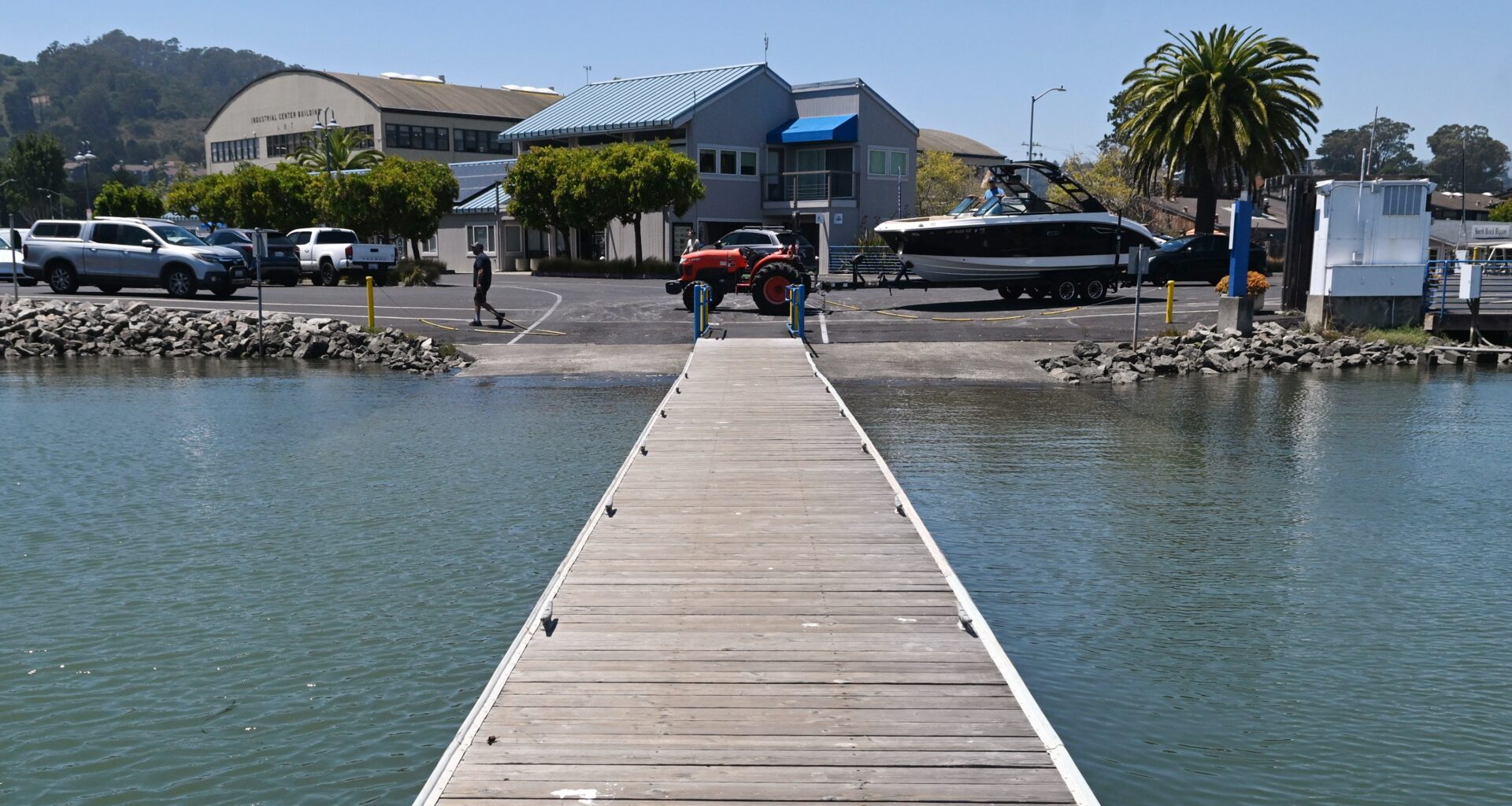
Sausalito voters will decide in the Nov. 3 election whether to ease 40-year-old development restrictions along the central shoreline and former World War II shipyard.
Measure X, the “Arts, Industrial and Maritime Preservation and Improvement Initiative,” or AIM, would rezone commercial parcels from Spinnaker Point north, including two-thirds of the Marinship area, the 210-acre former shipyard. It does not create housing sites or affect the historic downtown.
The ballot initiative was written by the community group Sausalitans for a Thriving Waterfront. Co-author Adrian Brinton is running for City Council.
Mayor Steven Woodside said the possible effects of Measure X include “two very important things.”
“The idea that there can be new levels of activity in the Marinship on land that’s currently completely vacant,” he said. “And that will help generate additional tax revenues that can be used to solve some of the significant problems in the Marinship: flooding, subsidence, blight, if you will, the underlying infrastructure.”
A 28-page analysis by city staff describes how AIM rezones two of the Marinship’s seven zones: 85 acres of waterfront lots and 59 acres of industrial parcels.
Measure X allows a greater floor area ratio, the percentage of a parcel that can be built upon. It allows building heights up to 47 feet, compared to the current 32-foot limit. Many new business types would be allowed, the staff report said, including art galleries, harbor and marine facilities, mooring facilities, community centers, libraries, museums, retail shops and temporary offices.
The changes would take effect immediately if the measure is approved. Shoreline rezoning would shift from ballot measures to the City Council.
City staff, the Planning Commission and City Council would retain project review authority, unlike large-scale housing projects that state density bonus law exempts from local control.
Measure X advocates say it will remove dated laws that block economic revitalization.
“For the first time in 40 years, Sausalito voters have a choice about whether the rules governing this part of our waterfront still make sense,” said Ray Withy, a two-time former mayor.
“There is a cost to doing nothing,” he said. “We risk losing our arts, industrial and maritime businesses. We have more than $100 million in infrastructure needs that continue to grow.”
“People can see what’s going on in the Marinship for themselves,” said Shelby Van Meter, founder of Sausalito Beautiful, a community group. “Look at the RV storage area along Marinship Way, the deteriorating buildings and underused properties. Walk Gate 5 Road at high tide and see the flooding. This is the reality.”
“Maritime trades don’t operate in isolation,” said Curtis Havel, a founding member of the Sausalito Sustainable Waterfront Association and harbormaster of Clipper Yacht Harbor. “Clipper hosts an ecosystem of maritime trades and other tenants. They support each other.”
“When more people have reasons to come to the waterfront, boatyard work goes up. More teak gets varnished, rigging replaced and engines serviced,” he said. “Those are jobs for local maritime tradespeople.”
Measure X opponents say it is excessive deregulation that will mar the city’s character.
Sophia Collier, a co-founder of Save Our Sausalito, said Measure X “is the opposite of planning.”
“It is a massive ‘one-size-fits-all’ upzoning of the most vulnerable property without any overall environmental review or development plan, while also repealing access and view protections,” she said.
“Measure X takes away zoning authority from Sausalito voters — handing that power to any three council members to make deals with developers without voter approval,” Collier said. “Voter control protects Sausalito by acting as a circuit breaker to make sure council decisions are good and have community support.”
Sandra Bushmaker, a former City Council member, said the proposal is “one of the most irresponsible initiative measures I have ever seen.”
“It authorizes up to 10 million square feet of building on our waterfront and in the commercial zones in Sausalito,” she said. “This is not the time to be tearing down our waterfront, impacting views, increasing traffic and congestion in Sausalito. We must have a better plan.”
Emmet Yeazell, an activist opposing the measure, said the rezoning “would remove the feeling” of being close to the bay.
“The waterfront, the view corridor, from a pedestrian’s standpoint or just driving, you can see and feel the waterfront as you go down Bridgeway,” he said. “Measure X would remove that feeling. You would see buildings instead of the water. You would have much denser coverage of lots.”
“Essentially, the industrial feel of Sausalito, left over from Marinship during World War II, would disappear,” Yeazell said. “That’s not entirely bad. But what it would be replaced with would be a San Jose high-rise environment and people in Sausalito would look at it and say, what the hell happened?”
Last November, voters rezoned more than a dozen parcels concentrated in the city’s north end to meet the state housing quota.
At one Marinship site across from Mollie Stone’s Market, a San Francisco developer is seeking to build nearly 300 apartments.
“We need to prioritize this impact mitigation first before a major new commercial expansion,” Collier said.
Measure X requires a simple majority to pass.