
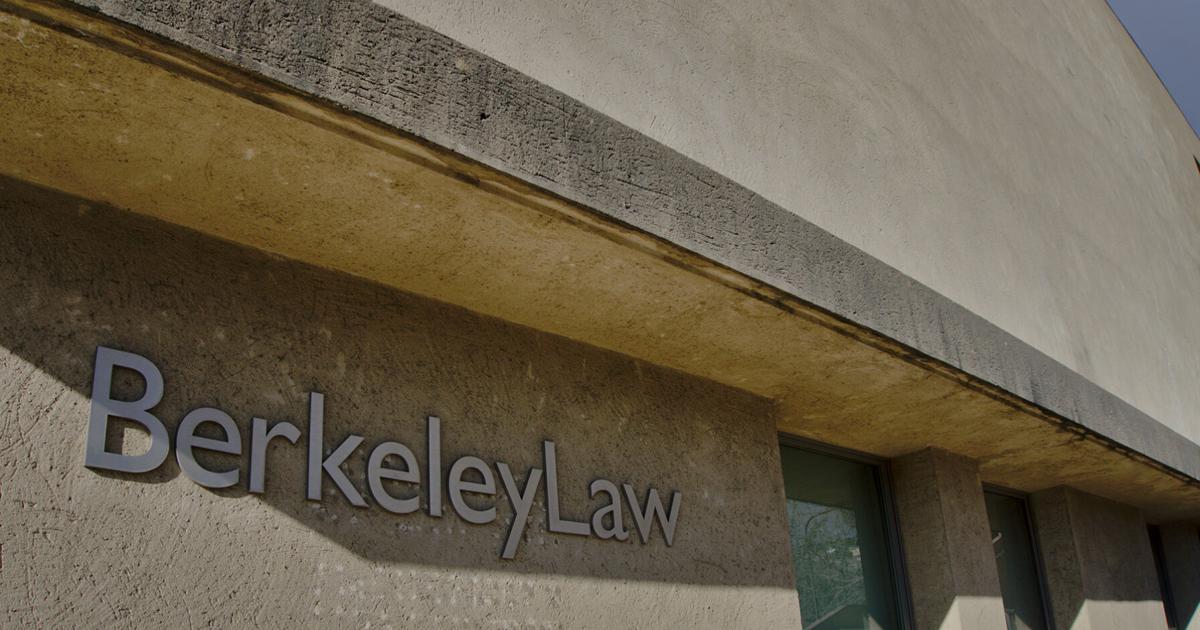
In the latest strike against college admissions practices, the U.S. Department of Justice’s Civil Rights Division and the Department of Education jointly announced today that they found UC Berkeley School of Law to have discriminated against white and Asian applicants, prioritizing Black applicants.
“The Department finds that Berkeley Law deliberately discriminated against Asian and white applicants based on race in its law school admissions,” the DOJ wrote in its findings letter. “This discrimination is apparent from the significant disparity in objective academic metrics between racially preferred applicants, and applicants from non-preferred races.”
The department said it analyzed data for applicants over the last five years and determined that admitted Black students had, on average, LSAT scores 5 points lower than admitted white and Asian students in 2025.
“In 2025, black applicants had 5.8 times higher odds of admission than comparable white applicants with similar qualifications,” the letter alleges.
The finding follows a federal investigation into multiple UC campuses’ admissions practices, which began March 27, 2025, as part of a campaign by President Donald Trump’s second administration to put pressure on institutions of higher education.
The finding letter, signed by Harmeet Dhillon, head of the DOJ’s Civil Rights Division, alleges that Berkeley Law Dean Erwin Chemerinsky knowingly encouraged the consideration of race in admissions in violation of federal civil rights law.
The letter quotes a video of Chemerinsky telling students in one of his classes that the law school may consider race and diversity in hiring, but may not express those opinions.
“Any time somebody says, you know, we should really prefer this candidate over this candidate, because this person would add to diversity — don’t say that,” Chemerinsky said in the video. “You can think it, you can vote it, but our discussions are not privileged, so don’t ever articulate that that’s what you’re doing!”
Chemerinsky denied that Berkeley Law considers race in admissions.
“Our admissions policy is clear that race is not considered in any way in admissions decisions,” he wrote in a statement to The Daily Californian. “Proposition 209, federal statutes, and the Supreme Court’s decisions do not preclude schools from pursuing diversity so long as they give no preferences based on race. Berkeley Law does not do so.”
The DOJ also alleges in the finding letter that Berkeley Law asks questions on its applications intended to collect racial information about applicants.
One question highlighted in the letter asks students to identify their race because some students “feel supported when grouped with other students with whom they share a primary identity.” Another asks applicants to write about how they will “contribute diversity in our classrooms and community.”
Many universities adopted these kinds of diversity-oriented questions for applications after the Supreme Court gutted affirmative action in 2023. Campus spokespeople did not answer a question about what the Berkeley Law application questions are intended for.
The DOJ and Department of Education have amplified their efforts in recent months to crack down on what they see as discriminatory admissions practices — particularly against white and Asian applicants — using statistics around GPAs and LSAT and MCAT scores.
Earlier this year, the DOJ also determined UCLA and UC San Diego’s medical schools to have discriminated in admissions, citing lower MCAT scores and GPAs among admitted students of color than their white peers.
Campus spokesperson Dan Mogulof pushed back on claims that UC Berkeley had not complied with civil rights law.
“UC Berkeley is committed to ensuring that every student is admitted based on their merit, and not on their race, sex, color, ethnicity, or national origin,” he wrote in an email. “UC Berkeley will spare no effort to provide ample evidence showing that the university complies with all relevant laws, policies and rules governing admissions.”
Mogulof did not directly respond to a question about how campus would respond to the findings.
As a result of the investigation, the government is seeking to enter into an agreement with the university to “ensure that admissions and oversight practices are brought into legal compliance.”