
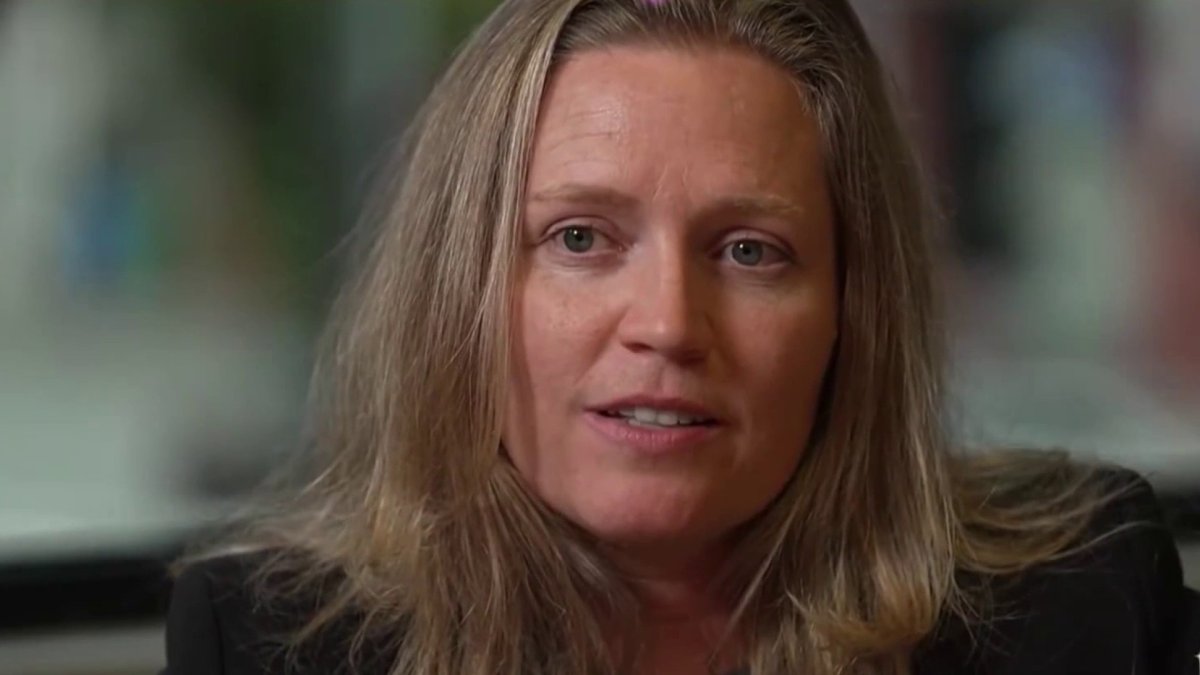
A former San Francisco immigration judge fired by the Trump administration last year filed a federal whistleblower lawsuit Thursday accusing the Department of Justice of terminating her for raising due process concerns over new policy directives and ICE enforcement tactics.
Judge Chloe Dillon is among 14 San Francisco judges fired since President Trump’s return to office and is the first of the group to sue over her removal.
Her lawsuit opens with a quote from George Orwell: “If liberty means anything at all, it means the right to tell people what they do not want to hear.”
Dillon, like dozens of other immigration judges fired since last year, was originally appointed by the Biden administration. She first took the bench in 2022 after serving for nearly a decade as a federal public defender in San Diego.
“I was really excited,” Dillon told NBC Bay Area. “I felt like it was an excellent fit for me. I felt it was something that I cared about – ensuring justice in immigration court.”
Over the next three years working as a judge at one of the country’s busiest immigration courts, Dillon said she resolved thousands of cases, earning excellent performance reviews along the way. According to Dillon’s lawsuit, her “decisions were almost never appealed.”
“It was really interesting work,” Dillon said. “I felt like it was really important that people were heard and that their cases were decided carefully and based on all the evidence.”
But Dillon said the job began to change almost immediately following President Trump’s inauguration, as new appointees took over the senior levels of the country’s immigration court system.
In the spring of 2025, Dillon’s suit alleges that San Francisco Assistant Chief Immigration Judge Loi McCleskey directed the court’s judges “to grant any and all motions to change venue” filed by ICE attorneys. That meant immigrants’ cases would be transferred out of San Francisco to another court – potentially far away from their attorneys and witnesses.
“I think my first reaction was confusion because I felt that the policy was not in accordance with what the law was,” Dillon said. “It was certainly part of a larger project to detain people and bring their cases to conclusion, likely resulting in deportation, as quickly as possible. Because these cases were being moved to detained courts and being moved to locations that were more remote.”
Dillon’s suit alleges she expressed concern over the new directive in an email to McCleskey and later met with her supervisor in person.
“ACIJ McCleskey expressed empathy with Plaintiff’s point of view but warned her that the ‘White House’ was paying attention to this and to be careful about pushing the issue further,” the lawsuit alleges.
McCleskey did not immediately respond to NBC Bay Area’s request for comment.
In one case, according to the suit, Dillon denied an ICE motion to change venue, but learned the case was transferred anyway.
Later that summer, Dillon described being alarmed by another new ICE tactic as the agency filed thousands of boilerplate motions to re-calendar cases in immigration court that had previously been administratively closed. Many of the cases had been administratively closed – essentially pausing removal proceedings – because USCIS, rather than the Immigration Court, had initial jurisdiction over the pending asylum applications.
Some of those cases involved unaccompanied minors, according to the lawsuit, and Dillon denied two government motions to reopen such cases.
“For unaccompanied minors, they have a statutory right under the law to have their asylum case decided in the first instance by the asylum office,” Dillon said.
The situation came to a head in August of last year. According to the lawsuit, ICE agents arrested a young man who came to the U.S. as an unaccompanied minor after a hearing in Dillon’s courtroom, telling the judge he would be placed in expedited removal.
“I had concerns because, first of all, people who are in that position cannot be put into expedited removal,” Dillon said.
Protestors clashed with federal agents as they took the young man from the courthouse and Dillon said she could hear the commotion from her chambers.
That afternoon, Dillon’s lawsuit alleges she emailed her supervisor warning of possible legal and due process violations, adding that courthouse ICE arrests – which had become common by then – were disrupting “the orderly administration of justice.”
Dillon said she was fired by email two days later by the acting director of the Executive Office for Immigration Review.
Dillon described being terminated as “really scary” – especially since it would leave her family of four without health insurance. But she said she has no regrets about sending the email.
“I don’t,” Dillon said. “Like, not at all. I felt that it was my duty to bring forward something that I felt was a violation of the law.”
Nearly a year after her firing, Dillon sued the DOJ, EOIR and Attorney General Todd Blanche, alleging a host of civil violations, including retaliation and violations of the Whistleblower Protection Act.
“I felt it was important for people like Judge Dillon to know that they had legal recourse and they had support,” said Melanie Proctor, Dillon’s attorney. “Federal employees have a right and a responsibility to raise suspected violations of the law to the appropriate authorities within their agencies.”
In an emailed statement, a DOJ spokesperson said the agency doesn’t usually comment on pending litigation or personnel matters but described the allegations in the lawsuit as “patently false.”
“After four years of the Biden Administration forcing Immigration Courts to implement a de facto amnesty for hundreds of thousands of aliens, this Department of Justice is restoring integrity to our immigration system,” the agency added.
San Francisco’s immigration court was officially closed earlier this month following a wave of firings and retirements involving the court’s judges. Most of the court’s cases were reassigned to the immigration court in Concord.
“I think if you go back and you look at Project 2025, that’s essentially a plan that you can see happening in real time right now,” Dillon said. “They consider the immigration courts to be sort of an obstruction to a project to detain and deport as many people as possible.”
For the immigrants with pending cases in immigration court, Dillon said the stakes are high.
“For people who are seeking asylum, it’s about making a decision as to whether they should be returned to a country that they’re saying that they face persecution and potentially even death in that country,” Dillon said. “I think that we all have an interest in seeing that those cases are heard and decided fairly because these are people that we know and that we interact with on a daily basis.”