
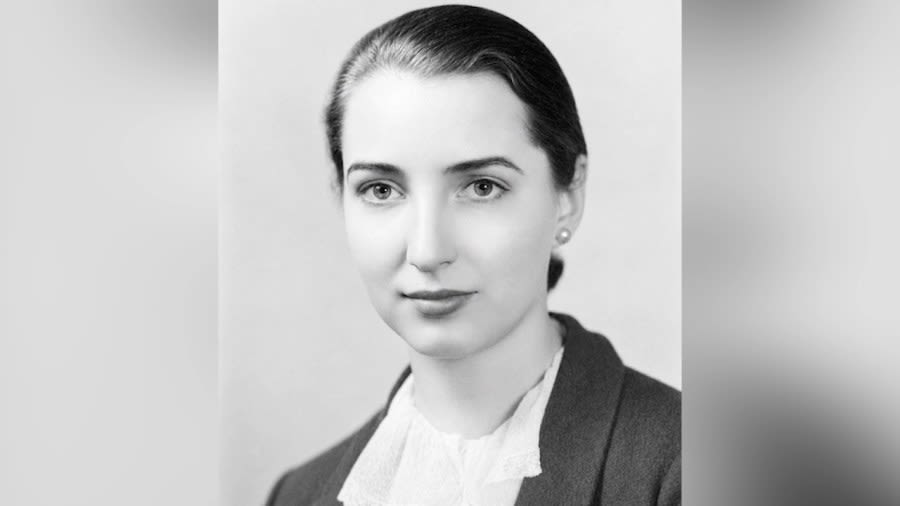
BAKERSFIELD, Calif. (KGET) – Mary Holman Dodge was the Bakersfield Police Department’s first female officer. What better time to honor her than now, the week of Sept. 12? Saturday is National Police Woman Day, an informal commemoration recognized within law enforcement.

Women haven’t come a terribly long way when it comes to staffing the nation’s police agencies. In the 135 years since the city of Chicago hired the first policewoman – Marie Owens, in 1891 – women have achieved only modest gender integration.
But their value today is virtually immeasurable. Women officers face fewer sustained allegations of excessive force, and they cost cities less in civil lawsuits, draw fewer citizen complaints, and more rarely injure suspects. Their strengths — empathy, collaboration and inclusivity.
For that reason police women’s duties have always differed significantly from that of their male counterparts. A 1933 Policewoman’s Guidebook described their work: questioning lost children, patrolling for truants and runaways, combating the distribution of “salacious literature.”
She pursued her passion for welding, and now Alisyn Palla is a sought-after artist
That was Mary Holman’s reality when she was hired in 1941, just a few months before the start of World War II. She grew up in Bakersfield and graduated from the University of California at Berkeley with a mathematics degree. She intended to pursue a career in engineering, but all the firms she contacted told her they considered engineering “a man’s profession.” So, she switched gears and entered another “man’s profession.” Police work.
First, however, she turned to a career that in the late 1930s was widely accepted as most appropriate for women. She returned to Berkeley, attained a teaching credential and landed a job in Tulare teaching math. But then, during the summer break of 1941, back home in Bakersfield, a newspaper article caught her eye. A story in the Bakersfield Californian announced that the Bakersfield Police Department was looking for a full-time policewoman. She took the civil service exam and scored 100 percent. When she was hired, it was news.
Over the next two and half decades she repeatedly proved the chief’s decision to be a wise one. Chuck Shannon, one of Mary’s step-grandsons, attended a recent ceremony at BPD headquarters honoring her.
“She was a true lady who was fearless,” he said, “and I think those two qualities made her who she was.”
Angela Juarez, one of BPD’s 59 female police officers, said she and her female colleagues stand on Holman’s shoulders.
” It’s really amazing to see the career that she built,” she said, “and the pathway she paved for us female officers.”
At first, Mary Holman was assigned to criminal cases involving juveniles, and she took her job seriously. Too seriously for her superiors, it turned out.
In 1944, she was tipped off to a situation at La Rita Rooms, a brothel at the northeast corner of 21st and L streets.
That’s exactly where the 1903 shootout with the outlaw Jim McKinney had taken place, at the Chinese Joss House, next door to what is now KGET.
Mary learned that that establishment was servicing Bakersfield high school boys who walked in wearing their “Big B” letterman sweaters.
She reported the situation to Acting Chief Robert Knight, who was running the department in the absence of Chief Robert Powers, who had joined the war effort as a special recruiter.
Mary assumed the department’s vice unit would investigate and make the arrests but Knight told Mary to handle it herself. Which she did: With the help of a uniformed officer and the “Black Maria” paddy wagon, Mary arrested not only the madam and her prostitutes but several of the high school boys, which Acting Chief Knight had not anticipated.
Alarmed by the considerable ramifications of her enthusiasm, Knight insisted on dropping charges against the boys. Mary wasn’t having it. The law is the law, she said. She had a deputy district attorney supporting her position on the matter, and she fought the chief on it. Those boys needed to learn a lesson.
A couple of months later, just before the trial’s scheduled start, the chief sent Mary to Los Angeles for a five-day FBI training course, and when she returned she learned that all charges against the teen “Johns” had been dropped.
Mary was so angry she obtained a leave of absence and enlisted in the U.S. Navy as a member of the WAVES – Women Accepted for Volunteer Emergency Service. She didn’t return until the war was over and a new chief, Horace Grayson, had come on board.
[sailthru_widget name=”Sailthru Widget Block” sailthru_list=”Daily News” title=”Daily News”]
Chief Grayson wasn’t exactly the type to take on prostitution either, though, as Mary soon learned. So she just kept her nose to the grindstone and did what she could to make this a better town.
Fact is, though, that kind of monkey business wasn’t confined to just teenage boys and houses of ill repute.
Some years later, 1956, a couple of two-bit thugs, one of them a recent parolee from Soledad Prison, tried to extort money from the wife of Morrie Chaimowitz. If the name doesn’t ring a bell, that is because he was better known as Morris Chain. He was the city’s most prominent defense attorney and founder of the law firm that today, after a series of comings and goings, is known as Chain Cohn Clark.
The two crooks advised Edith Chain they had “certain information” purporting to link her to other men. After three phone calls over two days from the blackmailers, Mrs. Chain got scared and reported the extortion attempt to Bakersfield police: The criminals wanted their money – the amount was never disclosed in the papers – in an hour.
Chief Grayson, with no time to waste, dispatched Mary to portray Mrs. Chain, whose platinum blond hair was a close match. Mary was a lieutenant by this time, but she was thrilled to get back out into the action. She slipped quietly into the Chain home through a back door, then walked out the front door to Mrs. Chain’s shiny new Cadillac and hopped in behind the wheel. As soon as she got around the corner, Lieutenant Butch Milligan, hiding in a bush, jumped in and hunkered down on the rear floorboard.
Mary drove straight to the arranged rendezvous, an empty lot at 25th and H. Mary parked at the appointed spot and waited for these two rummies to come along, with Milligan scrunched down behind her. After a few minutes, the two men, masked by colored handkerchiefs, approached the car to get their payoff. But when they got close, one spotted Milligan and shouted to the other. “It’s a set-up!” The thugs turned and ran for it. Milligan ran after them and eventually tracked them to a house a few blocks away. The cops had them cuffed within the hour. We don’t know how Mrs. Chain explained the whole thing to Mr. Chain that night at dinner, but at least it didn’t cost him any money.
In 1963, at age 50, Mary Holman married the widowed Charlie Dodge, who had risen in the BPD to the rank of Assistant Chief. Two years later, she retired after 24 years of service in the police department.
In 1966 Charlie was elected sheriff, and he served two terms. Mary Holman Dodge died in 2006 – eight months after Charlie, a month shy of her 94th birthday.
Today, women make up just 10 to 12 percent of the U.S. police force. Those numbers dwindle to a mere 3 percent when the subject is police brass – department leadership. BPD has 59 badge-carrying female officers, 12 percent of the department’s total of 474. Three of BPD’s 21 lieutenants are women – 14 percent.
Both numbers are right in keeping with the national average of 12 percent.
The Kern County Sheriff’s Department has an even higher percentage of female sworn employees – 17 percent of its 924 badges are worn by women. The first – Mary E. “May” Cronan, hired in 1912.
But the larger the department, the higher the percentage of women officers. Large U.S. cities average 12 to 18 percent female officers, and many mid-sized to large agencies have focused heavily on recruitment of women. The New York Police Department tracks around 18 to 21 percent women.
Why? Because police departments recognize that women tend to have specific skills less common in male officers.
“Communication,” Officer Juarez said, naming one such skill.
Funeral services held for Bakersfield trailblazer Irma Carson
“I think female officers have an easier time communicating with kids and other females, other women,” agreed Officer Denise Johnson.
“A lot of the time members of the community have an easier time talking to a female officer,” said Officer Angelica Rodriguez. “They feel a lot more compassion, so we definitely bring value to the community and our department.”
Said Dan Shannon, another of Holman’s grandsons: “We need more officers that are truly engaged in our community. That’s what I think we need. Female, male.”
Chief of Police Brett Stratton believes female officers’ role is crucial.
“A more traditional way of looking at that would be oftentimes the women are not as big or they’re not as strong, or they’re not as fast,” he said. “But what are you gonna do when there’s a fight? We find that our ladies that are officers oftentimes don’t have to resort to brawn and they’re able to communicate a little bit differently, and I think there’s a real value to that.”
Mary Holman Dodge would surely call that progress. She’d surely have a lot to say about a woman’s role in police work. Starting with this: all responsible young men are advised to steer clear of the corner of 21st and L streets.
Copyright 2026 Nexstar Media, Inc. All rights reserved. This material may not be published, broadcast, rewritten, or redistributed.For the latest news, weather, sports, and streaming video, head to KGET 17 News.