
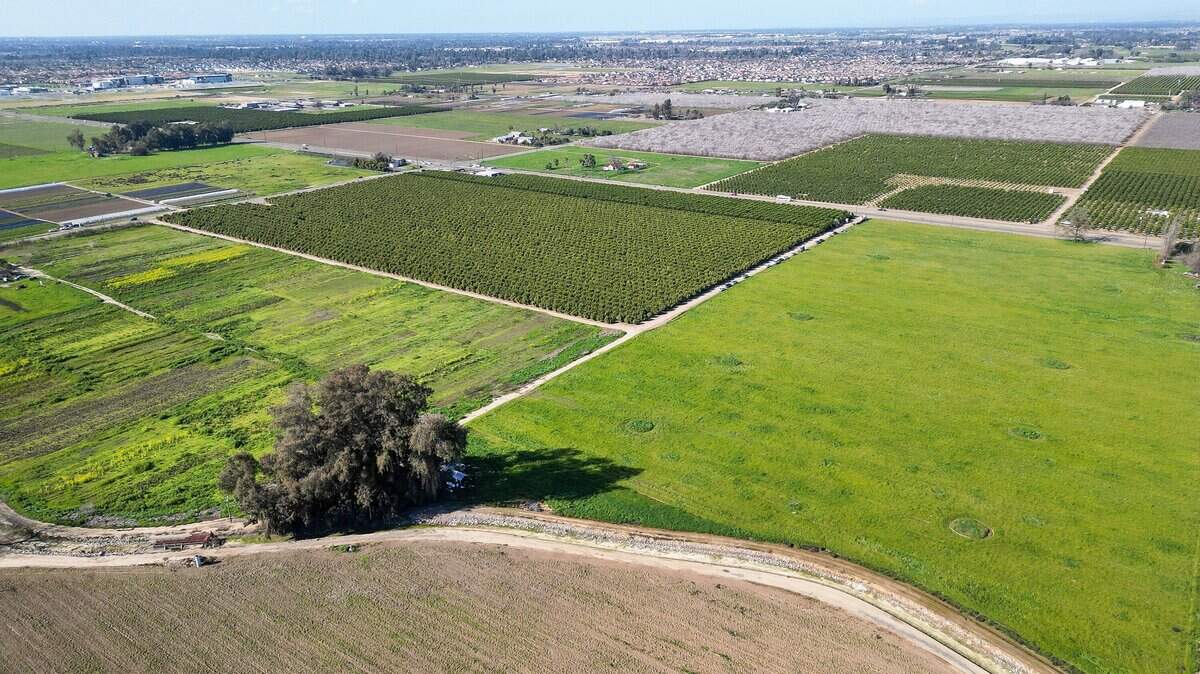
City leaders say Fresno will only be on the hook for $86 million to help get a proposed development in southeast Fresno off the ground – though many distrust the numbers.
Last Thursday, city officials unveiled new public financing and fiscal impact plans for the upfront cost of a proposed development in southeast Fresno. The hours-long Fresno City Council workshop was a first look at the numbers for the 2,000-acre project known as South SEDA. The financials come nine months after Fresno City Council requested further financial review of the controversial project in December.
And while the numbers presented by the city look “great,” in the words of Council President Nelson Esparza, critics of the plan remain unconvinced.
The Southeast Development Area is Fresno Mayor Jerry Dyer’s plan to expand the city to the south and east by annexing 9,000 acres of primarily farmland. The project could add up to 45,000 new homes to the city, according to city estimates. In response to pushback, Dyer has since shifted focus to a smaller chunk of the overall proposal that would allocate 467 acres for housing and 1,547 acres opening up south of Jensen Avenue (between Jensen and North avenues and between Minnewawa and Temperance avenues) for advanced manufacturing.
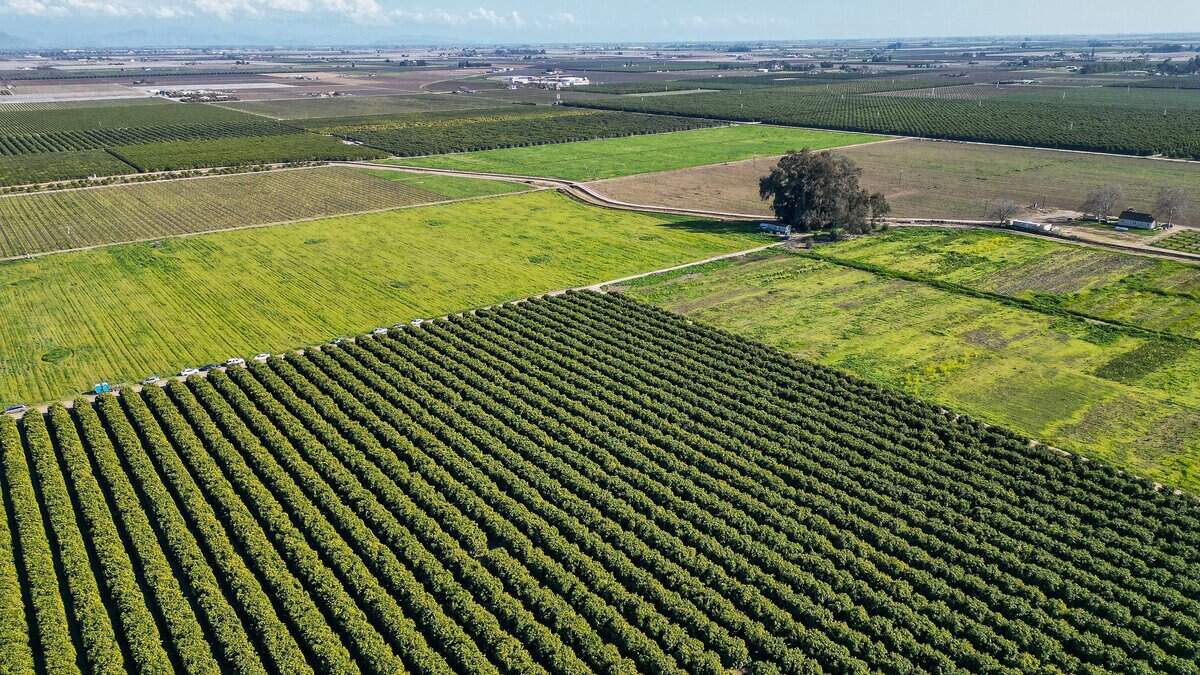 Mostly agricultural land is visible looking south from Temperance and Jensen avenues in rural Fresno County on Thursday, Feb. 12, 2026. The land is part of the Southeast Development Area, or SEDA, a 9,000-acre swath of unincorporated Fresno County land where Fresno Mayor Jerry Dyer and his administration are proposing the development of 45,000 homes. CRAIG KOHLRUSS ckohlruss@fresnobee.com
In August, the City Planning Commission voted for the second time in less than a year to recommend the controversial development to the Fresno City Council for approval.
A consultant hired by the city presented options such as land-secured bonds or bonds against enterprise funds or a public-private partnership to fund the upfront development costs for South SEDA. The report concludes that South SEDA would eventually pay for itself and would generate revenue for the city’s general fund.
Under the proposed financing plan, the sewer trunk main for South SEDA is estimated to cost the city a total of $86 million, which is the cost to build the estimated $72 million sewer line plus the financing cost. City officials say this is the only up front cost for which the city is responsible. A previous city study put the total infrastructure cost of the first phase of SEDA at $672.3 million.
“The only infrastructure that is pre-built by the city is the sewer trunk main,” Jennifer Clark, the director of planning and development, said during Thursday’s presentation.
Clark said that other infrastructure – such as streets, sidewalks, lighting, intersections – are constructed by development as development happens and will be included in an impact fee program. “It is required as development occurs; it does not need to be built prior to development,” she said.
Fresno Mayor Jerry Dyer has long-argued that the SEDA will provide good-paying manufacturing jobs and ensure Fresno doesn’t lose out on people moving to Madera or other neighboring Fresno County cities. Dyer said Thursday he was “anti-SEDA” when he was elected as mayor. But he’s open to it now that the development will start with a smaller chunk focused on advanced manufacturing and some housing, a new tax-sharing agreement with the county, a special tax for police and fire on new homes, known as CFD 18, and a proposed community benefit fund.
“When I look at all of this together, for me as a mayor of the city, I think it is a fiscally prudent to do thing to do in the future. It’s smart growth. It’s not allowing for leapfrog development,” Dyer said.
Not everyone was convinced by the financial presentation last week. Several commenters, including the proposal’s harshest critics, remain skeptical of the plan, and raised questions about the underlying assumptions in the financial analysis such as projected population growth and housing density in the planned community.
One of the project’s fiercest critics, Dillon Savory, who heads the Fresno-Madera-Tulare-Kings Central Labor Council, asked the Council Thursday to weigh the net benefit versus the harm to Fresno students and existing communities. He thinks prominent developers are those that most stand to benefit.
“Every time there’s a new restaurant or a new thing in Fresno, we all rush towards that, and then we abandon it later,” he said.
Patience Milrod, an attorney representing the CLC, is calling on the city council to send it back to the planning commission for further review.
During Thursday’s meeting, she cautioned the council not to vote to approve the entire 9,000-acre SEDA project based on financial projections for only South SEDA.
“My concern is that Southwest Fresno is still getting left out and put aside and overlooked because we’re not developing in that area like we should be,” Fresno resident Hester Hensley said.
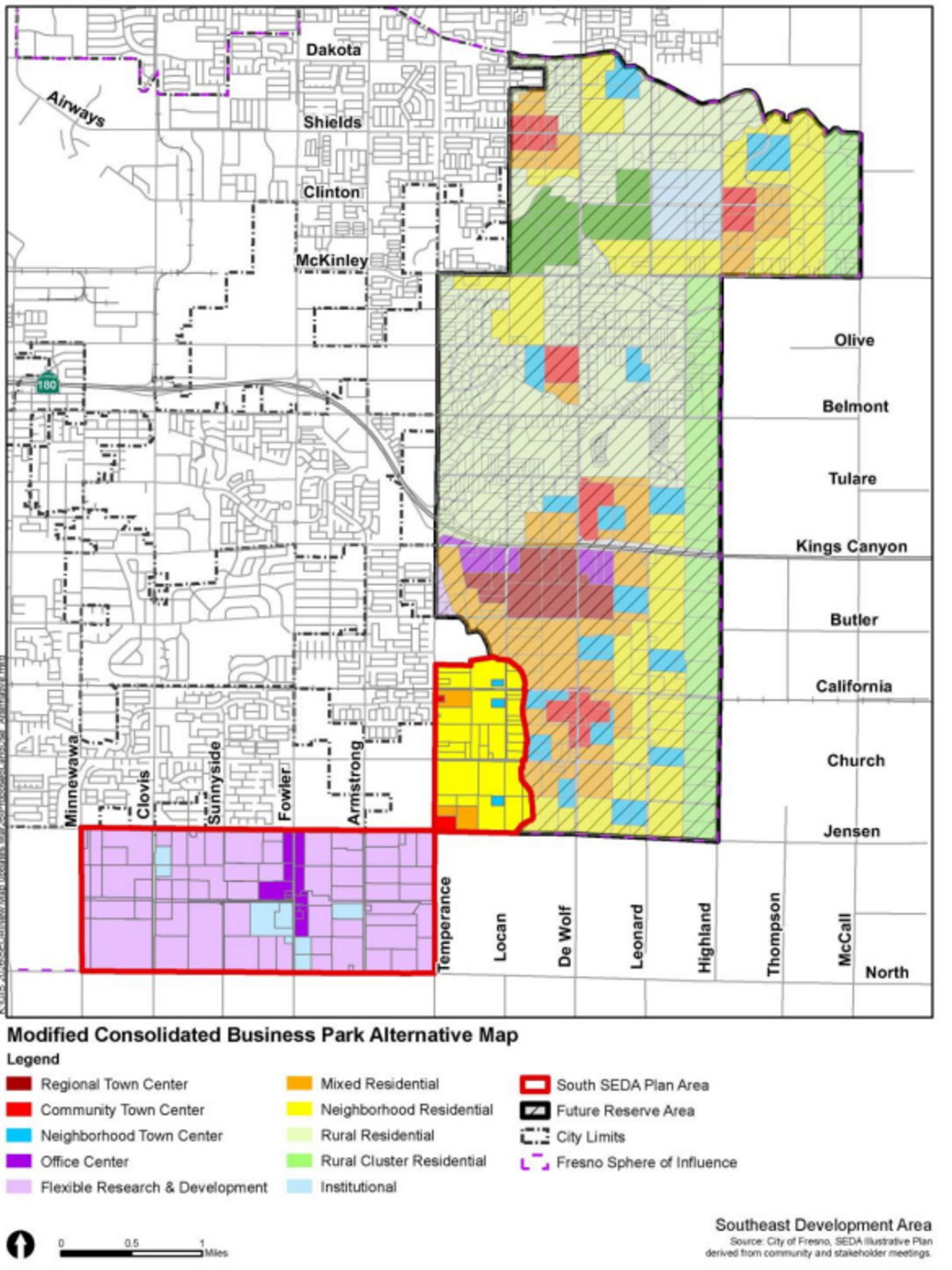 Modified consolidated business park alternative map for SEDA. City of Fresno How could Fresno finance South SEDA?
Amy Lapin, a principal with the urban economics consulting firm Economics & Planning Systems, presented a handful of public financing options for the “upfront backbone infrastructure” for South SEDA. The firm did not independently evaluate the feasibility of the proposed land uses as part of this study, the report states.
One option the firm analyzed was a bond secured by land value, such as a Mello-Roos Bond. A bond is a type of loan to a government, agency or company that is repaid with interest, according to financial services company Fidelity. Mellow-Roos bonds are typically used as a way to fund infrastructure and are payable through a special tax imposed on real property. This option isn’t feasible for South SEDA, the firm found, because it requires a three-to-one value-to-lien ratio.
“Before development occurs, South SEDA consists largely of undeveloped land with limited value, so this threshold cannot be met,” the report found.
The city could finance the upfront development for South SEDA through a revenue-secured bond, such as an enterprise revenue bond repaid from utility user rates and surcharges, Lapin said. An enterprise fund is a type of revenue source that is funded by ratepayers and is separate from the discretionary, general fund portion of the city’s budget. For example Fresno’s water and sewer systems are enterprise funds, funded by water and sewer fees from ratepayers.
Some councilmembers, such as Miguel Arias from District 3, and public commenters, including District 1 candidate Naindeep Singh, raised concerns about “skyrocketing utility bills in the middle of an affordability crisis.”
But Lapin, Clark and City Manager Georgeanne White said the city could use the utility’s $32.8 million reserve fund to make the first debt-service payments.
“The fiscal study described by Amy initially contemplates bonding and repayment from the reserves until the project is cost neutral and repays the utility reserves. It is not from rate payers,” Clark said.
The annual debt-service cost would be about $6.5 million annually, city staff said.
“That, in essence, loan would be for approximately three to six years (until the project is cost neutral),” White said.
Still, Dyer previously said the city of Fresno is planning to bring forth a plan to increase water and sewer rates sometime later this year.
The city could also explore a public-private partnership, where the private partner would fund the predevelopment costs upfront, and the city could issue a special infrastructure tax to reimburse the private partner or for other infrastructure costs depending on the specific terms of the agreement, the report said.
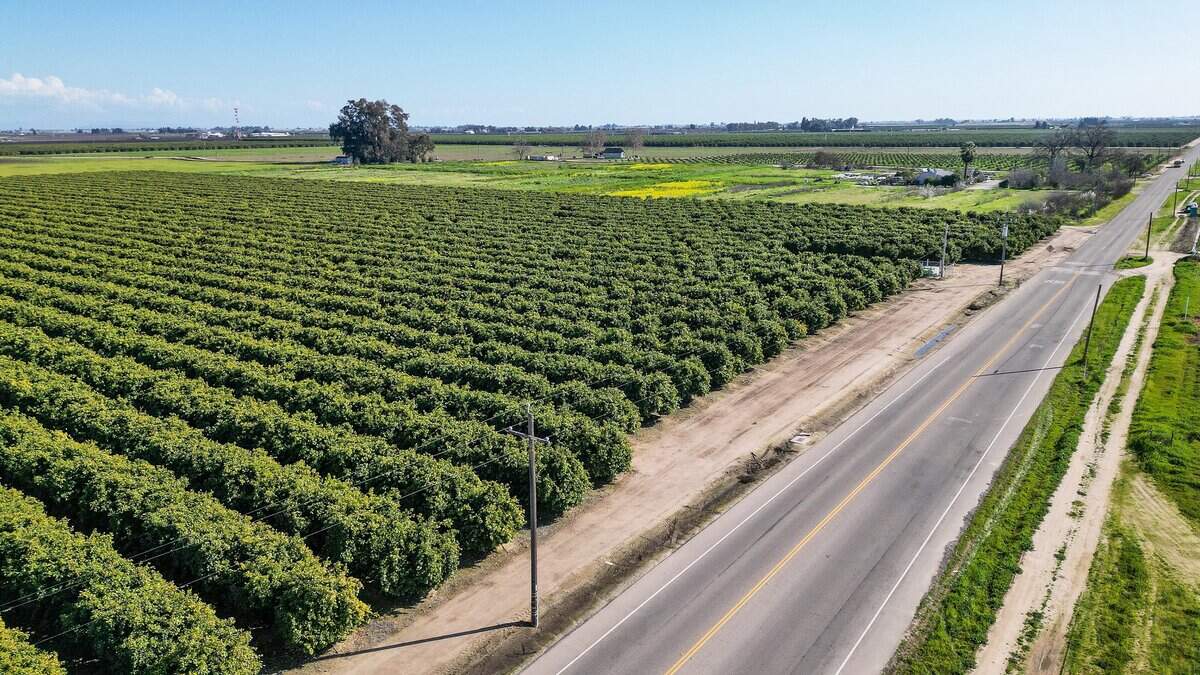 An orange orchard lines Temperance Avenue just south of Jensen southeast of Fresno on Thursday, Feb. 12, 2026. This is the northwest corner of land known as the Southeast Development Area, or SEDA, a 9,000-acre swath of unincorporated Fresno County land where Mayor Jerry Dyer and his administration are proposing the development of 45,000 homes. CRAIG KOHLRUSS ckohlruss@fresnobee.com Brandon Vang: my constituents have spoken
District 5 Councilmember Brandon Vang, whose district encompasses a large portion of southeast Fresno, including neighborhoods around Sunnyside, Roosevelt and Fancher Creek, raised concerns about the density proposed in the south SEDA financing proposal.
The South SEDA financial analysis assumes 20 single family residential units per acre across approximately 400 acres. By contrast, in 2016, the median net residential density of a typical American subdivision was 4.0 housing units per acre, according to the National Association of Home Builders.
“These numbers are mind-boggling to me,” said District 5 councilmember Brandon Vang. He said the proposal was “too big” and the impacts “too unknown for him” to support SEDA.
“The bottom line is I represent those people who live in District Five, and in this case, I’ve heard loud and clear from them, and they do not want SEDA,” he said, adding that he’s open to other ideas and financial means to move forward.
District 3 Councilmember Miguel Arias said he would continue to study the SEDA proposal, but he didn’t think it passed the “smell test.”
“Ultimately, I’m still unclear about who’s requesting that we go down this path,” he said.
The Fresno Bee
Melissa Montalvo is The Fresno Bee’s accountability reporter. Prior to this role, she covered Latino communities for The Fresno Bee as the part of the Central Valley News Collaborative. She also reported on labor, economy and poverty through newsroom partnerships between The Fresno Bee, Fresnoland and CalMatters as a Report for America Corps member.