
The Abridged version:
California is experiencing a significant increase in West Nile virus cases, with nine reported in Sacramento County since early July, including one death.
Mosquito control officials say prevention is key as warm temperatures continue, and Sacramento likely will not see a decrease until early October.
In addition to personal prevention like wearing repellent and eliminating standing water, residents can also report high activity to the Sacramento-Yolo Vector Control District.
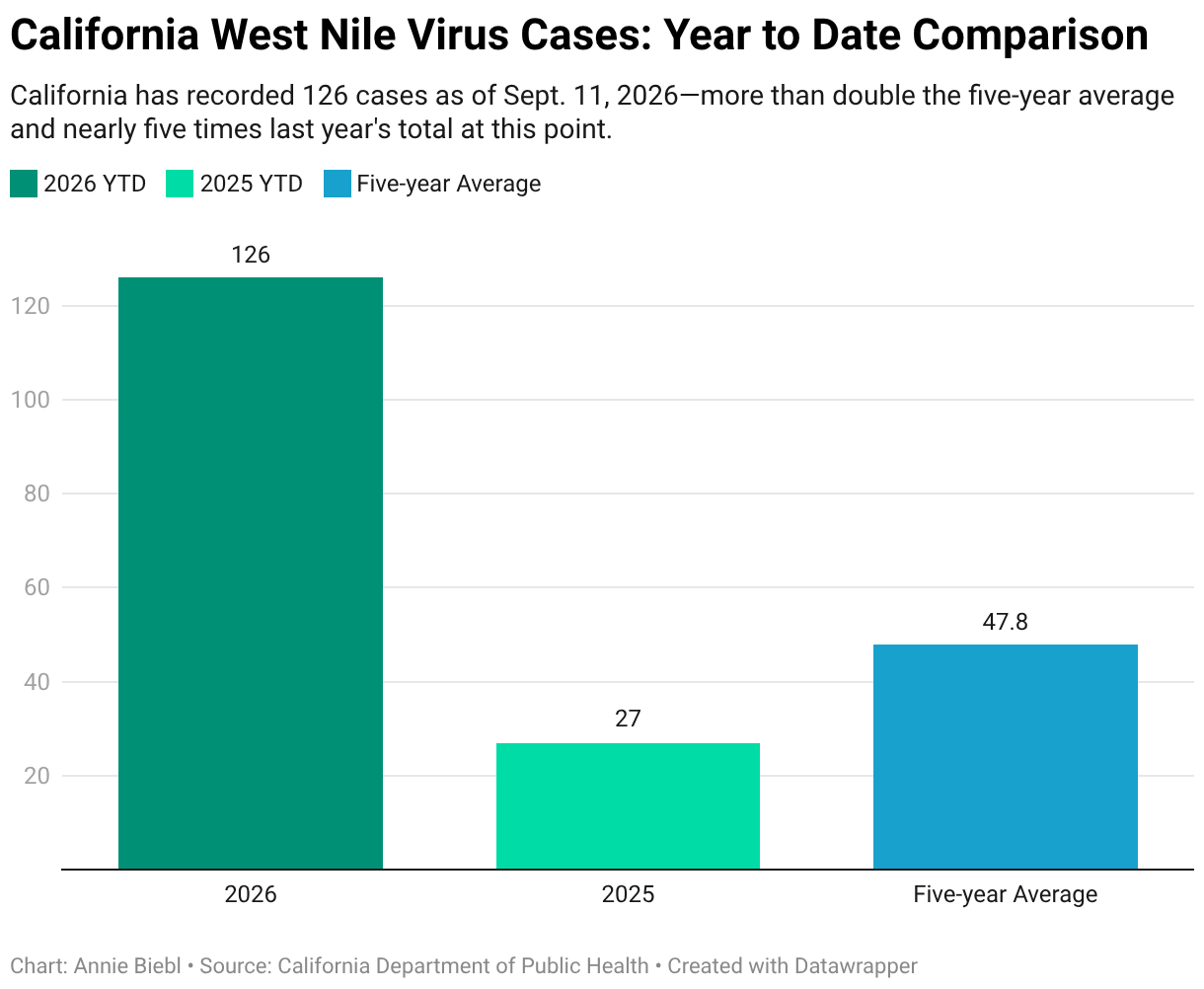
Around this time last year, California had 22 reported human West Nile virus cases. This September, the state has recorded 126.
With nine of those cases reported in Sacramento County, including one death, preventing the spread is not just the responsibility of mosquito control officials; it is a community effort.
Local agencies monitor mosquito populations, test for the virus and respond to areas of increased activity, while residents can help by eliminating standing water, reporting mosquito problems and dead birds, and taking steps to avoid bites.
Sign Up for the Morning Newsletter
The Abridged morning newsletter lands in your inbox every weekday morning with the latest news from the Sacramento region.
More than just a nuisance
As California reports more than twice the average number of West Nile virus cases over the past five years, and nearly four times the number of 2025 cases, the surge is bringing renewed attention to prevention and awareness.
The Sacramento-Yolo Mosquito and Vector Control District, which works to track and control mosquito populations and West Nile virus activity in the area, is experiencing a busy season, according to Public Information Officer Luz Maria Robles. Sacramento County confirmed its first human case in early July.
“It has been a year where we have seen more activity in terms of the human cases throughout the state,” Robles said. “And then for us, as a district, too, it’s been very busy especially in comparison to 2025.”
The California Department of Public Health describes West Nile virus as the most common and serious vector disease in California. Mosquitoes spread the virus to humans, birds and other animals through their bites. Most people infected have no symptoms, but about one in five develop symptoms such as fever, headache, body aches, nausea, vomiting and skin rashes. In rare cases, the virus can cause serious neurological issues and be fatal.
Dr. Phuong Luu, Sacramento County’s health officer, said that even though a small percentage of those with the virus experience severe symptoms, it is crucial for everyone to understand the risk. While children, the elderly and immunocompromised people are more likely to have a difficult time fighting the virus, everyone should take precautions, Luu said.
“I think most residents and individuals are just saying, ‘What’s the big deal? It’s just a small mosquito bite,’ but it can be a big deal,” Luu said, noting that in rare cases even otherwise healthy individuals can experience intense symptoms. “Prevention is the key. You don’t want to roll the dice of a progressively severe disease.”
Luu recommends practicing the D’s of mosquito prevention: draining standing water, dressing in long sleeve shirts and pants, and defending yourself with an effective repellent, especially at dawn and dusk when mosquitos are most active.
“For me, I wouldn’t take that chance,” she said. “I’m always cognizant and diligent about those D’s.”
The West Nile virus activity map from the county control district shows the majority of mosquitoes testing positive for the virus are in Arden-Arcade, Elk Grove and Woodland.
The Effie Yeaw Nature Center along the American River in Carmichael regularly educates volunteers and visitors on mosquito safety, according to Executive Director Rachael Cowan. This year, she has noticed an increase in mosquitos, and visitors and volunteers are actively protecting themselves in light of the recent West Nile virus cases.
“On the daily, I’m swatting them away,” Cowan said.
While the county can come out to spray areas with high activity, Effie Yeaw is a no-spray zone to protect the preserve and wildlife. Cowan said she has seen similar numbers of mosquitoes in and outside the center, and she regularly uses insect repellents, like DEET, as well as mosquito repellent bracelets.
Robles said one of the most important steps toward prevention is draining standing water, where mosquitoes breed.
“Whether it be a bucket, a watering can, or a pet dish, anything that holds water for more than a few days can and will become a mosquito breeding source,” she said. “Mosquito control is a collaborative community effort. We rely on people doing their part because we can’t be everywhere.”
Mosquitoes throughout the region
Sacramento resident and avid kayaker Karl Bly runs the American River Lost and Found Facebook page, where he regularly posts hauls of lost items he finds in the river and tries to find their owners. Bly said he is on the river four to five times a week and always keeps repellent in his bag, but he has not noticed a big increase in mosquito activity. He attributes this to local dams keeping the water flow consistent.
“As they lower the water, it leaves ponds and puddles along the river’s edge, and this year they’ve kept it at a fairly constant level,” Bly said.
Bly pointed out that people visiting the river usually come during daytime hours, so they may not be worried about taking preventive measures.
“Most people are out there just splashing around in the sun and having fun,” Bly said. “But in the evening hours, if you’re going on a picnic or walk around the river, you definitely need to have some mosquito spray with you or wear clothing covering your skin.”
Sacramento’s neighbors are experiencing a similar buzz of mosquito activity. Sutter and San Joaquin counties each have two reported cases, while Yolo has three. Yolo recently reported its first death from the virus on Sept. 8. Placer and El Dorado had no human cases as of Sept. 11.
Jamie Kneitel, a biological sciences professor and chair of environmental studies at Sacramento State University, said he has noticed an increase in mosquito activity, but he is not worried about West Nile virus. Kneitel said he has not worn insect repellent since he was in grad school, due to the chemicals and low risk of developing anything serious.
“I went on a hike up in Auburn this last weekend and I came back with a bunch of mosquito bites on my ankles,” Kneitel said. “The probability is so small, and so much of my time is spent doing outdoorsy things, but I don’t use it.”
More than 20 species active throughout the year
Robles said the cooler weather typically helps limit mosquito breeding and reduce exposure, but the work does not stop there. She said there are 27 different species active at different times of the year in the Sacramento-Yolo region.
“In late October, we will start to see a decline in the two species that can transmit West Nile, but we also need to be concerned about our two invasive species which are definitely trending upward in the fall.”
Culex pipiens and Culex tarsalis are the species carrying West Nile virus, while invasive species in the area include the Aedes aegypti and Aedes albopictus.
“Mosquitoes are very opportunistic,” Kneitel said, echoing their ability to rapidly reproduce in the smallest of vessels.
Kneitel explained there is a complex set of interactions between a vector and its environment, where things like rainfall and temperature can influence the virus and hosts. Timing plays just as important of a role, according to Kneitel. His research has examined how the timing and duration of flooding affect California vernal pool communities.
He said that while it does not offer a full explanation for the rise in West Nile virus cases, he noticed more mosquitoes in Sacramento’s vernal pools this year after the late rainfall led to a later filling of the pools than last year. He said rain that comes later in the season does not give the mosquitoes’ predators and competitors much time to catch up.
“If you’re concerned, use insect repellent,” Kneitel said. “Maybe it’s a do as I say not as I do.”
Residents can help the county continue to test for and track the virus by reporting high activity and giving mosquito samples to the Sacramento-Yolo Mosquito and Vector Control District, Robles said. Residents who notice an increase in mosquitoes near their home can request a free county inspection, in which a technician visits the property to assess, offer guidance and recommend next steps.
“If someone can catch one and put it in a baggy, it helps us identify the species of mosquito and where it could potentially be coming from,” Robles said. “It makes a big difference.”