
Law Students for Justice in Palestine at Berkeley Law alleged it was censored from advertising its co-sponsorship of a law school “disorientation” event last week because it has not revised its organizational bylaws barring Zionist speakers.
UC Berkeley’s settlement with the Brandeis Center over allegations of antisemitism earlier this year stipulates that registered law student organizations may not have bylaws restricting or prohibiting speakers based on protected categories at its events.
Although student organizations reserve the right not to invite speakers of their choosing, Berkeley Law does not allow these restrictions to be in written bylaws.
Minh Bui, law student and LSJP member, said LSJP was told its name could not be listed as a co-sponsor on flyers posted in the law building. LSJP was also unable to officially table at the law school’s Student Activities Fair and anticipates losing access to funding opportunities from the Student Association at Berkeley Law.
“We didn’t want to go down silently and just comply. We wanted law students to see how Palestine speech was being treated,” Bui said regarding why LSJP was unwilling to revise its bylaws. “It flows from our political commitment against Zionism … we couldn’t in good conscience take out our bylaws. We chose to remain principled and keep our bylaws, even if it means being deregistered as a law school organization.”
Event organizers, which included members from LSJP, the Law and Political Economy Society, the National Lawyers Guild and the Abolitionist Collective at Berkeley, then revised the flyer, crossing out LSJP’s name, but leaving it legible. Bui said these revised flyers were taken down.
“In no way does the settlement agreement impinge on student organizations’ First Amendment right to choose speakers based on their views,” said Berkeley Law spokesperson Alex Shapiro in an email. “In fact, the settlement is explicit about this.”
Shapiro noted that LSJP can participate in or support events, but it cannot be listed as a co-sponsor in law school-controlled spaces, such as bulletin boards and the online events calendar. In addition, Shapiro said student organizations that “circumvent” policies governing access to law school spaces by helping non-registered groups reserve rooms could result in losing access to those spaces themselves for up to the remainder of the academic year.
Bui said although LSJP can reserve rooms on campus outside of the law school building, members don’t intend to.
“We are going to try to continue holding events in the law school because we are an organization by law students, for law students, and we want to show that we won’t be cowed by Dean Chemerinsky’s or the law school’s intimidation,” Bui said.
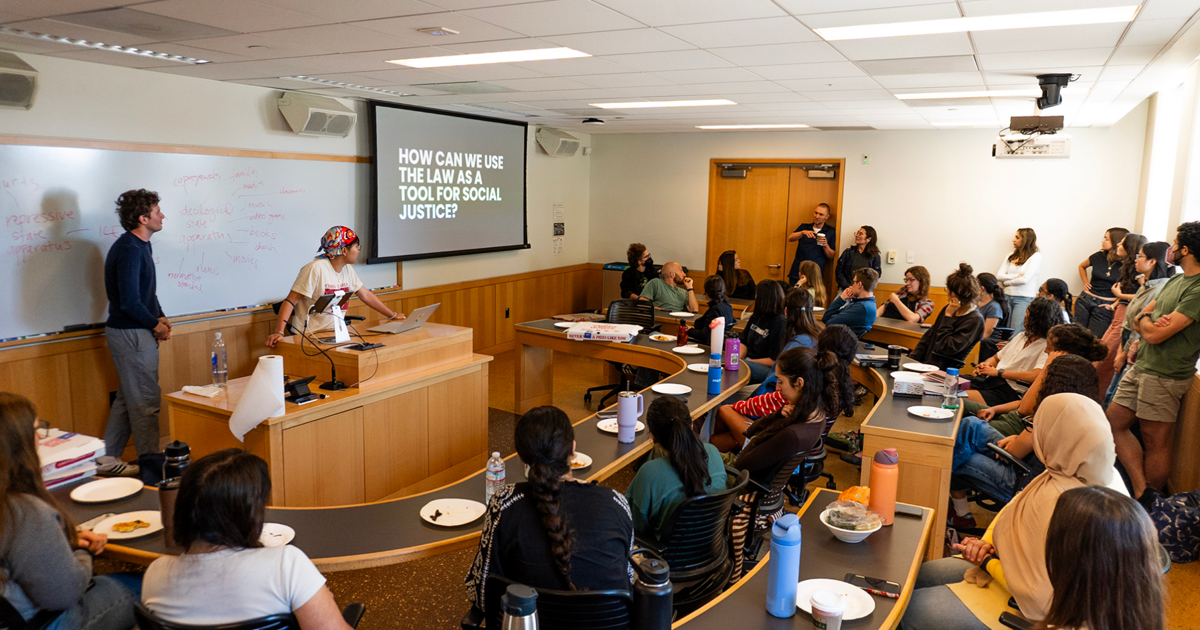
The event itself, “Disorientation,” was geared toward new students grappling with the “disorienting environment” of law school. Organizers spoke about the tensions between law and justice, political theory and disillusionment with careers in law.
Bui said the event had “incredible turnout despite the repression efforts,” and they saw interest in organizing for social justice and indignation on LSJP’s behalf from students.