
Jayden Lovelady is a senior editor of the Daily Titan. All opinions expressed in this article are those of the author and do not reflect the opinions of the Daily Titan as a whole.
Technology is constantly on the heels of tomorrow and education is getting caught up in the footrace, one where university leaders race to leave authentic learning as a casualty.
Cal State Fullerton was beyond the bend in many ways, launching an in-house artificial intelligence system in Jan. of 2025 titled TitanGPT. There has been a recent rise in critiques across the CSU system of the effectiveness of AI systems geared towards education, while university leaders simultaneously embrace them.
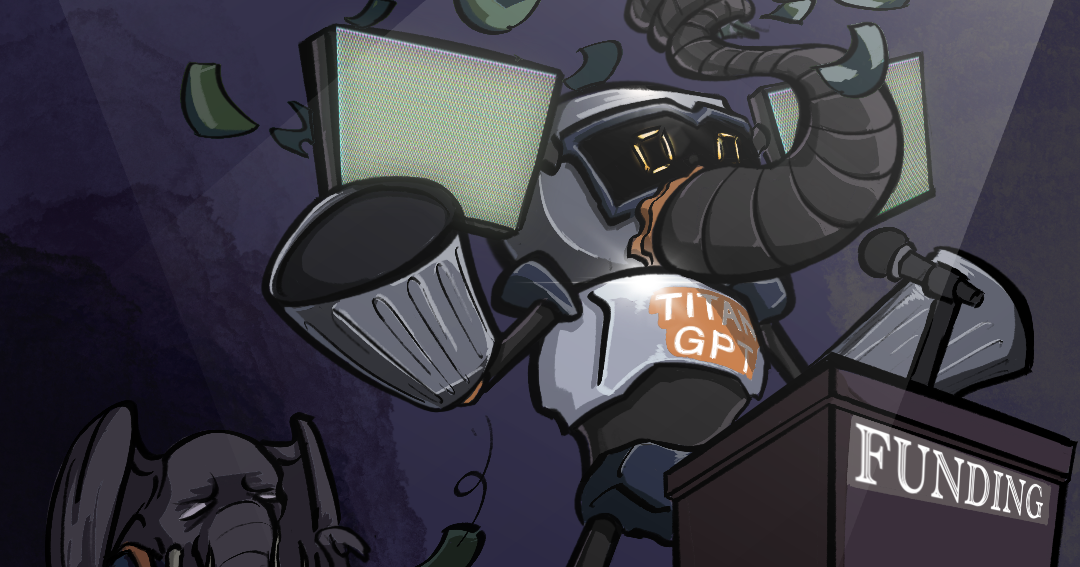
In the wake of the CSU striking a deal with OpenAI and the normalization of its place in higher education, the approximate $300,000 expense of TitanGPT is unable to keep up with the rapidly evolving information machine.
This May, CSU officials renewed the university system’s three-year contract with OpenAI, the artificial intelligence company responsible for ChatGPT, essentially making the program available for all students, faculty and staff for $13 million a year.
Predating this recent agreement — struck up before a $17 million 18-month subscription that ended in June — was CSUF’s individual initiative to adapt to the modern digital ecosystem by launching TitanGPT in Jan. 2025.
Vice President of Information Technology Chris Manriquez explains that in developing TitanGPT, which began roughly around the same time as OpenAI’s systemwide use in late 2024, the first distinct function was the chatbot.
“AI is radically different today than it initially was, it’s evolving at a rapid pace,” Manriquez said. “So even things that we make investments on today, looking at moving forwards, we have to be watchful of what we’re doing there because things are constantly changing.”
Of IT’s $8,303,493 operating budget for the 2026-2027 academic year, around $300,000 is being spent to keep TitanGPT operating. The platform has cost between $500,000 and $600,000 in total, amounting to 6%-7% of IT’s funds.
OpenAI, more commonly known for ChatGPT, offers extremely similar functions to CSUF’s alternative. Voiding the argument of ethical use of AI in higher education in the name of a closer examination into its functions, both systems share similar traits, such as being free to use through either the university or its mother system. However, ChatGPT houses a higher data capacity.
“TitanGPT itself was marketed towards professors as a research aide, however — and this is my last use of it so it may not be current — it doesn’t help because there are data upload limitations,” said Professor of Marketing Steven Chen. “For many faculty who have quote-unquote ‘real’ research projects, who need to upload more than just 20 files, you might have to upload hundreds, so this thing’s useless.”
Chen’s argument, though formed with the disclosure of TitanGPT’s facets to CSUF’s faculty and staff in 2025, is becoming evergreen as the CSU workers’ unions rally for AI safeguards in contracts to be reopened with CSU leaders in the current bargaining cycle.
As reported in EdSource this May, these concerns are growing rapidly as professors across the system raise complaints that AI, even when marketed towards academic spaces, is too faulty to live up to its promise. There are plot holes in the story spun around academic aid to research, from classroom assignments to professional development in multiple disciplines.
“I informally polled my students, and I know from just general interactions, very few students use TitanGPT,” Chen said. “And this is not an awareness issue, they know it exists, they just choose not to use it.”
When the biggest competitor is now a main talking point of coffee table conversation, the attention economy both programs compete in is becoming an uneven playing field. While TitanGPT may have broken in-home ground on campus, it cannot outrun the pace at which ChatGPT is growing like mold spores on the brick wall of academia.
Though CSUF is making innovative strides as an individual campus, the battle for attention against OpenAI shows TitanGPT’s inability to efficiently keep up with its rapidly developing counterpart, which begs the question of the necessity of a loss of $300,000 annually.