
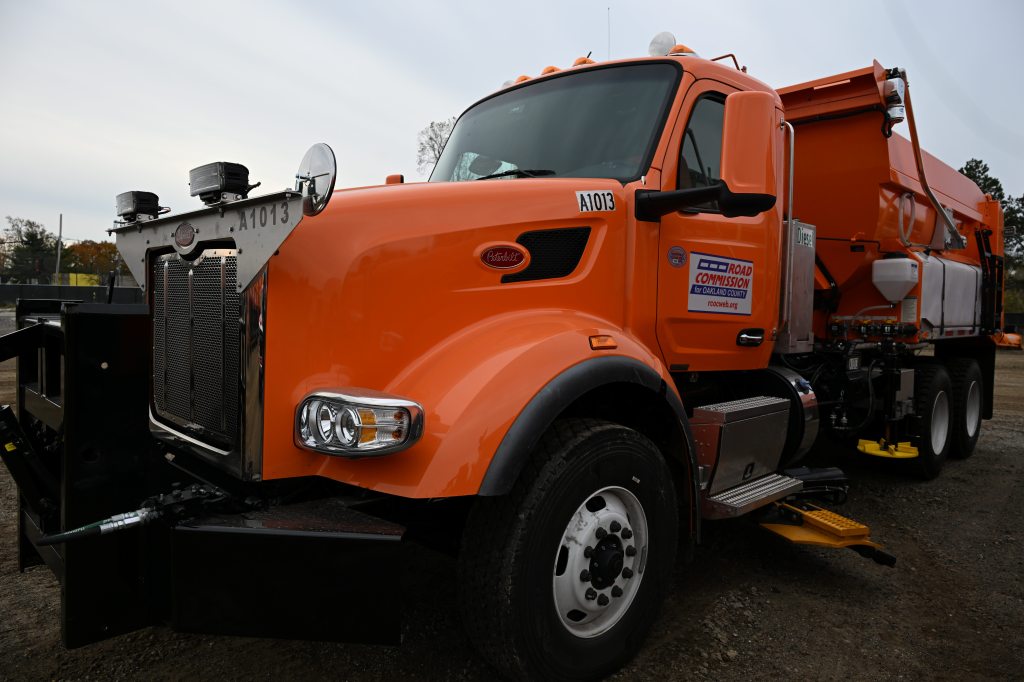
The snow season has arrived and the county road commission is ready.
This winter season that means purchasing 34 new trucks with more safety features to plow and salt the roads.
Each truck costs an estimated $425,000 each, said Dennis Kolar, the road commission’s managing director, adding that the trucks cost nearly 200% more than 10 years ago and snow plow blades have doubled in price since 2004.
“All new trucks are equipped with green lights that can be seen from a greater distance during winter weather,” he said. “Pickup trucks used for winter maintenance are also equipped with the green lights.”
All the new trucks will also be equipped with wing plows that extend from the right side of the truck and can be retracted when not needed.
“The wing plows increase the width of roadway plowed by a single truck, enabling trucks to plow a roadway lane and the shoulder at the same time, for example,” Kolar said. “Equipping many of our (current) trucks with wing plows has improved their efficiency.”
Kolar said the road commission typically prepares for winter by having plenty of road salt available and reviewing winter plans with truck drivers and mechanics.
Computers on the trucks automatically adjust how much salt is spread based on the vehicle’s speed. These salt spreaders also have pre-wetting devices to add salt brine to the salt which keeps it on the road and activates melting more quickly. This saves the amount of salt needed on roadways.
Pickup trucks are used to plow crossover and turnaround lanes on boulevards and for other urgent situations.
When six or more inches of snow fall, road commission employees not part of road-maintenance crews are deployed and contractors are called to help clear snow from gravel roads.
Kolar urged drivers to take extra care during snow storms.
Michigan law requires motorists to stay 200 feet back from a plow truck – which is about 12 car lengths.
“This helps to ensure the safety of motorists,” Kolar said. “It can take a longer distance to stop in snow and ice, and when vehicles run into the back of one of the big orange trucks, it’s not good for the passenger vehicle. So, please don’t crowd the plow — give the plows ‘room to groom.’ ”
The road commission plows on a priority basis:
• Critical roads are used by more than 10,000 vehicles per day per lane.
• Priority 1 roads see 2,500 to 10,000 vehicles per day.
• Priority 2 and 3 roads have less traffic.
Road priority details are online at http://www.rcocweb.org/160/Snow-Plowing.
Kolar said sand isn’t used on paved roads because it doesn’t melt snow but it does clog storm drains. Sand is only used on gravel roads with no storm drains and where salt is ineffective.
It’s not too late for people with roadside mailboxes to check how well they will withstand heavy snow thrown from plows.
Kolar said it only takes a few minutes to ensure that the mailbox box is secure by shaking the post and tightening any bolts.
Mailboxes installed on solid posts, at the proper height and set at the right distance from the road, are more likely to survive Michigan’s winter plowing season, he said.
The road commission plans to hire full-time laborers and truck drivers as well as part-time seasonal laborers and drivers. Visit rcocweb.org and click on the “careers” tab.
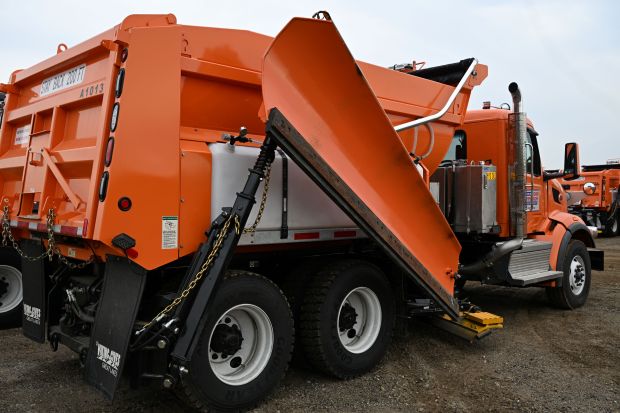 Oakland County snow plow. (Courtesy, Road Commission for Oakland County)
ROAD COMMISSION BY THE NUMBERS
Here are some fun facts and figures related to winter road maintenance this season:
• 4: That’s the miles per gallon for fully loaded salt trucks and snow plows. Empty they get about 6 miles per gallon.
• 6: The number of road commission garages scattered around the county with salt stores.
• 12: That’s the dollar amount in million spent on winter road maintenance.
• 12: Number of car lengths motorists are required by state law to travel behind plows to give them enough room to maneuver.
• 19: Number of road graders the road commission uses to plow heavy snow.
• 147: Number of snow plows and salt trucks in the county road commission’s fleet. They’re never all used at once because some are spares and others may be off the streets for repairs.
• 230: Number of miles of roads and multi-lane state highways maintained by the road commission for MDOT, which includes I-75, I-696, I-96, M-59, Telegraph Road and Woodward Avenue among others.
• 57.78: The dollars per ton spent on salt this year, an increase from the $55.29 paid in 2024.
• 400: The estimated number of pounds of salt needed for one mile of two lane pavement.
• 2,700: The estimated miles of county roads (including subdivision and gravel roads) maintained by the road commission.
• 37,500: The number of tons of salt when all county storage facilities are full.
• 43,000: The cost in dollars-per-hour to deploy salt trucks to 109 routes during an overtime period.