
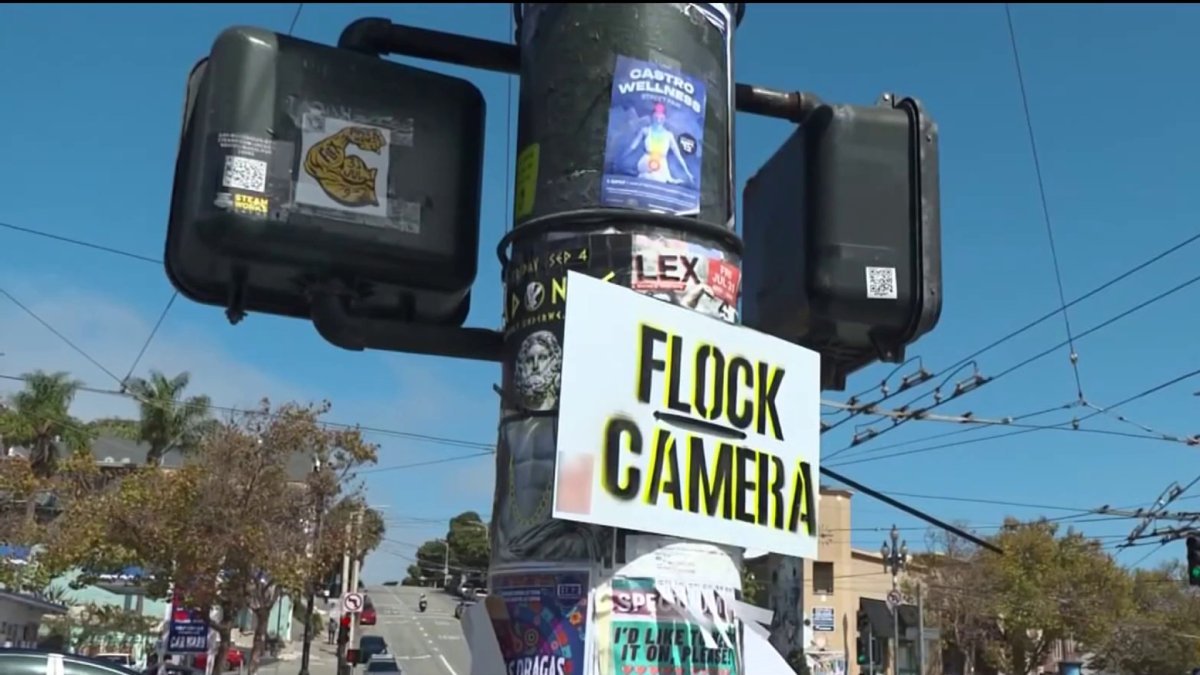
As community groups continue to raise questions about license plate-reading cameras operated by a company called Flock, one group is starting to label where the devices are installed across San Francisco.
According to the San Francisco Police Department, the agency has 400 Flock cameras deployed throughout the city. A group called “De-Flock-SF” is now trying to map every single one of them online.
At the corner of Market and Castro streets, a new sign has been added to the neighborhood’s collection of posters and flyers. It simply reads: “Flock Camera.” Most people interviewed did not see the sign or know much about what a Flock camera is.
“I presume they’re probably there to help police investigations, but other than that, not much,” said San Francisco resident Kat Feller.
Directly above the sign sits a small camera operated by Flock, designed to read car license plates. Police began installing the devices across San Francisco just over two years ago, and a police spokesperson confirmed the department now has 400 cameras.
“Right now, what’s really important is to educate people about the cameras,” said Zachary Schwartz, founder of De-Flock-SF. “So then in the future, hopefully enough people are educated about it that they can actually go ahead and make change, whether that’s through banning them or through policy changes.”
Schwartz has become one of the sharpest critics of the police department’s use of Flock cameras. He appeared at a Police Commission meeting earlier this summer calling for a comprehensive audit of the cameras’ uses and the data they collect.
Data access by outside agencies has been a primary concern. Earlier this summer, the SFPD acknowledged that federal agencies had accessed San Francisco’s license plate reading data. A police spokesperson said the data has now been walled off.
However, concerns regarding the misuse of the cameras by local police officers have also surfaced. This week, the San Jose Police Department fired an officer for sharing Flock data with a family member.
“The officer accessed license plate reader data and provided that to a suspect in a domestic violence situation, which enabled that suspect to locate the victim,” said San Jose Police Chief Paul Joseph.
A criminal investigation has also been launched. A San Francisco police spokesperson stated that the SFPD only allows officers to query their system using a case number or a computer-aided dispatch number.
The police spokesperson also credited the license plate-reading cameras with driving down certain types of crime in the city, including car burglaries. They noted that in 2023, before the cameras were installed, the city had more than 19,000 car burglaries, whereas, so far this year, there have been 1,764.
Still, some residents argue the police department should be more transparent about how it uses the cameras and where they are located.
“Transparency builds trust,” said San Francisco resident Jeremiah Mayfield. “And if you want people to trust you and trust law enforcement, then clearly label things, just like they do with the red-light cameras. They’re clearly labeled, they’re obvious, you know where they are.”