
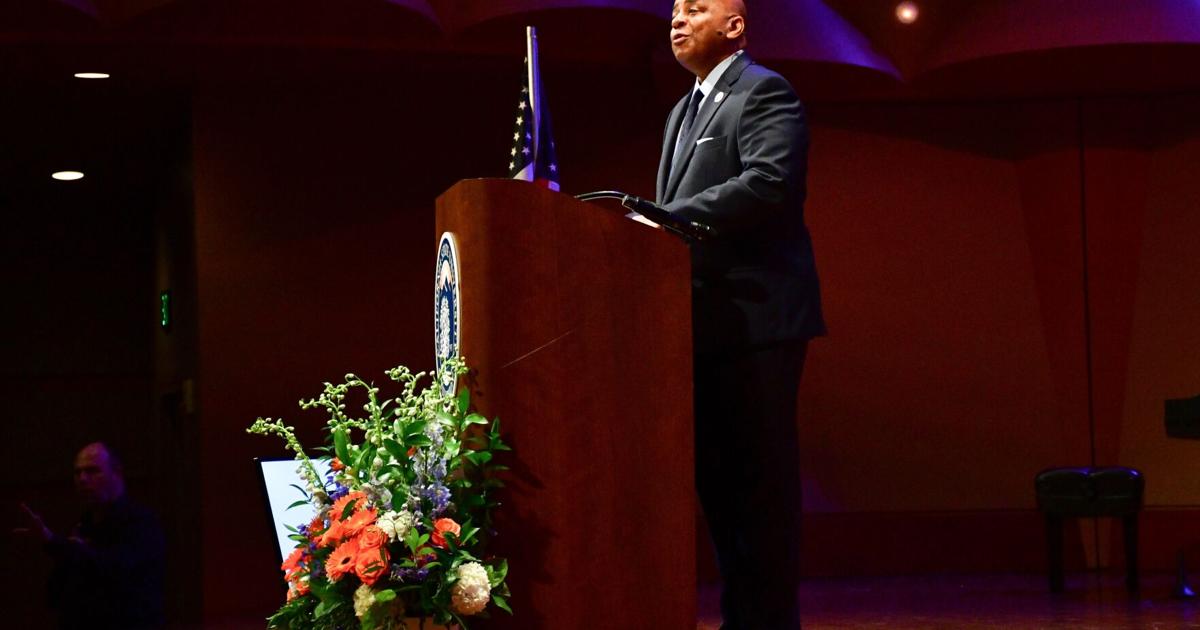
Cal State Fullerton hosted its 2026 convocation last Thursday, where campus leaders spoke about the campus’s future goals and current state.
The CSUF jazz band opened the convocation held at the Clayes Performing Arts Center. Rochon spoke to three commitments drawn from the strategic plan: guiding students toward graduation, preparing students for post-graduate life and building an inclusive campus culture.
Last year’s convocation focused on four points, including placing students at the center, a focus on enrollment, fostering campus growth and cultivating campus culture.
This fall marks the third annual convocation under campus president Ronald Rochon, and the third year under the Fullerton Forward 2024-2029 strategic plan, which was developed as a “roadmap for the university.”
Fullerton Forward states five goals, enhancing support for student academic success being the first goal, fostering student engagement and well-being the second, recruiting and retaining high-quality faculty and staff the third.
The fourth and fifth goals of the strategy are to expand and strengthen the physical and financial capacity of community relations as well as to innovate and improve campus operations.
Pursuant to its first goal and under its strategic enrollment plan, the university has seen an increase in the number of students accepted to campus.
While no head count of total enrollment has been released for the 2026 fall semester, Rochon noted that the fall 2025 enrollment count of 45,863 students highlights a need to focus on students as individuals and to cultivate a welcoming campus environment.
“As academics, our culture is, in truth, our curriculum; it is our DNA. What matters most at Cal State Fullerton is not enrollment numbers, it is the lives behind those numbers,” Rochon said
This number has only risen over the past few years, with 43,662 total students recorded in the fall 2024 semester and 41,962 recorded in 2023.
In accordance with rising attendance, CSUF’s overall acceptance rate has also increased. College Tuition Compare shows a steady increase beginning in the 2021-2022 academic year, with an acceptance rate of approximately 59%, to the 2024-2025 rate of 90.52%.
Su Swarat, senior associate vice president for Institutional Effectiveness and Planning, discussed that the university was tasked with achieving a graduation rate of 55.1% for the fall 2027 incoming cohort of first-time students, nearly a 10% increase over the recorded 2025 graduation rate.
Speakers representing various organizations and administrative bodies, including Associated Students Inc. and the Academic Senate gave speeches at the event, with various speakers emphasizing the importance of connecting with students on a personal level to encourage retention.
“Graduation is a path. Students rarely leave because they didn’t understand an assignment. They leave because (the) path was not clear, they leave because the requirement was changed, they leave because the class was not offered, they leave because we give them four answers for one question,” Academic Senate Chair Amir Dabirian said.
Dabirian and Sean Walker, provost and vice president for Academic Affairs, each spoke about the various concerns students face coming into the semester, such as the evolution of artificial intelligence in educational spaces, financial issues and post-graduate job security.