
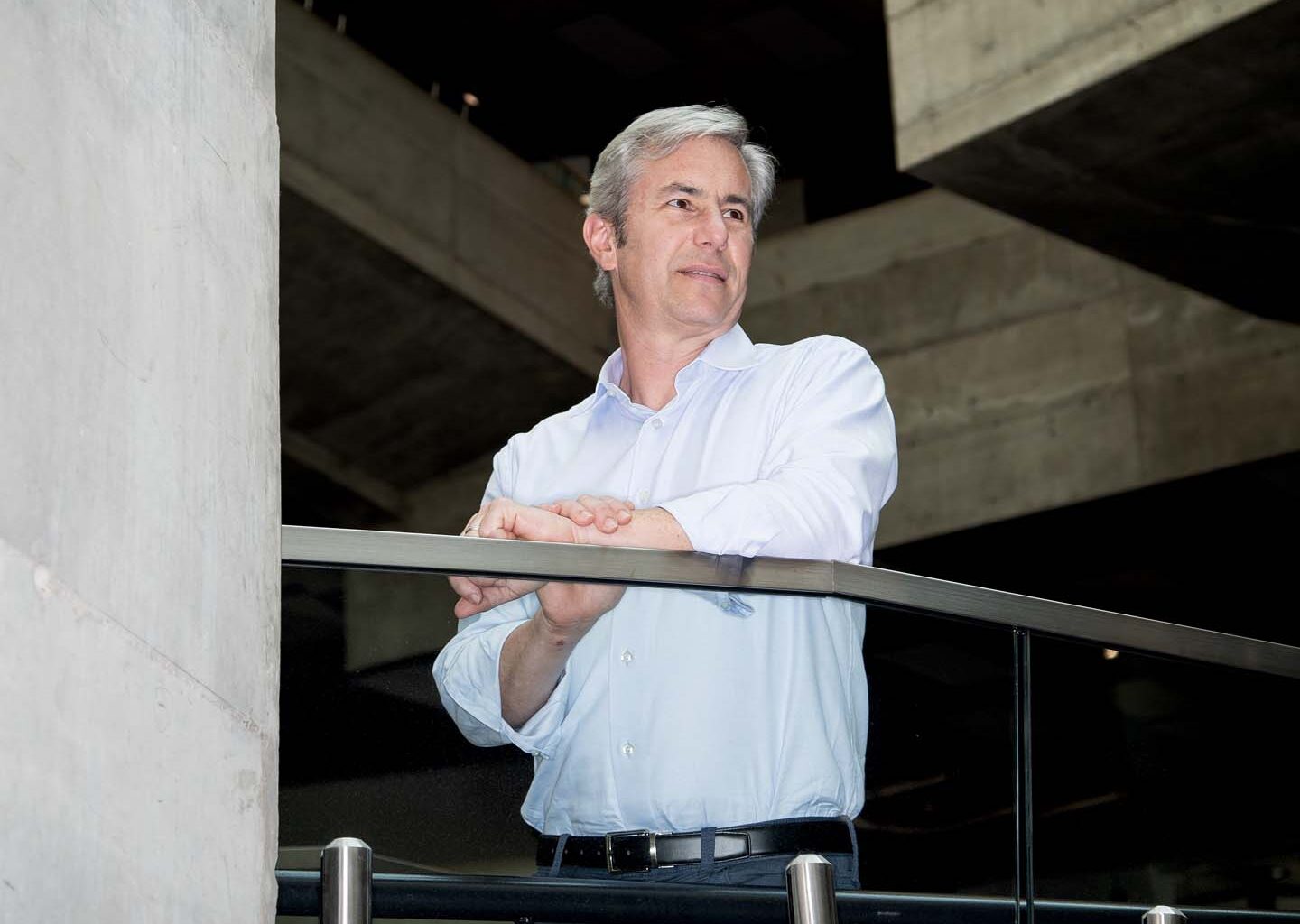
Photosynthesis, the chemical process fundamental to life on Earth, has a flaw. So says Chris Eiben, Ph.D. ’19, founder of the biotech startup GigaCrop. “There’s a series of enzymes nature uses for this, but one of those enzymes is very slow.”
The weak link is RuBisCO, the most plentiful protein on planet Earth and the enzyme that begins the process of turning carbon dioxide into plants, algae, and cyanobacteria. For nearly three billion years, RuBisCO has shaped our world. Eiben is not impressed.
“If you look at plants today, they’re only productively using 20 percent of the photons they have access to at midday sun.”
To help plants meet their full potential, GigaCrop has designed brand-new enzymes that Eiben says could double crop yields.
It’s the kind of bold idea that gets nurtured at Bakar Bio Labs, the largest university-run biotech incubator in the country. Opened in 2021 in the former Berkeley Art Museum and Pacific Film Archive building on Bancroft Avenue, Bakar Bio Labs offers a rotating cast of tenants—as many as 30 at a time—access to mentorship, state-of-the-art wet labs, Berkeley facilities, and a
community of fellow dreamers to help launch their fledgling startups.
“The incubator provides the protected environment for these vulnerable early-stage companies to do their essential proof-of-concept work,” says Kaspar Mossman, Ph.D. ’06, managing director of QB3, the University of California institute that supports Bakar Bio Labs. “It makes the process of innovation more efficient.”
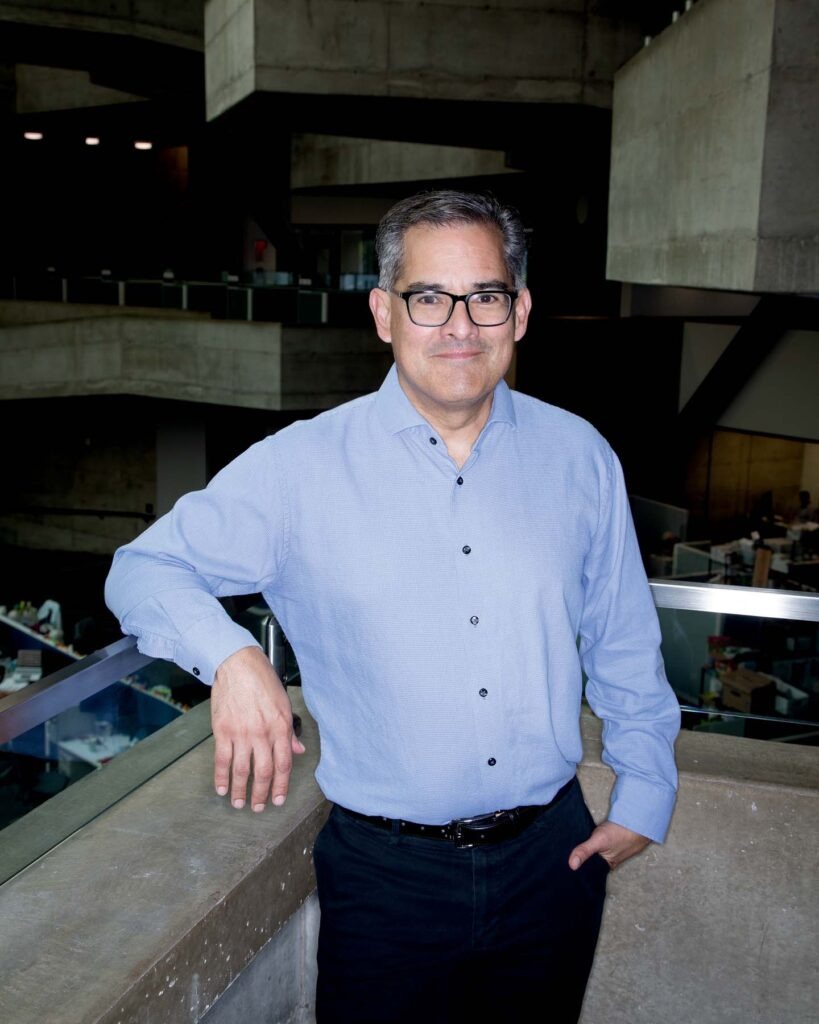 David Schaffer, the director of QB3, the UC institute that supports Bakar Labs. (Photo by Marcus Hanschen)
Mossman and I stood on one of five cantilevered concrete slabs that spiral up and over the vast central atrium of the Bakar BioEnginuity Hub. Two decades ago, following damage from the 1989 Loma Prieta earthquake, the building’s demolition seemed imminent. But a costly seismic retrofit gave new life to the architectural icon. Once graced by paintings and sculptures from around the world, the atrium is now carpeted and hosts tidy rows of cubicles. Floor-to-ceiling glass walls offer a new kind of display: lab-coated technicians doing things like pipetting samples into centrifuge tubes.
As we navigated the strange layout of architect Mario Ciampi’s brutalist masterpiece, through bunker-like hallways, up and down ramps, and through oddly shaped spaces, I felt lost. Mossman said, “It’s very difficult to say what floor you’re on in this building.” Still, it’s a stunning space, monumental in scale and flooded with natural light.
“It’s probably the most beautiful biotech incubator in the world,” says Chad Miller, chief technical officer of ResVita Bio, a startup taking aim at Netherton syndrome, a rare skin disorder that can be excruciating and sometimes fatal. Sufferers lack a protein called LEKTI that slows the natural breakdown of skin cells. Miller, who trained under Nobel laureate David Baker, Ph.D. ’89, genetically engineered a bacteria that manufactures the crucial protein. ResVita’s product is a lotion that continually produces LEKTI directly on the skin.
“I don’t think there are any companies here that are doing stuff like working on a peptide to make you more tan.”
The work is expensive. “The thing that startups don’t have is a million dollars to buy a microscope,” Miller says. “If they do have a million dollars at all, that has to go to pay scientists who are going to want access to things like million-dollar microscopes.”
Those can be found across the street, on campus; Bakar Lab tenants can also utilize university lab facilities.
Human resources have been just as crucial, Miller says. A Cal internship program, Break into Biotech, trains and compensates students who work with the tenant companies.
Then there’s networking.
At one point, Mossman led me past an open door. Inside, a dozen people mingled around folding tables, drinks in hand. “It’s kind of like speed dating for our energy materials companies.”
Miller met the cofounder of ResVita while his own company, Nosis Bio, was also at Bakar Labs. They were cubicle mates. After Nosis “graduated,” the ResVita founder hired Miller (who remains a scientific advisor at Nosis, which has since partnered with Johnson & Johnson). ResVita recently submitted an Investigational New Drug application with the FDA, a big deal for a pharmaceutical startup.
“For a therapeutic, it typically takes between 10 and 15 years from the lab to when it’s actually available in clinics to be sold to patients,” Mossman says. The average cost of developing a new drug and bringing it to market is in the hundreds of millions. “We have our fifth anniversary this fall. Have we seen any FDA-approved drugs? No. Have we got a couple clinical trials happening? Yes.”
For early-stage biotech startups, investment can be hard to come by. Given the regulatory hurdles, the costs, and the experimental nature of the science, they make for inherently high-risk, high-reward investments. But that’s just what investors were after during the biotech boom of the late 2010s. Then the COVID era sent biotech speculation into the stratosphere. Money poured in, and even young, unproven biotech companies reaped the rewards. Recently, however, investors have grown more cautious, parking their cash in safer bets.
“So there were companies getting 250 million bucks instead of 250 companies getting a million,”
Mossman says. “And then AI came in waving its shiny little banner.”
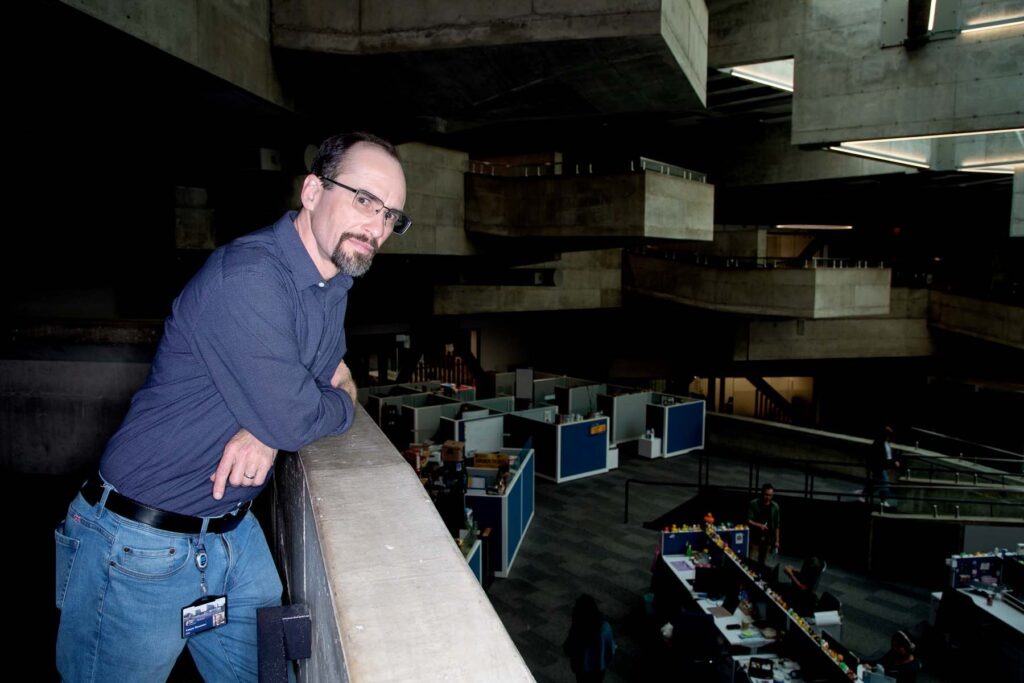 Kaspar Mossman, managing director of QB3. (Photo by Marcus Hanschen)
To ensure its startups have a fighting chance, Bakar Labs carefully vets aspiring tenants. Mossman rattles off a list of criteria: “Is the science good? Does it meet an actual need? And has it got any likelihood of commercial success?
“What size is the market? What’s the FDA path? What has previously failed in this area? Why did it fail? Are these guys going to be any different than that? Who’s on the team? Is it one undergrad? Is it three grad students? Is it out of a powerhouse lab? Is it two people who actually seem to know what they’re doing?”
And perhaps the most important question: Is there potential social benefit?
“I don’t think there are any companies here that are doing stuff like working on a peptide to make you more tan,” says Collin Blinder, the deputy director of communications at Bakar Labs and QB3.
“The phrase is ‘double bottom line,’” added Mossman. “Something that is good for society and profitable.”
Take GigaCrop. If Eiben’s new enzymes succeed, it could mean cheaper biofuels and increased carbon fixation. But first they need to move from the test tube to plants, and that’s a challenge.
“It’s not getting the genes in,” Eiben says, “it’s knowing that they’re all going to connect and work the way that you want. That’s the harder part.”
Despite the challenges, Bakar Lab tenants have raised over a billion dollars in investments since the incubator opened its doors. But funded or not, the odds are long. Mossman says one way Bakar Labs can help its tenants is by speeding up the innovation process. “Maybe that means you fail faster…. If you start a company and fail in the Bay Area, it just means that you started a company, and you’re ready to start another company.”
As Mossman led me through the maze-like building, I admitted I was disoriented.
“It was designed for disorientation,” he said.
One startup founder told me that it usually takes about three weeks for new tenants to figure out how to find their way around the building.
We went down another windowless hallway. Mossman opened an exit door. “This is West,” he said. “The ocean is that way.”
Coby McDonald, M.J. ’17, is a writer and podcast producer.