
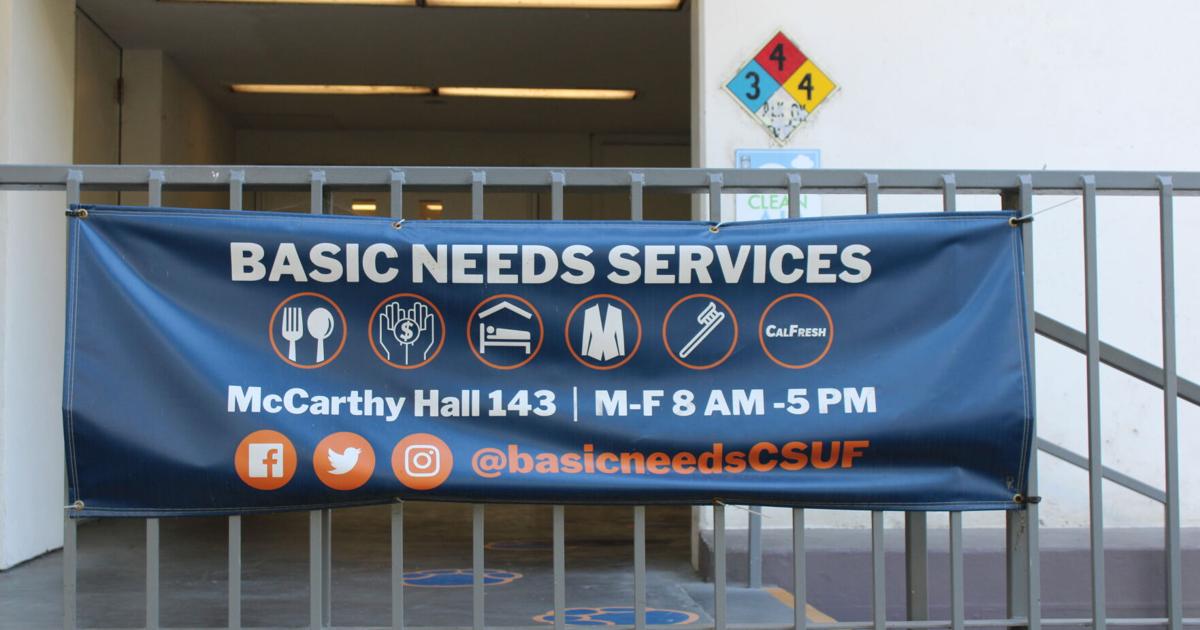
Cal State Fullerton’s Basic Needs Services is entering the second year of its Rapid Rehousing and Housing Security Program, a collaborative service with the Orangewood Foundation and Pathways of Hope that provides housing support to eligible students to maintain enrollment and progress toward graduation.
Funded by a grant from the CSU Chancellor’s Office, the Rapid Rehousing and Housing Security Program (RRHHSP) provides CSUF students with housing resources such as bridge housing, housing stability funds and access to community resources with two local nonprofit organizations.
The Orangewood Foundation is a 501(c)(3) nonprofit that works to support Orange County youth who are facing challenges. Their programs focus on housing, education, employment and life-skill development. The foundation offers services including transitional housing for youth, financial aid for move-in costs and scholarship opportunities.
Pathways of Hope is a nonprofit organization dedicated to supporting individuals in north Orange County experiencing homelessness or hunger. Some of the services provided by the organization include the Hub of Hope food pantry, emergency housing and permanent supportive housing.
“Students face many challenges such as limited income, high rental cost, lack of affordable housing…or difficulty navigating landlords and housing systems,” Senior Director of Programs at Pathways of Hope, Sarah Peña wrote in an email to the Daily Titan. “Combining Pathways of Hope with RRHHSP allows us to continually improve how we connect students to housing and provide the ongoing support necessary to make that housing sustainable.”
Both organizations offer housing stability funds and access to community resources through the RRHHSP. However, bridge housing will only be available through services offered by the Orangewood Foundation.
According to Victoria Ajemian, the director of Basic Needs Services at CSUF, the decision to work with both nonprofit organizations was made to ensure the program was as accessible as possible to the university’s student body.
“Orangewood Foundation is only able to serve clients between the ages of 18 to 24, and not all Cal State Fullerton students are between the ages of 18 to 24,” Ajemian said. “That’s why we also have our partnership with Pathways of Hope to ensure that we can support as many students as possible.”
Findings from a study conducted by CSUF and University of California, Los Angeles found that, as of Spring 2024, 52% of CSUF students experience housing insecurity and 6% experience homelessness.
The most common types of housing insecurity reported included struggling to pay for housing, not paying the full price of utility bills and living with others beyond the capacity of their space.
To be eligible for the RRHHSP, interested students must be facing a “current, immediate, unexpected housing situation,” which can include housing displacement, couch surfing, living in a car or inability to live in their current residence.
Students interested in participating in the program can submit a Basic Needs Services request form to meet with a staff member to discuss eligibility and to be referred to the Orangewood Foundation or Pathways of Hope.
According to Ajemian, consultations for the program will include reviewing the various options and resources available to a student, depending on their circumstances.
“We will always bring up the Rapid Rehousing and Housing Security Program if it’s applicable,” Ajemian said. “Sometimes a student may not be interested in that service, and that’s totally fine. If they are, we’ll talk about next steps and we’ll determine which of the organizations may be a better fit to their circumstances.”
If a student opts to use the program’s resources, BNS will ask the student to sign an information release form to communicate with the appropriate organization and initiate the referral process.
From there, a case manager from one of the organizations will reach out to the student to provide resources based on their circumstances.
“Once a student is referred to us, we first focus on stabilizing their immediate housing situation and understanding the barriers that put them at risk of losing their housing,” Peña wrote. “At the same time, we begin identifying resources and services that can further support the students.”
Temporary housing support through BNS currently offers students an on-campus apartment for up to three weeks.
Although the partnerships with the two nonprofits with the RRHHSP is intended to provide students housing support longer than BNS’ temporary housing period, Ajemian states that the program cannot offer students semesterly or year-long support.
“What we’re going towards is to provide…immediate support to a student,” Ajemian said. “Whether that’s through just a conversation with our team, going into the referral with one of our partners and then hoping that they get that long-term stability by accessing that program.”