
SACRAMENTO, Calif. – When the Blueprint to Better competition was announced in May, Sacramento District employees were encouraged to propose ideas in which the district can improve operations in terms of efficiency and AI use. For one employee, this was an opportunity to present an innovative idea that she already implements in her work.
Engineering Technician and Office Engineer Danielle Meaux Burks submitted her idea “Responsible AI for Smarter Construction Delivery” and placed third in the competition.
Having a crucial role in construction delivery, Meaux Burks spends a lot of her time reading through proposals and construction modifications that can be worth anywhere from $20,000 to millions of dollars.
It is Meaux Burks’ job to provide the cost analysis for these proposals and draft the Price Objective Memorandum (POM) and Price Negotiation Memorandum (PNM) – a job that requires great attention to detail as proposals can be upward of thousands of pages long. Sorting through these pages could take days to complete.
“I started realizing how much of my time was being spent just finding, sorting, and organizing information before I could even get to the part that really requires my experience and judgment,” Meaux Burks said.
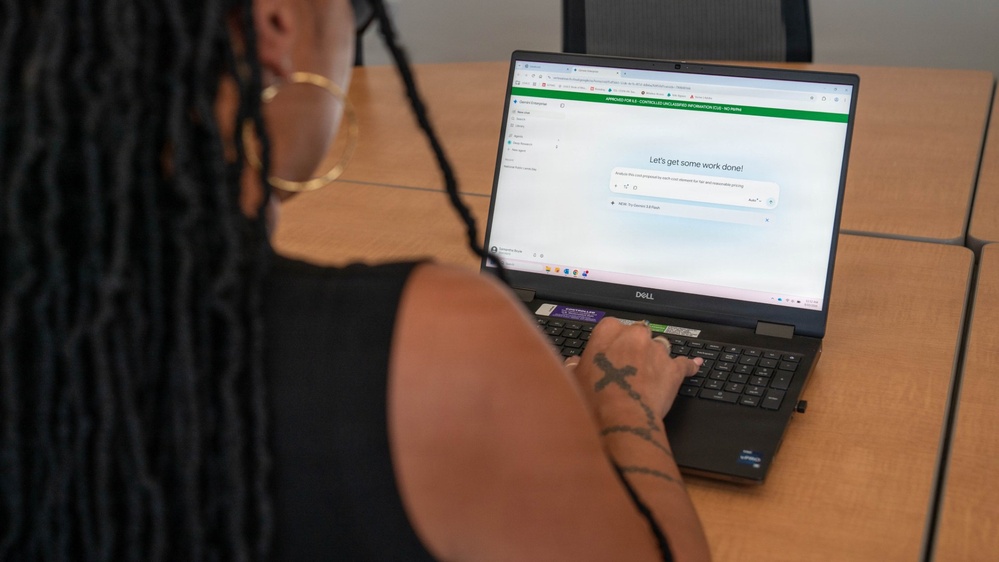
That changed in 2025, when the Department of War approved GenAI.mil for use with certain Controlled Unclassified Information, allowing Meaux Burks to use the platform to support aspects of her work that previously required extensive manual review.
“It was like a world of difference,” Meaux Burks said as she could now upload lengthy proposals to GenAI.mil and request information such as:
Now, instead of manually sorting through information on her own, Meaux Burks had a research assistant. Within minutes, she could organize project correspondence, create timelines of events, and analyze cost information. However, Meaux Burks still validates all information provided by AI through extensive review and ensuring she understands the contract and the project. She is also responsible for documenting the process properly to present decisions to district leadership.
“I’m still making the decisions,” Meaux Burks said. “I’m using AI to assist me with the research and the paperwork.”
As Meaux Burks gained experience in these platforms, she ultimately gained the confidence to submit this as an idea to the Blueprint to Better competition.
“My idea is really pretty simple: use approved AI tools to help with the repetitive, information-heavy parts of our work while keeping people responsible for the actual analysis and decisions,” she said.
When implemented in the construction delivery process, using AI could lead to faster modifications and more efficient delivery, improved cost analysis, better documentation, faster information retrieval, and so on.
For example, on one recent project, Meaux Burks used AI to assist with reviewing and organizing a contractor proposal that was hundreds of pages long and with developing a detailed timeline of events from multiple project documents spanning approximately two years.
“I estimate AI reduced the time spent on initial document review, information extraction, organization, and timeline development by approximately 70% to 80%, reducing what could have taken several days of manual effort to a matter of hours,” she said. “It also saved approximately 1 to 2 days in developing the associated POM and PNM.”
The Blueprint to Better competition required all participants to present their ideas to the Executive Leadership Council. During her presentation, Meaux Burks was able to use examples like the one previously mentioned where using approved AI tools led to better construction delivery.
“I think sometimes we assume an innovation has to be something completely new or complicated,” Meaux Burks said. “It doesn’t. If you’ve found a better way to do something, or you keep thinking, ‘Why are we still doing it this way?’ there’s probably something worth exploring.”