
Gizelle Medina is the opinion editor of the Daily Titan. All opinions expressed in this article are those of the author and do not reflect the opinions of the Daily Titan as a whole.
My mother’s humble brag of never spending a single cent on international phone calls during the ‘90s while her and my father rekindled their relationship after 10 years of no contact rendered me bitter once the initial “awe” wore off.
Despite unlimited data for phone calls at a fraction of the price, FaceTime, text messages and social media DMs all being available at my 21st century fingertips, I do not feel as lucky as my parents, veterans of the long-distance relationship.
The normalization of overcommunication dilutes the meaning words or gestures are meant to deliver, and we must be wary of the impact this expectation poses on the health of our relationships. Without the self-actualized concept of fulfillment, connections between one another fall flat, leaving a lingering dissatisfied, insatiable craving for either something more or something else.
The recent trend of a “man who yearns is a man who earns” made me grow quietly resentful before the sour taste grew more apparent in my day to day. Suddenly, neglect became a feeling I routinely experienced in a relationship with my current partner without obvious or legitimate cause.
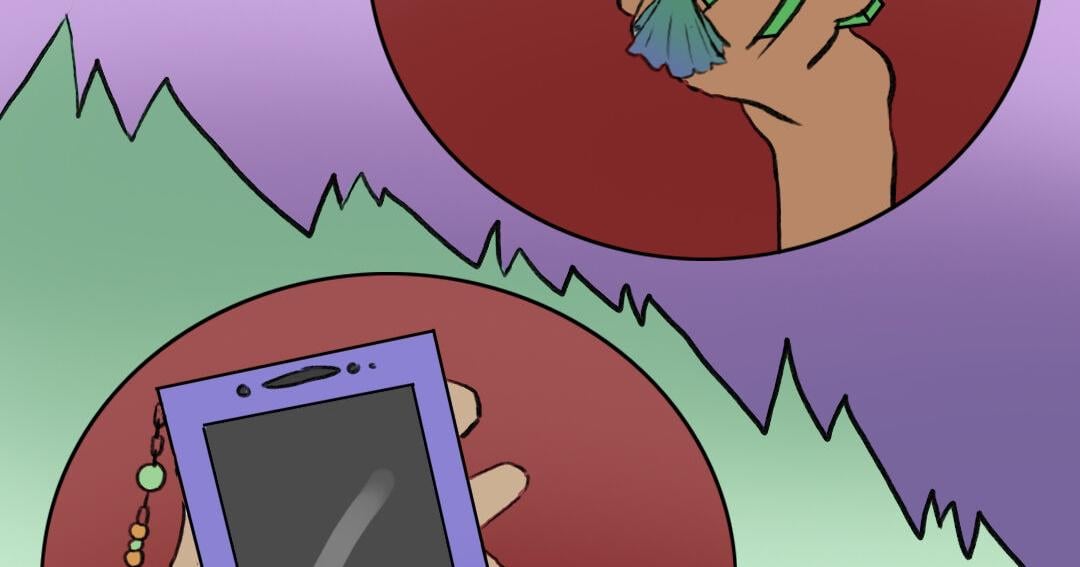
My expectation for our connection to constantly be monitored and measured by immediate, quantitative means, like the amount of text messages per hour or the speed of a heart appearing on my Instagram posts, forced the modern-day rubric that fell flat against the grand gestures that Disney movies and the previous generation promised me.
Despite the 6.04 billion internet users Statista reports, the National Library of Medicine officially diagnoses our current social climate with a “loneliness epidemic,” revealing a gap between the accessibility to communicate endlessly online and secure, fulfilling relationships.
Particularly infecting the same generation fluent in Meta’s language, born alongside these governing social media platforms, a 2025 study by the global health service company Cigna reports Gen-Z as the “loneliest” generation.
Dustin Abnet, an American Studies professor and graduate program advisor at Cal State Fullerton, reflects on how content creation structures our digital environments, inadvertently influencing our understanding of control, reward and expectation.
“Our digital environments really work to isolate us within our own individual worlds, where the kinds of content that we see are personalized, where everything we get is increasingly framed in ‘this is content dedicated directly towards you,’ rather than ‘this is designed to build connections and unify people,’” Abnet said.
These algorithmic models wield the power to spoil us rotten. While the dopamine hits linked to the instantaneous nature of phone addiction are nothing new, the way in which we think about the rewiring of our reward systems must be evaluated.
Beyond centering me in personalized feeds, these models offer a pseudosense of control over life’s unpredictability, almost oversimplifying the complexities of the human condition. While technology is coveted for its ability to circumvent “struggle,” the same friction that nurtures enduring connections between people is then also obliterated.
The absence of a bouquet or the delay of a reply was a cause for worry that exploited a hyper-vigilance imposed upon me from childhood — equating surveillance with control and control for protection and affection.
With the prim and proper demands of optics, especially in a chronically online time where digital footprints can turn accountability into a fear of being perceived, it is incentivized for us to equip highly-curated aesthetics despite ironically craving authenticity.
Irene Matz, professor of human communication studies and former dean for the College of Communications at CSUF, reflects on Gallup’s 2025 study which reports a significant decrease of alcohol consumption amongst young adults and the implications of the lack of a youth night scene in a post-pandemic landscape.
“They’re consuming less alcohol, but they’re also isolating themselves more too, because if you’re socializing, you’re out, having a drink together, and if you’re not drinking, then you’re not taking that opportunity to go to a bar or go to a party,” Matz said, “Less drinking is good. We know that, right? But socialization has also been affected.”
With weakening third spaces for youth to be carefree and unapologetic, paired with this idea that we are constantly connected online, a distinction between being interacted with and feeling seen is drawn. Whether in a physical or online space, the constant but passive presence of communication between two people does not translate into the intimacy and sincerity fulfilling connections require in a relationship.
Opting for these bids for voluntary vulnerability and striving to understand one another, as frustrating and exhausting that process may be, is where closeness clothed in trust emerges.
The idea of the sole remedy relying on the shift of my phone’s off switch pins the blame entirely on the device trademarked by an icon of a forbidden fruit, but we must remember that it was man who chose to take the bite.
Instead of resenting the current culture perpetuating that more notifications mean a more secure relationship, I must dissect my own suspicion that grows into the discontent feeling I mistake for loneliness. Choosing to trust my partner without quantifiable certainty and recognizing the practice of error and repair, exercising the enduring quality of my personal relationships.
There is no boyfriend or software to blame, just my own intergenerational and intrapersonal understanding of what makes for a fulfilling connection.