

For over a week now, my editor and I have been incensed about the Dodgers — and not in a fun, baseball-loving way.
Our current mutual frustration with the team comes from the recent Día de Muertos celebration held at Dodger Stadium titled “Día de Los Dodgers” — clever.
Part of me gets it. The Dodgers have a large Latino fan base and they are acknowledging the culture of some of their most strident supporters. I’ll even admit that the calavera-themed bobbleheads associated with the Sept. 8 event were cute.
What wasn’t so cute was fans needing to purchase a special upcharged ticket to get access to the bobbleheads.
Those goofy little dolls are often free with the price of admission, but it seems like the Dodgers couldn’t help but exploit Latino culture and prey on the pride of its fans. Where fans saw heritage, the Dodgers, one could argue, saw dollar signs. Also Día de Muertos takes place in November, not during Hispanic Heritage Month. The team couldn’t even bother learning that those are two different things.
But it shouldn’t be that surprising, L.A.’s favorite sports team recently celebrated their 2025 World Series victory at the White House alongside President Trump; it tried to prohibit singer Nezza from performing the Spanish-language version of the national anthem at a home game last season; one of its owners previously had millions of shares invested in private prisons — which included Immigration and Customs Enforcement detention centers; and another co-owner has donated millions of dollars to political action committees funding Trump-aligned politicians.
When it comes to its Latino fans, the Dodgers are more than happy to acknowledge them for the right price.
Unfortunately, they aren’t unique when it comes to appealing to Latinos around the time of Hispanic Heritage Month, which kicked off on Sept. 15 and runs through Oct. 15.
Spotify, which ran ICE recruitment ads on its platform in 2025, put together Hispanic-themed music and podcast playlists, plus audiobook recommendations for the monthlong celebration last year. And, of course, Home Depot — which has consistently been labeled by immigrant advocacy groups as complicit in ICE raids conducted in their parking lots and whose co-owner was a major Trump donor — is “committed to creating opportunities to learn about and celebrate Hispanic and Latino culture.”
The co-opting of Hispanic Heritage Month by companies like these have soured me on the celebration for years now. They’ve turned Latinidad into a marketing ploy. Our identity is a branding opportunity.
I‘m good on the performative Latino allyship.
Perhaps some of my cynicism stems from having grown up in the L.A. area, where I saw Latinidad celebrated pretty much everyday. Maybe it’s because my parents are from Mexico and I can’t help but always feel deeply connected to my roots. It could also be that I’ve reported on the constant attacks the Latino community has faced over just the last two years, so I don’t feel like there’s much to celebrate at this moment in the country’s history.
Or perchance, I’m just a natural hater.
Part of me thinks that as Latinos we’ve moved beyond the point where we need this month — or two half months stitched together, if we’re being completely honest. It made more sense decades ago when we made up a smaller percentage of the population and there was, in general, less representation in government and pop culture.
To be clear, I don’t hate everything about Hispanic Heritage Month.
I like that the month has roots in L.A. It was first conceived back in 1968 when Mexican American U.S. Rep. Edward R. Roybal of Los Angeles sponsored the bill for Hispanic Heritage Week. President Lyndon B. Johnson authorized the week in 1968 and President Reagan made it a national monthlong event in 1988.
To get a different perspective on the month of celebration, I reached out to L.A. City Councilmember Eunisses Hernandez, who previously served as the chair of L.A.’s Latino Heritage Month festivities.
“My relationship to Hispanic Heritage Month is one that has grown deeper over time, and I’ve learned to appreciate it more over time,” she told me. “In moments where attacks are coming to our community, the occasion is important. Having Hispanic Heritage Month has felt like an opportunity to tell different stories of our culture by us, when oftentimes they’re being told for us.”
However, Hernandez was not blind to the reasons why someone like myself would raise an eyebrow at this month’s celebration.
“If people are feeling jaded, if they are feeling disconnected in different ways because of what has happened to us in this moment, I would say go with that feeling because the only reason why corporations say they care about our identities is so that they can make money off of it,” the 36-year-old politician said.
Ultimately, the council member believes that the event can be about whatever a celebrant wants it to be. Hernandez views it as her opportunity to educate community members on the great work Latinos are doing across the city.
“It’s a chance for me to take up as much space as possible to tell the stories of my people, to bring them into City Hall, bring in danzantes, bring in local restaurant owners,” she said. “These are moments to [invite] promotoras [community health workers] to City Hall and celebrate their work or to talk about the grind of the paletero in a moment where our paleteros are being kidnapped.”
Hernandez noted she’s been especially heartened by how engaged many Latinos have become in light of increased ICE activity within L.A. over the last two years.
“A part of our community hid, but another part of our community stood up … What was happening was that the government was trying to make it scary to be Latino, but we can’t hide our skin,” she said.
“It does feel like people are hella loud, hella proud and I think that’s very powerful. Joy is resistance.”
Hearing from Hernandez was simultaneously validating and challenging. Yes, she understood my curmudgeon outlook, but she also provided some solutions to my cynicism.
Maybe it wouldn’t be so bad to bask in the light of being liked, if even only for a month.
But also: Bah! Humbug!

(Jackie Rivera / For The Times; Martina Ibáñez-Baldor / Los Angeles Times)
100 years of La Opinión 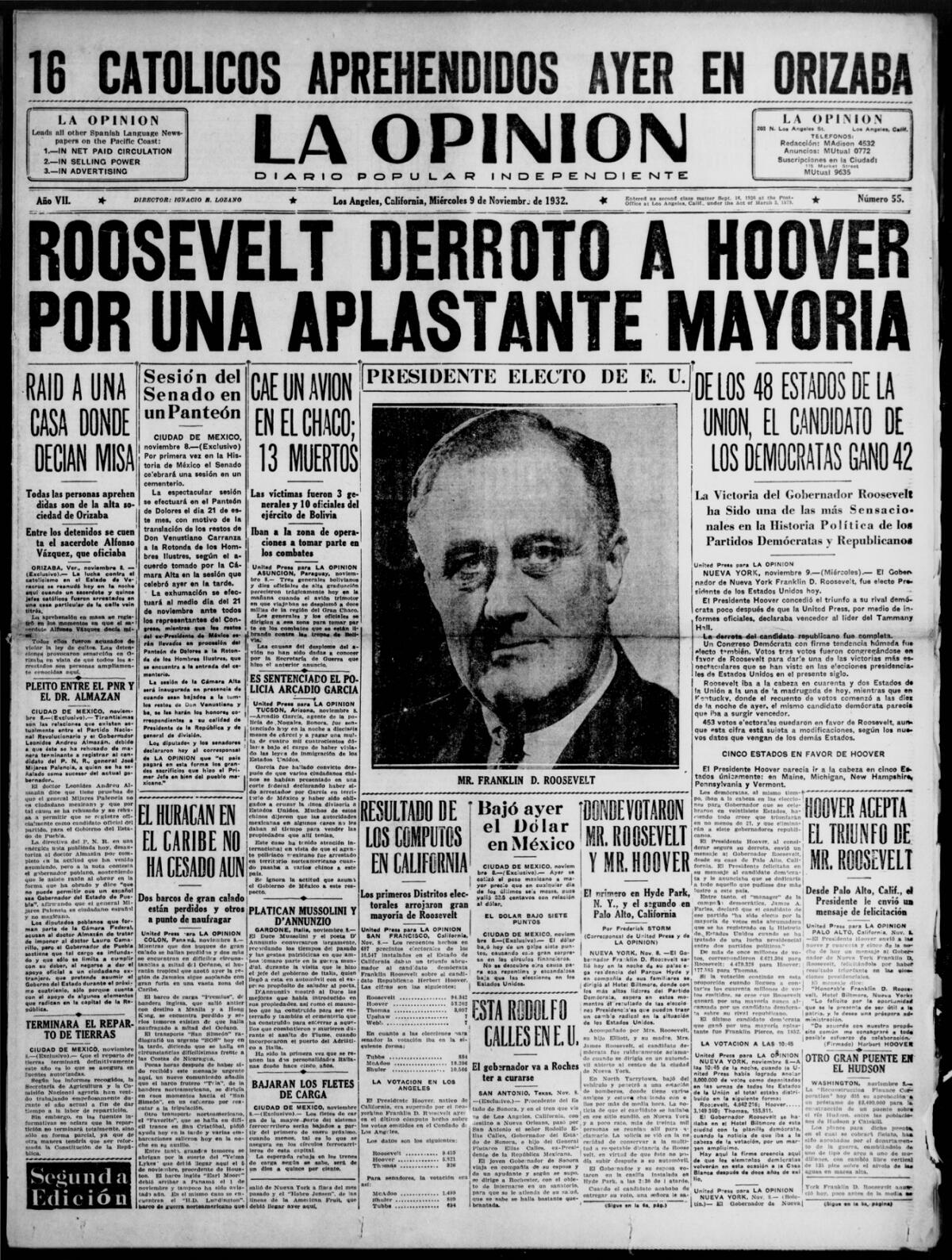
La Opinion front page with Roosevelt Derroto a Hoover
(My Code)
Wednesday marked the 100-year anniversary of the Spanish-language daily newspaper La Opinión.
To commemorate the occasion, my colleague Ruben Vives wrote about the paper’s history, legacy and how it — like many other news outlets across the country — is currently operating with a much smaller staff than in past decades.
La Opinión has chronicled the lives of L.A.’s growing Mexican community for generations. It reached huge levels of influence in the 1980s and 1990s as immigration from Mexico and Central America reshaped the region in profound demographic and political ways.
Once operating with a staff of hundreds, La Opinión‘s staff has dwindled down to 50 full-time employees and freelancers.
“I would say the paper had a dual mission: One was to represent our community and the growing influence it was having,” said Monica Lozano, who formerly served as the paper’s chief executive and publisher.
“But to also defend and make clear that we needed to be seen as an immigrant community that came with aspirations and dreams to provide for our families, contribute to the country and to be considered a fundamental part of the fabric of society.”
La Opinión is now the largest Spanish-language paper in the country and the second-most read in L.A., behind only The Times.
City and company officials say the former site of La Opinión at 302 N. Los Angeles St. will be featured in the city’s online inventory of historic places, HistoricPlacesLA Revealed: Latino Los Angeles, a city initiative that highlights places that reflect the history and heritage of the city’s Latino population.
“The need for outlets like this has become even more critical, people are searching for content that they can trust and is community focused,” Lozano said.
You can read Vives’ full story here.
NBC4 news helicopter crash 
An aerial of the NBC4 news helicopter crash near the Lizard Production building on Wednesday, Sept. 16, 2026, in Chatsworth, Calif. An NBC4 news helicopter crashed Tuesday night in Chatsworth while covering a Metro city bus and motor vehicle accident.
(Kayla Bartkowski / Los Angeles Times)
On Tuesday night, three people were killed after an NBC4 news helicopter crashed and went up in flames in the L.A. neighborhood of Chatsworth.
Veteran KNBC and Telemundo reporter Eliana Moreno and helicopter pilot George Marciniw were killed in the incident. A 29-year-old pedestrian, Edy Gutiérrez Mejia, also died at the scene.
The helicopter crashed in a driveway between two warehouses, smashing into a pair of truck cargo containers while the news crew tried grabbing video footage of a serious collision involving a Metro bus that also left two people dead. Four nearby vehicles also caught fire. Neither of the warehouse buildings were hit.
Both the National Transportation Safety Board and Federal Aviation Administration are investigating.
Moreno grew up in Orange County and received her bachelor’s degree in broadcast journalism and political science from Chapman University. A veteran aerial reporter, she delivered news from helicopters in both English and Spanish for several news outlets beginning in 2010.
Moreno was 38.
“She was just such a light, such a spark plug. She’s teeny tiny. Tiny, but she had the biggest heart and enthusiasm,” Lynette Romero, NBC Los Angeles’ morning news anchor, said of Moreno. “It was really contagious.”
Moreno was also a longtime member of the L.A. chapter of the National Assn. of Hispanic Journalists.
“Eliana had a unique presence in Los Angeles journalism. Reporting from the air, she brought breaking news directly to our communities in both English and Spanish,” NAHJ L.A. wrote in a social media statement. “Her work reached audiences across languages and reflected the vital role bilingual journalists play in keeping our diverse communities informed.”
Stories we read this week that we think you should read
Unless otherwise noted, stories below were published by the Los Angeles Times.
Politics and immigrationArts and entertainmentSouthern California