
(Music: “No One Is Perfect” by HoliznaCC0)
Anne Brice (intro): This is Berkeley Talks, a UC Berkeley News podcast from Strategic Communications at Berkeley. You can follow Berkeley Talks wherever you listen to your podcasts. We’re also on YouTube @BerkeleyNews. New episodes come out every other Friday. You can find all of our podcast episodes, with transcripts and photos, on UC Berkeley News at news.berkeley.edu/podcasts.
(Music fades out)
Michael Bolden: Good evening, everyone. Welcome to the Logan Multimedia Center at North Gate Hall. I’m Michael Bolden, Dean of the School of Journalism. Thank you. This is actually our first major event of the academic year and we’re very excited about here at the J School. This is the finale to our AI Journalism and Public Trust Symposium that we’ve co-hosted today with the Pulitzer Center. Thank you to the team at Pulitzer for their partnership and for the Pulitzer affiliated reporters who spoke earlier today about covering AI. And I have to acknowledge, somewhere in the room is the president and CEO of the Pulitzer Center, Lisa Gibbs, my friend who’s seated in the back. So thank you, Lisa, for your partnership.
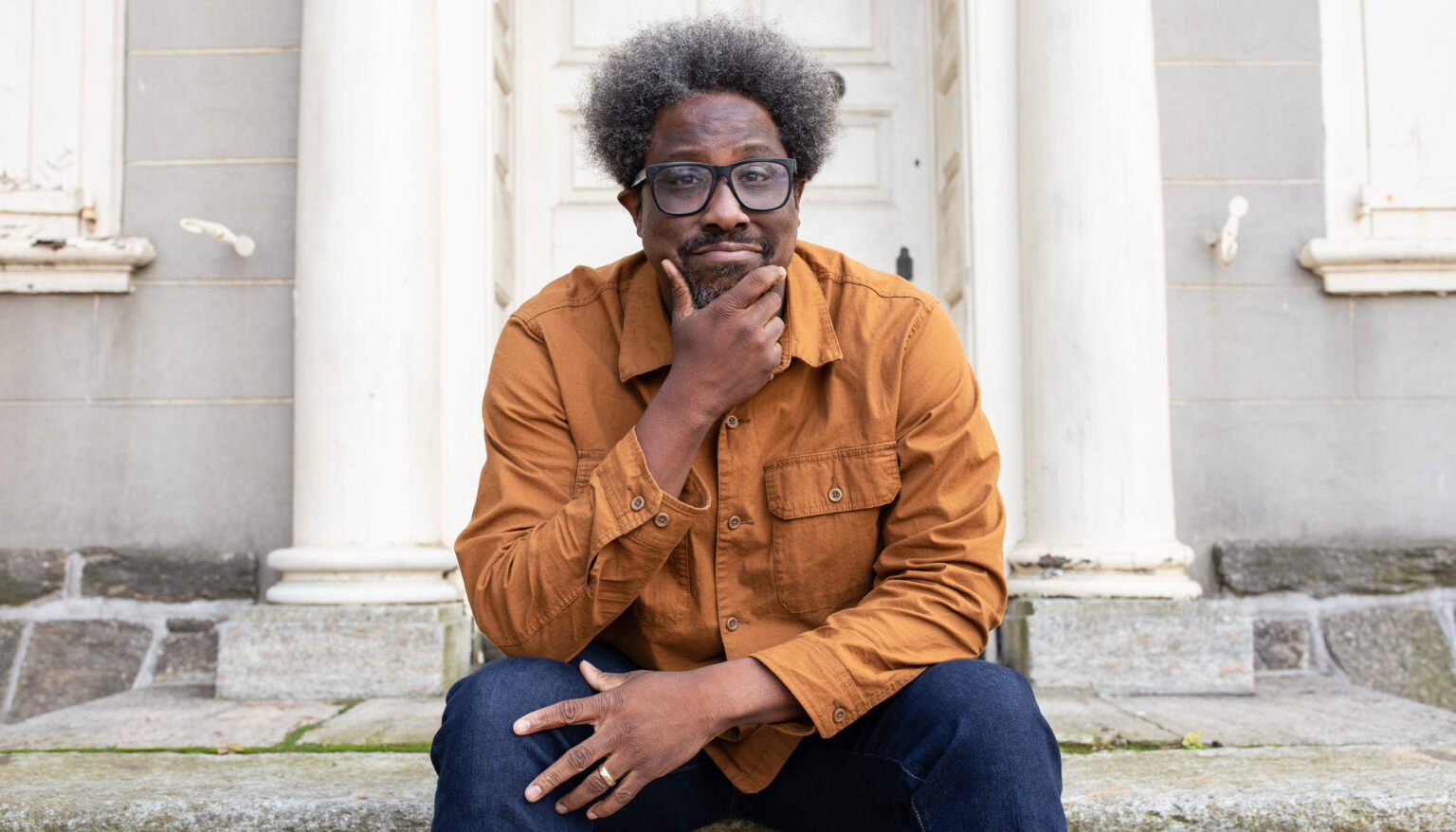
Now on to tonight’s headline event. W. Kamau Bell is one of the most incisive voices today on culture and politics. He uses comedy as social commentary. He was the executive producer of the five time Emmy Award-winning CNN docuseries, United Shades of America for seven seasons. He traveled the country talking with people from all parts of the political and cultural landscape. He won a Peabody Award for his Showtime docuseries, We Need to Talk About Cosby, about the comedian celebrity, his infamy and our culture. He’s also the co-author of the New York Times bestselling book, Do the Work! An Anti-Racist Activity Book following his memoir, The Awkward Thoughts of W. Kamau Bell.
He is no stranger to Berkeley Journalism. In the past, he has recorded right here in our studios just up the hall there. But he and I first met last year in Washington DC, where he accepted the Free Expression Award from the Freedom Forum for using humor, comedy and documentary storytelling to address race and social justice while being a champion of the First Amendment. He always has his eye and his wit trained on the most important issues of our time. Lately, he’s been talking and writing a lot about artificial intelligence, and I’m eager for you all to hear what he has to say, and I’m sure he’s eager to tell us.
So thank you for being with us, Kamau, and special thanks to your mother, Janet, who I understand is also on her way. Kamau, please come on up.
Great to see you. All right.
W. Kamau Bell: A gift bag already.
Michael Bolden: I’m not responsible for whatever’s in that bag. OK. So I guess we should first establish some ground stakes for this conversation.
W. Kamau Bell: Great.
Michael Bolden: Now, you told me you actually are not a technophobe.
W. Kamau Bell: No.
Michael Bolden: So let’s just sort of tell the people about you and technology.
W. Kamau Bell: I mean, first let’s tell the people about the fact that it is so strange to me where my career takes me, just that I’m here right now. Does this mean I get a Pulitzer? All I want to say is I will sit here until I get a Pulitzer. It’s Berkeley. You’re used to sit-ins and lockdowns. So yes.
Michael Bolden: Might be able to give you a parking space. That would be the equivalent.
W. Kamau Bell: That’s a good start. That’s a good start. I’ll negotiate my demands. So yeah, you said … I used to record … The studio’s in the basement. Is it still in the basement?
Audience: Yeah.
W. Kamau Bell: OK. That’s …
Michael Bolden: We do have one in the basement.
W. Kamau Bell: Yeah, they put me in the basement one. I used to record my podcast, Denzel Washington is the Greatest Actor of All Time Period, in the basement, for those of you who who know that podcast. I used to live in downtown Berkeley, so I would walk from my house to here and I never imagined that I was just trying to work my way upstairs a little bit. So I’m happy to be here.
I am not a technophobe, as a person who is … I think somehow being a comedian in the 21st century, it’d be kind of hard to be a technophobe, but also being a kid who was an only child and really fell in love with the TV and that took me to the rest of technology, and as a kid, my mom bought us a Commodore VIC-20. I’m old school.
Michael Bolden: Well, old school would be an Atari, but go ahead.
W. Kamau Bell: But we wanted a learning device, although we did have Pong. My dad did buy me Pong. I had ColecoVision. Yeah, I’m super … Oh, here she is. There’s Janet Bell.
Michael Bolden: Excellent.
W. Kamau Bell: Yeah, she’s heard all this. So yeah. I mean, and I was always a person who was interested in whatever the new technology was. I told you on the phone or on the Zoom, I had a MiniDisc player. So I was always a person who was interested in new technology. So none of this commentary about AI is coming from a person who does not like technology. I am the person in my family where if the TV’s not working, it’s up to Dada to fix it.
Michael Bolden: I think that framing is important for this conversation tonight.
W. Kamau Bell: I’m a person who loves … If you say, “We’re going there, there’s no WiFi,” I’m not going there.
Michael Bolden: Very good. Well then, so tell us, how do you actually use AI? Do you?
W. Kamau Bell: Let me say this. I understand there’s a certain amount of AI that comes baked into things now.
Michael Bolden: Yep.
W. Kamau Bell: So as a writer who writes on Google Docs a lot and Google Docs is like, “Did you mean to say?” Even in emails with Gmail now, you’ll be like, “I’m ready to send my email,” Gmail’s like, “Eh-eh,” and they will start to correct you. And I’m realizing when I see that, “Oh, you want all to sound like the same person.” I know that’s a run-on sentence. That’s one of my trademarks. And if I change it to what … You’re just wanting me to not only correct the grammar, but correct the … because it’s not all grammar, it’s styles of communication. And so if I do that, then the email I send is going to sound like the email I get back and it’s going to level out, and then the people who know me are going to be like, “What happened?”
So yeah, I think there’s a lot of AI I’m getting that is just baked into things and I have to be really … Sometimes it’s like, “Yeah, you’re probably right. That probably would be better spelled correctly,” but a lot of it is like, “Yeah, no, that’s not the way that the king designed the English, but the king wasn’t also expecting me to be here.”
Michael Bolden: So do you intentionally leave the misspellings in sometimes?
W. Kamau Bell: Not misspellings, but grammar. Grammar’s a suggestion. How dare you? I’m not trying to misspell. I’m also a good speller. There’s a lot of things about me, but I’m also like, I understand that the English language is constantly evolving. I don’t think it’s still that way, but I was a kid who was told ain’t is not a word, and Black people sat on that for a long time and they went, “OK, well, OK, fine, but it’s not a proper word. We’ll just keep sitting on it.”
Michael Bolden: I was going to say, well, we can talk about the South a little bit later.
W. Kamau Bell: So I mean, I just know that the language is meant to evolve, so if you tell me that … And to be clear, I actually have a Substack, and I pay someone to edit the Substack. So I’m not against suggestions. That person’s sitting right here.
Michael Bolden: Who is an author in her own right.
W. Kamau Bell: Well, no, my mom doesn’t get to read them early. It’s Kelly Rafferty right here.
Michael Bolden: Oh, sorry.
W. Kamau Bell: Ph.D. So yeah, I’m surrounded by academics and surrounded by people who are like, “Maybe this, maybe not that.” So I’m not against that. It’s the idea of Kelly knows, “Kamau, this is a run on sentence. I know you like to do it, but this one’s running on too long.” That’s different from the computer just saying, “I just don’t like the way this sounds.”
Michael Bolden: Fair enough.
W. Kamau Bell: And then I’ve experimented with AI, but as far as like, “Well, how does this go around?” And now there’s thing where you Google anything and the first thing comes up is the AI description of what AI thinks you want to know.
Michael Bolden: Which could be totally wrong, right, or may have no relation to what you actually want to know.
W. Kamau Bell: Yeah. I mean, you want me to tell the …
Michael Bolden: Yep. Go ahead.
W. Kamau Bell: OK. I mean, we had a pre-talk and I was like, “Are we doing …” I’m happy to say anything. I just want to make sure … I respect you is what this is about.
Michael Bolden: Fair enough.
W. Kamau Bell: Normally I don’t ask questions like that. Normally I just go. So the day that Charlie Kirk died, was killed, I was sort of like everybody, like, “What just happened?”, trying to figure it out. And then I had this question that happens to me a lot, “Have I ever interacted with this person?” I knew I never met him, but I also didn’t know if we’d ever maybe had an exchange on the internet, on Twitter, back in the day on Twitter. And so I Googled my name and Charlie Kirk. This is the day he died. This was within hours of the story breaking. And the AI at the top says, “W. Kamau Bell made fun of Charlie Kirk the day he died,” and had a quote of something that the AI said I had said to Charlie Kirk. And I’m like, “Unless I’ve had a stroke recently, none of this has happened.”
Yeah. And then I clicked on it to see where it went, and it went somewhere where it was like I had posted something and somebody under it said something about something completely unrelated to any of this, but the AI had somehow scraped the internet and decided that I had insulted … And so I screen grabbed it. I still have it somewhere. I sent it to my lawyer, my manager, like, “Do I get to sue Google? Do I get to own Google?” They said no.
But to me, that was the moment I was like … Having that happen to me was a very bracing moment, because I am a person who sometimes when I show up places, they go, “We hired extra security.” So to me, knowing that could happen to me, it was a very big wake-up call.
Michael Bolden: So with that wake up call actually, so if that could happen to you and it’s not something that was real, where does your level of anxiety around AI sit today?
W. Kamau Bell: Actually, I was working on a piece. We’re working on a piece on Substack about this right now. The thing that sort of bums me out right now is the idea that I’m seeing people who I respect, who I know have good ideas just sort of bow down. A lot of what I do on social media is promotion for things I’m doing, for like, “I’ll be here, I’ll be there.” And I’m starting to see a lot of people I respect clearly using AI to promote their events, or, and this is difficult, using, “Donate to people in Gary, Indiana, because the power’s out,” AI flyer. And you go, I get that you don’t want to go through three different versions of this with a graphic designer while they need these things now, but there’s also something weird about this. This is saying that we’re bowing down to this idea.
So for me, that’s the thing I’m seeing. I’m seeing a lot of people who I know, I know you’re not with the idea, the end game of this, I know that you who’s saying, “We need to support people in Gary, Indiana,” also knows that data centers are being put in Black communities and affecting Black communities. I know you know that, but as you sit here on your computer and you go, “We need a flyer for this today,” it’s easier to prompt.
Michael Bolden: Well, and then the flyers sometimes have AI slop, right? People will have three arms and all kinds of things that don’t make sense for the flyers themselves.
W. Kamau Bell: Yeah. And they also, to me, a little bit when I see an AI flyer that is clearly AI, it makes me not necessarily trust the information.
Michael Bolden: Yeah.
W. Kamau Bell: Now, the thing I know, I remember hearing this. There’s a YouTube channel. I’m a big YouTube person as far as watching things on YouTube. There’s a channel called ColdFusion. Does anybody know that channel? ColdFusion is this guy, he’s out of Australia, Black guy out of Australia, and he talks a lot about tech in the business world. The thing he said three years ago, I’ll never forget it, when he was showing AI images of people, and it was at that point fashion models and you could tell they were fake, he’s like, “But just understand, as bad as this may look to you now, this is as bad as it’s ever going to look.” And so I’ve kept that with me with I’m catching this AI stuff now because I have some things I’m looking for, but I have to be aware that I’m not going to be the smartest guy catching AI forever because AI is getting better at it.
Michael Bolden: Yeah. But a lot of people in trying to justify AI, they like to make claims about what AI can do. What’s the most ridiculous claim you’ve ever heard someone make about what AI can do?
W. Kamau Bell: Again, I don’t want to be … I’m not anti-AI. I am a subscriber of it as a tool, but it is a very specific tool. My podcast called Who’s With Me, I interviewed Sara Sidner from CNN, and she had breast cancer diagnosis. She’s cancer free right now. She talked about the Breast Cancer Research Fund and they are using AI to help cure breast cancer. I get that. I get that. But I also know they’re going to double check it. They’re not going to say, “AI, what’s the cure? Thank you.”
I think the most ridiculous thing I’ve seen AI try to do was I was a part of a thing with Vulture magazine where they had AI see if it could write standup comedy routines. So they put in a thing like, “Write,” I don’t know what the prompt is, but they had about five or six comedians, all who had very different styles, and I was one of them, and it was like, “Write a standup comedy routine in the style of W. Kamau Bell.” And from reading that, I was like, “Oh, AI doesn’t have any Black people in there anywhere.” It was a long routine for W. Kamau Bell that did not mention race, America, Blackness, politics. It was like, I can’t even imagine … If I did that, people would be like, “Kamau’s been bought and paid for. Something happened.”
Michael Bolden: Or taken over by an alien.
W. Kamau Bell: Yeah, yeah, yeah. There’s an alien wearing his suit. But yeah, and it was just very clear to me. Again, we remember when cameras couldn’t detect Black people.
Michael Bolden: Which wasn’t that long ago.
W. Kamau Bell: No, I know. It was like six months ago. No, but I’m saying that’s what I understand about technology, which I think is important to know technology is that technology is rarely … well, I say rarely … never invented, generally not invented in mass market with Black people in mind unless we’re the target of it.
Michael Bolden: Well, yeah. So let’s jump a little bit then. So let’s talk about that, right? I mean, so having this technology that seems to be all around us and affecting people, the first question I guess would be how do we even begin to deal with it? And I would surmise that most people in this room are probably better equipped with knowledge about this than some of the average people because we’re on a college campus, etc., etc., but everything that’s going on around us and everything that’s happening, how do you avoid going numb from all of the tech chaos around AI?
W. Kamau Bell: What is it? You don’t have to get angry if you stay angry? I don’t know if that’s the best way to put it. Thank you, 40% of you. The stakes are high. I have three kids at home, so whatever I’m saying about AI, they’re living a different version of it every day. I’ve got a 15-year-old, an 11-year-old and an 8-year-old. I’m also interacting with them about the state of the world.
And so for me to see … I have my knowledge to be paying attention to this, and they’re just growing up when AI is just already there. So for me, the idea of if I have to … The way my mom over here, she’s 89. She doesn’t look 89. She’s 89. We’ll show her ID. I would not be doing what she did if I took my foot off the gas right now and was like, “It’ll all be fine,” because I also think that we are being lulled to think … Even right now, talking about the midterms of the next election, there’s a sense of like, “Well, once we get it back …” It’s a pendulum.”
Michael Bolden: Well, there’s no going back, is there?
W. Kamau Bell: There’s no going back. And I think we also are misunderstanding how history works, world history works, if we think it always goes back or that countries don’t just collapse occasionally, and so I think the idea being that I feel a real, to my own detriment as a person who also has to feed my family, I feel a real sense of, and that’s that lady’s fault, that I got to say something and I got to do something even if the thing I’m saying and doing is calling David Ellison a doofus while the next day I have a Zoom call with Paramount like, “Would you like to buy my projects?” And I’ve done that, yes. They didn’t buy it.
Michael Bolden: But I mean, you’ve raised an interesting point, so let’s circle back a little bit. So you’re raising three children here in the East Bay in the age of AI. I mean, what do you worry about, in terms of how AI is reshaping childhood and the social connections that your children might have?
W. Kamau Bell: I mean, so I think that, again, I wish my wife was there because she’s not anti-technology, but she’s definitely more careful about it than me. I do understand that my 11-year-old, who’s an introvert like I am, has this iPad which allows her to connect with people that she wouldn’t have been able to connect to when I was 11. She’s actually on FaceTime with her cousins. Now you can be like, “You’re on your device,” but I’m like, “No, you’re actually having a conversation with your cousin that you wouldn’t have otherwise.”
So I see it that way. So I definitely think I’m not a take-all-the-technology-from-the-kids person. Far from that. My wife would wish I was sometimes. But I do understand that we have to be constantly monitoring, what are you getting? I say that as I have a 15-year-old now and the connection starts to be, you have to be able to monitor everything, and I don’t want my kid to grow up like this. So she didn’t have social media until she got to high school, and it was like she wanted Instagram, and me and her mom had a real long talk about it, and my wife was like, “I don’t know about that.” I was like, “That’s how these kids talk to each other now. Now we can put rules around it, but I think if we don’t let our kid have Instagram, we’re actually closing her off from her social circle.”
Michael Bolden: So how are you actually teaching them to use the tools? And actually, something that I think is interesting, because of the range of their ages, even how they embrace the technology and their attitudes toward it are probably different because the 15-year-old is going to be different from the other one, and …
W. Kamau Bell: The 11-year-old.
Michael Bolden: Yeah, yeah.
W. Kamau Bell: Yeah. They’re also just weirdly different people.
Michael Bolden: Right. They’re all girls, right?
W. Kamau Bell: They’re all girls. Yes, yes. Yeah. I mean, one thing that we have done, and I’ll give my wife a lot of credit for this, is be very clear from day one who our family is and what our family’s about and what goes in our family and what does not go in our family. And I will say, but we also like to have a good time, so it’s not exactly like, “We don’t have fun,” or, “We do between 8:15 and 8:30.” No, I’m their dad and my wife married me, but there is a sense of our kids didn’t have the, “I need social media” thing that some kids have at their age because we’ve been talking about it their whole lives and giving them the reasons why we don’t do that. It doesn’t mean they always like it, but they understood coming in this is what it is.
So I think some of this is about really being actively aware and not giving up to the thing, my wife is good at this, just because everybody else is doing it. Like when does your kid get a cell phone? Our kid got a cell phone when she turned 13, which we thought was the right age, but then around 10, kids started showing up with cell phones around her, but we had had our kid, 13 is when you get it, so she sort of, “OK.” But then guess what happened? 13 came. My wife was like, “This was faster than I expected it to be.” And my kid was like, “I wrote it down,” which she had. And I told my wife, “Do you want to break this promise? Do we want to be those parents?” And so we did it. But I just got a text, but my wife, now we have the … The iPhones, for whatever they are, do have very good parent controls, ways to make your kid’s phone less fun.
And so we engage those things, but I think it’s also about, we are very clear with them about that, and they also know they don’t live in a house where we’re afraid of technology. And also, I have to get over the fact that I’m talking to my 11-year-old and I’m like, “What do you mean you get a calculator at school? I didn’t get a calculator at school. Those were for rich kids.” Their education is different than my education, so some of that is also about learning about how my expectations of what they’re doing are different than they actually are.
Michael Bolden: So is the 8-year-old sitting there counting the years and saying, “OK, at 13, I’m going to get my phone,” or is the expectation from her that …
W. Kamau Bell: Well, how about this? The fact that the 11-year-old is like, “My birthday’s in October. Her birthday is in May. So if I’m 13, then that means I’m actually in the next year of school, which means I start that year of school without a phone. I need it in the summer.” We’re saying the summer between these two years of school.
So yeah, it happens when your kids are smart. And that becomes part of the discussion because I was like, “Yeah, if you were to start whatever it is, eighth grade or ninth grade and you don’t have a phone, we’re waiting for this arbitrary day in October that’s your birthday to give you the phone,” so we’ve had those discussions.
Michael Bolden: Man, it was an entirely different discussion when we were kids.
W. Kamau Bell: No, it was an entirely different discussion.
Michael Bolden: What did I want? What did I want?
Janet Bell: A color TV.
W. Kamau Bell: A color TV. I wanted a color TV. That’s why you bring Janet Bell. I think: “It’s not fair that TV’s in color and in our house, it’s in black and white. I get that the world was black and white when you were born, but now they’ve invented color.”
Michael Bolden: Oh, goodness. So in our conversation, and actually in your work, you’ve explored what I’m going to bring up next. We know that tech development and wealth are often concentrated on the coast. Here we are on the West Coast. Rural communities in the Deep South often face underinvestment while bearing the environmental or labor costs. You spent many summers in Alabama and have deep family roots there going back generations, I understand.
W. Kamau Bell: Yes. Yep.
Michael Bolden: And of course, I grew up in Mobile.
W. Kamau Bell: Anybody else from Mobile, Alabama?
Michael Bolden: Well, we do have another Alabaman, but I don’t know if he’s actually in the room tonight. We’ve got somebody from Birmingham.
W. Kamau Bell: Three is too many?
Michael Bolden: Yeah.
W. Kamau Bell: Yeah. We’re connected to the same town in Alabama, which is very funny.
Michael Bolden: Yeah. Yeah. Yeah. Which, OK, I have to take the little deviation since we brought that up. So I’m from Mobile. Your dad lives in Mobile.
W. Kamau Bell: Right now.
Michael Bolden: So just Kamau. So which is better, Mobile or New Orleans?
W. Kamau Bell: I’m going to answer that question wrong. Just so you don’t understand, Mobile, Alabama is the birthplace of Mardi Gras. You don’t know that because New Orleans is loud and they lie. They’re loud liars in New Orleans. Tell Michael Lewis I said so. I know he lives nearby. When I met Michael Lewis, who from New Orleans, I was like, “You know Mardi Gras started in Alabama.” Yeah, so yeah. So Mobile’s better.
Michael Bolden: Yeah. Mobile’s also older. But back to the AI question. So when Silicon Valley builds these systems that claim to represent everyone, first of all, do they miss the reality of life in the Deep South?
W. Kamau Bell: I mean, they miss the reality of life full stop, but certainly the reality … I mean, I don’t know this. Mark Zuckerberg, what are we talking, Meta has to pay $18 billion, an $18 billion settlement, and I’m one of the people that’s like, “That seems light.” So I think that we are very aware that the people who control these platforms and control this technology, maybe they … Remember Google’s, what was it used to be, “Do no harm,” or …
Michael Bolden: Do no evil?
W. Kamau Bell: Do no evil?
Michael Bolden: Yeah.
W. Kamau Bell: And then that’s not the way it is anymore. Kamau Bell and Charlie Kirk are beefing. Oh, really, Google? So I think the idea being that we have to really understand that these people have been very clear about they’re not in it for humanity just generally. And if you’re not in it for humanity generally, that means you’re definitely not in it for humanity. You’re already preferencing the cities and you’re definitely not in it for poor, rural, Black and brown areas and Indigenous areas for sure, because all those places are to you are places to build your tech centers, which is what they’ve done outside of Memphis and other places, and apparently talking about downtown Oakland. That’s what rural means, downtown Oakland.
Michael Bolden: Yeah, because Black people are there.
W. Kamau Bell: Yeah, Black people, Black people.
Michael Bolden: But to that point, so Tommy Tuberville, who’s a candidate for governor of Alabama …
W. Kamau Bell: Ex-football coach, everybody. He’s a football coach in Alabama. Said, “That seems like a senator.”
Michael Bolden: Well, yeah, former football coach of Auburn, and there’s an entire debate about whether or not he actually lives in Alabama.
W. Kamau Bell: Of course not.
Michael Bolden: But he’s touted putting data centers in rural areas like northern Mobile County and that the data centers will help the state be able to quote “take care of the elderly, the veterans and the kids that need food.”
W. Kamau Bell: Because those are the words you say when you’re a Republican politician in Alabama to get anything done. It’s going to take care of the elderly and the military. Those are the buzzwords, and rural. Those are things you say. When we know that these centers, first of all, they’re damaging the environment, but Republicans in Alabama don’t care anything about the environment. It’s where they do, but not in a meaningful way. And they’re not bringing jobs and they’re going to put it next to a private majority Black community because that’s what they do, and then they won’t have to worry about if it damages the environment.
Michael Bolden: Well, because actually in Alabama, I mean, we see these things happen and then they’ll do things like make it impossible to get a driver’s license or to vote, or you’ll be in a community where you’re still piping raw sewage on the ground because of the lack of investment in infrastructure.
W. Kamau Bell: And we’re talking about communities where you’re already people feeling disenfranchised just based on the idea that they’ve never seen politicians work for them before, so you don’t even have to tell them not to vote because they feel totally disconnected.
Now, there’s an organization called Black Voters Matter, which is in the South. It’s based out of the south, which is going around actively registering Black voters in the south because so many Black voters have been completely disenfranchised by the system, they’re not even thinking about voting. And so therefore, there’s a natural vote suppression in the south based on gerrymandering and other things.
Michael Bolden: Yeah. Well, we could go on all night about that.
W. Kamau Bell: I don’t know if they want … Yeah, go on all night about gerrymandering. Yes.
Michael Bolden: So with this sort of systemic problem, and we alluded to this a little bit earlier, so what happens when we take that neglect and the historic human prejudices and feed them into algorithms to automate decision making that underpins things like generative AI?
W. Kamau Bell: I mean, it’s the same that we talk about. It’s how you get the cameras that couldn’t see Black people. It’s like once you feed in bad information, bad outputs come out of there. And so my job, I feel like one of my main jobs is just to, in the morning, listen to Democracy Now like this and figure out, “How do I make this funny?” I know there are other news outlets too, but I just like that one. And I know Amy Goodman a little bit, the least funny news possible. Lovingly, lovingly. Why should she be?
But the idea being I hear all this stuff and I figure out how do I then translate this to people who aren’t going to spend the time doing what I’m doing here? Because I think that’s the key part that I feel is a certain responsibility to be like, yes, I like being funny. Yes, I like having a good time. Yes, I like telling jokes about my kids and I have a ton of jokes about my kids, but there is a real sense of that I feel like that we’re at a tipping point of world history, this country’s history, that I feel like necessarily, especially as my hair gets grayer as I sit here, that I feel I have to do something. I have to say something.
Michael Bolden: Well, part of what you’re doing is keeping the human cost in the conversation, which so often gets overlooked.
W. Kamau Bell: That’s what I meant to say.
Michael Bolden: That’s why I’m the dean, Kamau.
W. Kamau Bell: You should run a journalism school.
Michael Bolden: I never thought a boy from Alabama would be sitting here doing that.
W. Kamau Bell: Neither one of us though boys from Alabama would be sitting here, so look at us.
Michael Bolden: Right. So one of the beauties of comedy, it really relies on shared human pain, absurdity, timing. Code can try to mimic those elements. It can’t feel them. As a comedian and storyteller, what do you think a machine fundamentally fails to understand about human art and comedy?
W. Kamau Bell: Why would the goal be for a machine to understand that?
Michael Bolden: Some of the tech bosses would say that’s what they’re trying to do.
W. Kamau Bell: And you know what they are? They’re not art critics. It is so interesting because whenever you look at the people who run the tech companies, very rarely are they even computer experts. If you look at some of the resumes, they’re not qualified to do the thing that they’re doing, but they’re good at talking to people and getting them to give them money.
So to me, the idea being like, I don’t know why … There’s a comedian named Stavros Halkias, who I’m going to butcher the joke, but the idea was like, “Wasn’t AI supposed to do all the work so we could make art? Why did we flip it?” Yeah, Stavros said that, not me. So the idea being that why would we want to put AI in a position where we were even competing with art for … I don’t even understand the question.
I mean, there’s another one. The platform Sunos, which is AI music, this guy said something to the effect of like, “Nobody likes all the hard work that goes into making music.” That’s actually why you do it, because it’s fun to struggle.
I have a book that’s due Sept. 16 that I have written one chapter of. Please don’t tell my publisher. I am sitting here right now going, “I could just knock this out while we talk.” I could get on my phone right now and be like, “Here’s the premise prompt,” and be done and then text it to her while I’m sitting here talking to you. First of all, I don’t believe in that, but second of all, where’s the fun in that? The fun is in that on Sept. 15, I’ll be up at 4 a.m. like I’m a college freshman like, “Oh God, whose idea was this?” And out of that, some idea will come out. “That’s great. Where did that come from?”
Michael Bolden: But hey, that’s what journalists do. They love to crash on deadline, too.
W. Kamau Bell: Yes. Like, what is … why would we want … Do we think the Beatles were the Beatles because it was easy? I don’t understand what we’re even talking about.
Michael Bolden: There’s beauty in the struggle, right, and it’s like, “I can create this.”
W. Kamau Bell: Or the idea that even if there’s certain level of … I think there are musicians and artists where it just sort of flows out, but it flows out from a place. It doesn’t flow out from an algorithm. So I don’t even understand why. Here’s the thing I do think is close approaching.
So Spider-Man: Brand New Day just came out. Superwoman just came out. There have been things that come out that there has been concept art from both of those movies, some of it was created by AI. If you buy the Spider-Man: Brand New Day concept art book, there’s pictures where people have said, “This is clearly AI.”
Those studios want AI movies, especially of a blockbuster like that. They may let you weirdos make the indie sort of … the character dramas, but there’s no reason to work that hard to make these big blockbusters. And I watched some of those big blockbusters. Spider-Man: Brand New Day was great, I thought, but they want to eventually just go, “Tom Holland, we will pay you X amount just for your likeness and to promote it and we will then take it from here.”
Michael Bolden: Well, because then they don’t have to spend $300 million to make the movie.
W. Kamau Bell: No, but they will not charge us less to go to the movies. It’s not like, “Oh, now all art is free.” They’re not going to do that. They’re probably going to raise more money. “We used a lot of AI on this. This new movie has the most AI that’s ever been used, so the tickets go up a price.”
Michael Bolden: Well, and actually I would be remiss if I didn’t, in this conversation, didn’t mention one of the most creative persons who’s ever lived who just passed, Dolly Parton. No AI could do Dolly Parton, right?
W. Kamau Bell: No. And here’s the weird thing about this, and I posted this yesterday and it’s funny, a lot of people respect it. I said, “Dolly Parton is on the list of white people that Black people don’t play about.” And there’s a lot of white people who are like, “What does that mean?” That’s exactly what I got online. But do the Black people in the room know what I’m talking about when I say … Yeah, thank you. OK, there we go. There we go.
Black people, we don’t play about Dolly Parton. I don’t even know why that is. You know what I’m saying? I can’t even point to the eight things that Dolly Parton did that I’d be like, “That’s why I feel that way about Dolly Parton.” When I tweeted that, I’m like, “Is this true or is this just me?” And I sent it out and people were like, “You right, brother.”
And then white people were like, “I’m going to need you to explain.” And I was like, “I’m going to need you to Google. Don’t read the AI part at the top.” But what I’m saying is there’s something Dolly Parton did that let Black people know she’s one of the good white ladies. She’s not like the rest. She speaks so well.
Michael Bolden: She was down.
W. Kamau Bell: Yeah. Yeah. I think it’s maybe from Appalachia. Anyway, just the way it is. I’ve spent time in Appalachia and you have to be close to everybody up there because there’s no getting out of town. But yeah, it’s the idea that there’s something that Dolly Parton had that resonated with people, with Black people in LA, even though she was from Appalachia in Tennessee, that AI can’t reconstruct. We can’t go, now that Dolly’s passed, “AI, please create a virtual Dolly Parton.”
Michael Bolden: Oh, well, so I’ve got one for you. I was in this conversation at the Aspen Institute recently, and so we were considering … There’s actually a company here in Silicon Valley that’s developing grief bots to create virtual representations of people after they pass. What do you think about that?
W. Kamau Bell: My mom just went, “Oh God.” How much do they cost? This is those times you go, “Are we broken?” I just think that the idea … And I mean, this is the other part. We all know that many of those Silicon Valley billionaires are all working in life extension and all trying to figure out, the guy who’s like, “I’m only 50 years old,” yeah, brother, are working it.
So there’s this idea that, I get the want to live together. I get the want to let people live longer, healthier lives. I don’t get the trying to beat death. And also I don’t get trying to beat death unless you’ve really figured out some sort of Octavia Butler spell that she left behind. Thank you. I don’t get thinking that technology can do that.
I’m old enough to remember the hologram Tupac at Coachella. Anybody else remember the hologram? And there was a moment where you were like, “Yeah. Ugh.” And they though, they were going to take that on tour. And everybody was like, “That looks … Now I’m sick.” Exactly. So the idea that, again, I think it’s also a way to distract all of us from the fact that life is pretty hard for many of us and AI is not going to make that easier on us. I remember, and now that the media, not you all, you’re all different, but mainstream media can be so compromised in that.
I’ve seen news stories, weirdly it was on CBS News, about a guy who had fell in love with his AI chatbot and they just told the story like, “This is a guy who fell in love,” and meanwhile, literally, they’re like, “And here’s his wife,” and she’s like, “Ah.” There was like, “And his wife’s not done, but anyway.” And this work to be objective, they’re normalizing this thing that is like we should not … He’s the broken one here. It’s not weird that his wife is upset.
Michael Bolden: So Bernie Sanders recently said that he just thinks the effects of AI are cataclysmic, and he advocated for pausing AI development. Do you agree? Do you think that could get any traction?
W. Kamau Bell: I’ve never thought that you can stop technology from moving forward. I’m not trying to be like … I just think that what you can do is go, “While this is happening, what can we do?” I mean, we talked about this, the idea that I was of the generation, they said, “There’s not going to be any more record albums. There’s no more vinyl. Vinyl’s going to be over because CDs have really come here.” And there was a period where vinyl went down and then a lot of people went, “Whoa, whoa, whoa, whoa, whoa.” So I think there’s a way to sort of, how can you invest in things that are not AI to keep those structures around and to keep people doing laps of reps of not AI so we can all remember how to be human is the question.
I mean, Kelly, I keep pointing to these two people over here, but Kelly, we were working on this piece about AI for my Substack that I thought was going to be out today, but it’s not because I had a lot going on, Kelly. I’m sorry. But her wife is in a band called Mutt, a great band, and they were on a festival, a music festival, and the festival, the flyer was just marker on a white piece of paper, “Music festival. These are the bands. Gate and time,” which is a way of going, “This is not AI. This is a real thing you’re going to experience.” And people got it printed up on t-shirts because there’s a sense for when AI is coming for you, what can you do if you’re not with it? You can go the other direction.
And again, I get that AI is a tool that we’re using every day in predictive text and all sorts of things, but we don’t have to submit to it. Dr. Dre just said AI is just a tool. It’s easy to say that after you’re a billionaire. You know what I mean? It’s just the idea that there’s been lots of musicians and lots of people and people who I like and respect. Martin Scorsese says he’s using AI. You know what I mean? The idea that I think Matt Damon or Ben Affleck just sold an AI company to Netflix.
Michael Bolden: Yeah, he did.
W. Kamau Bell: The idea of being like, these are people who have done work that I respect and have enjoyed, but it’s also like, “You’re a compromised asset here. Why would I trust you?”
Michael Bolden: But it’s interesting, this point you bring up too. I was thinking, so between the conversation that we had last week and today, one of the things I did this past weekend, I was out in an old record store in Albany going through the vinyl because it was sort of an antidote to some of the stuff that surrounds me on a daily basis.
W. Kamau Bell: Yeah, I think that there has to be a sense of really reaching for the opposite of that and getting back in rooms with each other, and I’m not saying I’m anti-Zoom, but I do think there’s got to be a sense of those of us who don’t want to turn our lives over to AI or just go, “OK, billionaires, you take it from here, let me know where I fit in,” that we have to actively work to make sure we’re doing the opposite of that, whatever that means for you.
Michael Bolden: Yeah. So on college campuses, I mean, especially in graduation season, we saw a lot of people speaking out against data centers and AI and really trying to draw attention to the issue. Do you sense, do you think that’ll become a defining issue for this generation?
W. Kamau Bell: I think that issue is off the tree of oligarchs and technocrats and billionaires. I think that’s the defining issue of our time and how they then use their means and power to create the world they want to see. So I think AI is a big part of that, but I don’t think it is the issue. I think we are just seeing it in this way right now.
Michael Bolden: So where do regular people then, where do we actually have leverage? Do we?
W. Kamau Bell: Well, yeah, leverage to do, I guess, what? I mean, leverage to … We could go outside right now and block traffic if we wanted to.
Michael Bolden: Let’s go.
W. Kamau Bell: I got the evening off. My wife’s with the kids, so I can do that for a few hours. Of course we have leverage, but I think the idea, and just yesterday, again, another thing like, “How did this happen?” So a good friend of mine, a mentor of mine, my pastor, Pastor Michael McBride, he’s got a church here in Berkeley, the Way Christian Fellowship here in Berkeley, who I met 10 years ago when I first moved back to Berkeley when I was doing podcasts here, and he is an old-school social justice pastor in the tradition of the civil rights movement in the 21st century. So you say do we have leverage?
He called me up and he was like, “Hey, there’s a press conference to get Gavin Newsom to sign a bill to study reparations in California. I can’t be there. Can you be there?” I said, “Where is it?” He said, “Sacramento.” I said, “What time is it?” He said, “9 in the morning.” I said, “Hello? Who’s this? Wrong number.”
So here’s what I feel. I was like, “Yes, I can be there. Do I really want to be there? Not really. Nothing against 9 in the morning or Sacramento, but can I be there? Yes.” So for me, the question is: What are you willing to do? And also, in the grand scheme of things, going to Sacramento to speak for five minutes, even though it’s not a thing that when I was a kid watching Eddie Murphy on SNL being like, “I want to do that,” it feels like I’ve sort of moved off the path a little bit, but it is the path that I’m on apparently.
So for me, the question is: We all have things we can leverage. We all have things we can do. We all have people we’re in community with. We all need to build more community around us and strengthen community ties around us, and then we will be better able to make decisions with community.
So because I met Pastor Mike 10 years ago and we have been … Actually, that’s funny. I met him in the basement here where we recorded the podcast. I emailed a group chat of influencers and activists going, “Is there anybody here who can talk about Ferguson?” And he was like, “I can.” I go, “Where are you?” “Berkeley.” He’s like, “Oh, come down the street.” So that was here. We have built community for over 10 years now, and that led him being able to call me and go, “I can’t be there in Sacramento tomorrow. Can you be there?” And I was like, “I can be there.” So to me, the idea is, do we have leverage? Yes. What is your leverage?
Me and Kate Schatz wrote this book, Do the Work, that was all about … Part of it is about figuring out what your privileges are. There’s a section called “Check Your Privilege” where there’s a list of things and you check which ones you have. Some of them are like, “I’m over six feet tall,” because it’s a privilege to be tall in this society. Some of them are like, “I am George Clooney.” You know what I mean? There’s different levels of privilege. Not over six feet tall, though. And then some of them are not afraid of an extra bill, not afraid of an interaction with a cop. Why do we do that? Because people have to see what their privileges are, because once you know what your privileges are, you know where you can put leverage.
Michael Bolden: So the other side of that, I guess, what does accountability look like in an era when we seem to be having tech people self-police themselves?
W. Kamau Bell: Or not self-police themselves.
Michael Bolden: Or exactly, not self-police themselves?
W. Kamau Bell: I mean, I would give you an example. This is just from the Black community since we’re people. What, was it last year, two years ago, after Trump got in, Target said no more DEI?
Michael Bolden: Yeah.
W. Kamau Bell: And Black people, who love Target like we love Dolly Parton, maybe not that much, but we’re like, “Huh.” Target stocks a lot of Black businesses and a certain percent of Black people said, “I’m not going to go to Target anymore.” A little bit, I was first, I was like, “Are we really able to do that? Is this really a real boycott?” We were able to do that, and it affected Target’s bottom line. Target keeps trying to figure out how to come back from that.
And again, Target is a place that we felt safe shopping, we felt comfortable shopping. And that was not the kind of organized, sustained boycott that MLK did with the Montgomery bus boycott, but it was a legit action that did affect the bottom line of the company that we were looking at. And I think that I take all those things super seriously. It’s easy to look at those things and go, “Eh,” but I think those things exist in this world and we can all figure out ways to participate in ways to say no.
Michael Bolden: Well, because on the other side of that, right, I mean, so Target did what it did and there was the response, but Costco benefited on the other side because …
W. Kamau Bell: Yeah, Costco’s like, “We love DEI and hot dogs.” And so people were like, “Oh, look at Costco over there.” I think the idea being that that’s where we’re at right now. That’s where we’re at right now. You have to really … I know somebody saw the Target thing yesterday. They have so few Black people in Target right now in decision-making positions. You’ve seen this? That they released a Halloween costume.
Michael Bolden: Oh, the minstrel.
W. Kamau Bell: Yeah, exactly. You said all you need to say: minstrel. Minstrel, a costume with a little Black boy in it as a spooky minstrel. And I was like, “That’s how few Black people you have in Target.” Or there’s probably Black people who are like, “Yeah, good luck with that. Anyway, let me go get my paycheck.” You know what I mean? So the idea being that’s how lost they have gotten since Black people said, “We’re not messing with you anymore.”
So for me, the idea that I think what we have to do, and I feel like this, we have to be loud and clear, and when you can organize people around you, it’s easier to be louder and clear. One of the great things about yesterday when I went to Sacramento to talk about reparations for Black people who descended from slavery is that there were Japanese American citizens there who were saying, “We understand the need for reparations because what we dealt with in our community internment camps.” I was so enthused and excited. That to me, that’s so Bay Area and so California, Northern California, maybe Southern, I don’t know, but that we are doing this together. So I think for me, the big thing is to build bridges in your community with people like you, but also build bridges with people who may not be like you.
Michael Bolden: No, I think that that’s absolutely critical actually.
W. Kamau Bell: Yeah, no, for sure.
Michael Bolden: Go ahead.
W. Kamau Bell: No, no. I just want to be clear when I say that, there are some people who are lost to you and I don’t encourage people wasting their time. I’m not that guy. “Kamau, you met with the KKK.” I didn’t bring a pie. That is a thing I did for television. I’m saying there are people around us every day who are like, “I feel like things are wrong. I feel like things are wrong, too. I feel like the world is going to a worse place.” Those are the people you can reach out to and build with. I’m not telling you to put yourself in dangerous positions or positions where you’re banging your head up against the wall.
Michael Bolden: Actually, how do you make that calculation though? Because sometimes you’re optimistic, right?
W. Kamau Bell: People ask me that all the time. I’m optimistic if we do the work. I’m not optimistic just because yay. So I feel like I’m optimistic, but I also try to be very clear that my life is different than my work. I might talk to a Klan member on television, but I’m not saying, “What are you doing after this?” Mom, you didn’t like this. She hated that. When I talked to the Klan member, weirdly, she didn’t like it.
So in my life, I am very clear about, I’m not saying you get one strike and you’re out, but it’s very clear to me that me and this person are not aligned. It doesn’t mean I can necessarily move my house away from your house, but it does mean that … I think it’s very … Especially as a Black person in this country, I have to be super clear with who I can lean on and who I cannot lean on.
Michael Bolden: I agree with that. I think you have to be very clear about what your values are and where you stand so that people know that.
W. Kamau Bell: And I also have to be clear with my kids to know that that’s what we do. So there may be a teacher at your school that you should not trust, and I want you to know that I know that, and I want you to feel like you can tell me that so we can figure that out.
Michael Bolden: So actually, I want to ask you one more question, then we’re going to go to the audience Q&A. You brought up your kids again.
W. Kamau Bell: Jesus, all the time with this.
Michael Bolden: But one of the things we talked about that I thought was very telling and important is the fact that you go back and forth to South Alabama and you take your kids and you make sure you do that. I mean, it’s important to do that. So tell us about that.
W. Kamau Bell: So this lady over here, Janet Cheatham-Bell, she’s 89, I lived with her during the school year, and then the summer I’d go visit my dad in Mobile, Alabama. And we lived lots of different places, Boston, Chicago, Indianapolis. I was born out here, but every summer I would go visit my dad in Alabama. And this was back in the days, and I’ve told this story a lot before, where she would just take me to the airport and put me on a plane, and then I would be like 4 years old flying to Alabama, changing planes in Atlanta. My kids were like, “Ah.”
At the time, it felt like Alabama wasn’t always the most fun place. It wasn’t always like …
Suddenly I couldn’t see PG-13 movies. It was just weird. When I was at my grandmother’s house, I watched whatever. It was just not the most fun environment. As I got older, and especially when I moved out here in my mid-20s, because my first job was right near campus, and I would tell people in Berkeley, they’re like, “Oh, where are you going? You’re going out of town?” “Yeah.” “Where are you going?” “Alabama.” “Alabama?” People of all different Black, white, Latino, Asian, “What are you going to Alabama for?” “My dad lives there.” “Your dad lives there?” The South to so many people in this country is just verboten. It is the place to not be. It is a place of ignorance. It is a place of violence.
And while that can be true, also so is Berkeley. So the idea being that I understood, yes, there are things there that need to be worked on, but also there’s a lot of beauty there. And so as an adult, I started to really be happy that I spent so much time in the South, because especially as a Black person, our stories, if you’re a descendant of slavery, come through the South, so it’d be ridiculous to sort of freeze them off.
And then as I had kids, it became really important to me to take them to the South as young as possible, as often as possible, so that when you say Alabama to my kids, they go, “We love Alabama. The beaches there are great.” Many of you didn’t know there were beaches in Alabama.
Michael Bolden: They’re some of the best beaches in the world, actually.
W. Kamau Bell: Yeah. They literally call it the Redneck Riviera. That’s what they call it. And so we just came from the Redneck Riviera a couple months ago, seeing my dad. And so my kids have this idea of Alabama, so that to me, it’s important that the South is accessible to you because to so many people in this country, all they’re going to know about what the South is is what AI tells them.
Michael Bolden: Yep. That’s right. OK. So on that …
W. Kamau Bell: Had to bring it all together at the end with the AI thing.
Michael Bolden: Well, you did, and I’m grateful. Maybe I’ll make you a dean here.
W. Kamau Bell: A Pulitzer and a dean.
Michael Bolden: OK. So we’re going to turn to the audience. We have time for a couple of questions, and there are people who have microphones, so raise your hand and somebody will make their way to you.
Audience 1: I’m always interested in the way that the patterns of our lives and the history of our lives converge to create realities in the present day, and I’m really curious about what it is you think about what has converged to create a situation when we’re so willing to give ourselves away, give our humanity away, give our humanness away to some greater power or a corporation. And that’s the way I see AI is, yeah, it can be a tool for good, and I’m sort of in the same vein as you, I support that, but what is it existentially that’s happening to us where we’re willing … So many people, I know intelligent people who are blithely using AI, and I just wonder what is the convergence? Was it partially COVID? Was it partially the fame monster? What is it that makes us want to give our humanity away? Are we anti-human now?
W. Kamau Bell: You take it from there. I feel like you can answer this question. I think that America as a country, this is all baked into how this country started, because this country was started on a myth that didn’t exist. This country was started … There’s twin war crimes, the genocide of Native Americans and the transatlantic slave trade that immediately got papered over as we had Thanksgiving together and the slaves had room and board. So I think that the ways in which we have told the story of America has been faulty. That faulty lie has been bought by many of us, even those of us who should have known better, but how could we have known better? Because it’s the idea that I’m lucky I grew up in household where she’s like, “What did they tell you in history class today? No, no, no, no, no, no, no.”
But the idea being that America, I think this has only ended recently, I said for years, had the greatest publicist in the world. It made sense that Hollywood came from America because we are a country that is about myth building and about selling the lie when the truth is inconvenient. And I think that just being the foundation of this country, the way in which this country was founded, and the way in which this country sort of very early on can … I was going to say, this is a funny thing about this. All the microwave oven is is a technological version of enslavement. Convenience is more important than anything else. So slavery is very convenient if you’re not a slave, and a microwave is very convenient if you don’t have time to cook.
But I think the idea that we’ve prioritized convenience means that you sit at a computer and you go, “OK, I could reach out for a graphic designer by going online and not thinking, or I could make this easier on myself.” And we have been taught to believe that easier, that you work hard, you deserve things to be easier, but often on the back end of that easier is like that microwave is fucking up your food. You know what I mean? Again, I’m not against microwaves, but I’m not cooking a turkey dinner in there. You know what I mean?
So I think the idea being that the way in which we told the story of America has been so faulty that we bought into, and then the people who get to the top tell you, “That story’s pretty true.” I said this yesterday when I talked about reparations. When Black people are successful, we are often used as tokens of, “If he made it, that means Black people can make it.” And I learned long ago, no, that means I got lucky several times. I think it is really convenient, especially when you become a person in a position of power and authority and wealth, and I’m not saying I’m all that, but I am saying that to start to buy your own bullshit, so then you can be Dr. Dre being like, “AI is just a tool. Hey, man.”
I think that’s the idea that we have allowed … I think it also ties into the fact that as much as we were told America didn’t want a monarchy, we just didn’t want that monarchy. We wanted our own monarchy. And you can see that in the fact that, “Lindsey Graham died, his sister should be the senator.” What are you talking about? But she just won her primary. Did I answer any of your questions? We’ll talk later at Pete’s. It’s just the idea that I think this is about how America has sold itself to itself, and right now the cracks are pulling apart is what’s happening.
Audience 2: So my question is, do we have the wrong focus? Because there’s been a lot of things like AI is just a tool, but it’s kind of focusing on how we are using the tool versus do we have the wrong focus? Are we deluding ourselves because who is giving us this tool? Why should we trust Sam Altman, Elon Musk, Peter Thiel?
W. Kamau Bell: Who’ve given us lots of reasons not to trust them, each one of those people.
Audience 2: Or Google, who went from, “Don’t do evil,” to, “Don’t don’t do evil,” right? Are we deluding stuff they’re going to give us a tool that we can use to do actual good versus just being deluded into thinking we can use this to do some good and they’re pulling all the strings and ultimately it’s the illusion of choice or power that we have?
W. Kamau Bell: Yes. Next question. No, I think that the idea being that is so frustrating is there’s certain things that as Americans we take for granted and that it takes a while to sort of break out of, not so much people in this room probably, but the idea that you’ll see people in the news arguing with the idea that healthcare can’t be free. Around the world, they’re like, “What are you talking about you go bankrupt for medical bills. What’s a medical bill?” You know what I mean? And the idea that we have accepted that if you fall to a certain level, then you’re just supposed to be homeless, where in other civilizations they go, “No, no, no. If we have enough, we’ll take care of everybody.”
We’ve accepted the fact that there are countries, developed nations that don’t believe in life in prison no matter what the crime is. They just check in with you every so often and be like, “Are you still … Oh, you are. You stay here.” But the idea that we accept that people should go to jail for life for things that you’re like, “I don’t even understand that the first thing was a crime.”
And so the idea that there are certain things that we have been, again, this is back to what you’re saying, that have been baked into the definition of what it is to be an American … And Berkeley is different. If this is happening in Mobile, Alabama, this right here, actually probably be just the cool people who showed up, but the idea being that this conversation sounds very radical in other rooms, in other places, that it does not sound that radical here.
And so the idea of being that I think that’s why it becomes up to us to really actively reject the framing of these things, and I appreciate what you’re saying about saying AI as a tool. It’s just a way to shift the conversation away, but then there’s a question of should it be a tool? And then there’s also this idea of we have a real limited idea of what the public good is and what society owes you.
And so when you say things like, “Housing is a right, food is a basic right,” there are people who will fight you on that while we’re also throwing away food every day. That’s why I think that whatever’s happening now is not about, “Well, once we get the Democrat on the left in office next time, it’ll be all back to dah dah dah dah dah,” and that’s why I try to really sort of highlight the people in public office who I’m like, “That person is fighting for the people, not for the organization at the top.”
Michael Bolden: Well, because I mean, back to the theme of what underpins a lot of what you do, you challenge the systems, right? And we so often don’t look to the systems.
W. Kamau Bell: Yeah. I guess it is a conscious decision. Yeah. No, I was in New York. Me and my wife were in New York for two years with my first TV show. The show got canceled. And there was this idea of do we stay in New York or do we go back to the Bay Area? She’s got a lot of family out here.
And at some point I was like, I don’t want to be … And New York is fine, but I don’t want to be somewhere where I’m not grounded. That’s a big part of it. If I go back to the Bay, my wife’s family’s there, I can move my mom out here. People have known me for a long time out here. I have relationships like this. I’ve been in this building, whatever. So the idea being that part of my story is not feeding myself to the beast.
I had Megan Rapinoe basically say to me on her podcast recently, “It seems like you could be more successful than you are.” And I was like, “I never thought about that, but yeah.” I don’t even have choices before me that I can make those choices because I’m not in the place where those choices are offered to me. I get things all the time where like, “Come out, this weekend in New York.” “I can’t be there.”
And part of me is like, “Also, that sounds awful.” To me, it’s making sure that I’m not even in position. This only happens because I live in the Bay Area. I’m not trying to say anything, but a plane ticket from New York would’ve wiped out whatever I’m being paid here. But here it’s like I can come be here. He’s getting paid. Come on, I got kids. But the idea being that to be here and to sit here is important to me because this is my community and I know I’m going to run into you somewhere at the farmer’s market and you’ll be like, “I saw you at that thing. I didn’t agree. Great. Anyway, kale.”
Michael Bolden: So we have one more?
Audience 3: Hi. Just wanted to say shout out to Mobile. My granddad’s from there.
W. Kamau Bell: Oh, yes. See, I knew we had one more.
Audience 3: I have a background in astronomy and I’ve watched a lot of folks in astronomy, astrophysics and physics and other academics do the Ph.D. to big tech company kind of well-trod path. I’m curious to hear about your thoughts on that, that machine learning and generative AI was something that maybe started in academic spaces and then was developed into big tech spaces in Silicon Valley. And I’d just love to hear your thoughts on the academia big tech connection.
W. Kamau Bell: I mean, my wife’s a Ph.D. in critical dance theory, so she was not welcomed into tech, but I do understand … (laughs). I mean, critical dance theory, guys. I mean, although she’s more qualified than Sam Altman, which doesn’t take much. OK, I’m going to stop talking. But I am certainly a person who believes in the pursuit of knowledge for the sake of knowledge. I’m certainly a person who believes in let’s just follow our noses and see where we end up. I think the problem is, and one of the reasons that academics end up in those tech spaces is because education will bankrupt you.
And I think the idea is, again, we’re upside down. We’re just upside down. There are countries where they think … Canada’s big on this. There’s a certain amount of funding that goes into the arts because they believe it’s important to have the arts. And it’s funny to say that, but here in America, as we know, every public school’s smaller and smaller art programs, have no art programs, have no music programs.
And so the idea being that I think it’s important for us to prioritize the art and knowledge for knowledge’s sake, and I think the problem is then once you have that knowledge, who are you handing it off to? And as long as we live under a system of capitalism, you’re going to hand it off to the person who has the most money, and we have enough evidence to show that’s never the best person. It’s never the best person, the person who wants to monetize the idea. It’s the person who wants to free the idea. And I think Google, as you said, started with the idea of wanting to free the idea. OpenAI was a nonprofit at one point.
Michael Bolden: Well, not that long ago.
W. Kamau Bell: Yeah, yeah, yeah. So the idea being that American capitalism goes, “Oh, come over here. Come over here.” And I think for me, that’s why I’ve tried not to go over there. I just know that that’s not for me over there. And I think those of us who know that’s not for us, it’s not an easier path, but I do think that we have to have more of us who choose not to just go over there. And it’s also, I’m never the person who’s like, “Don’t take that job. Don’t get your …” I mean, it’s a different conversation that we can have outside, but the idea being that I think those of us who know it’s wrong have to be OK making different choices and saying, “Over there might pay better, but it’s not going to be better and it’s not who I am.”
Audience 4: Thank you for your work generally and for tonight. I appreciated your reminder that we need to use our power to say no, and I’m wondering if there is a future with AI that you want to say yes to.
W. Kamau Bell: Again, I’m not anti-technology. The idea being that yes, I am down for a future of AI that doesn’t exist under American capitalism, which is almost like an Octavia Butler novel waiting to happen because I think that’s the problem is that AI existing under the current system of American capitalism means you get what we have right now, which is like it just is being sort of foisted onto us without the idea of is it helpful to us? I think we all know Meta owes us a lot more money than $18 billion.
Michael Bolden: OK. So let’s end it there. I think that’s a very strong …
W. Kamau Bell: Let’s go get Mark Zuckerberg!
(Applause)
Michael Bolden: (Laughs) Please join me in thanking Kamau Bell for being here with us.
W. Kamau Bell: Give it up for my mom!
Michael Bolden: And for his mom.
(Applause)
(Music: “No One Is Perfect” by HoliznaCC0)
Anne Brice (outro): You’ve been listening to Berkeley Talks, a UC Berkeley News podcast from Strategic Communications at Berkeley. Follow us wherever you listen to your podcasts. You can find all of our podcast episodes, with transcripts and photos, on UC Berkeley News at news.berkeley.edu/podcasts.
(Music fades out)