
By David John Chávez | KQED
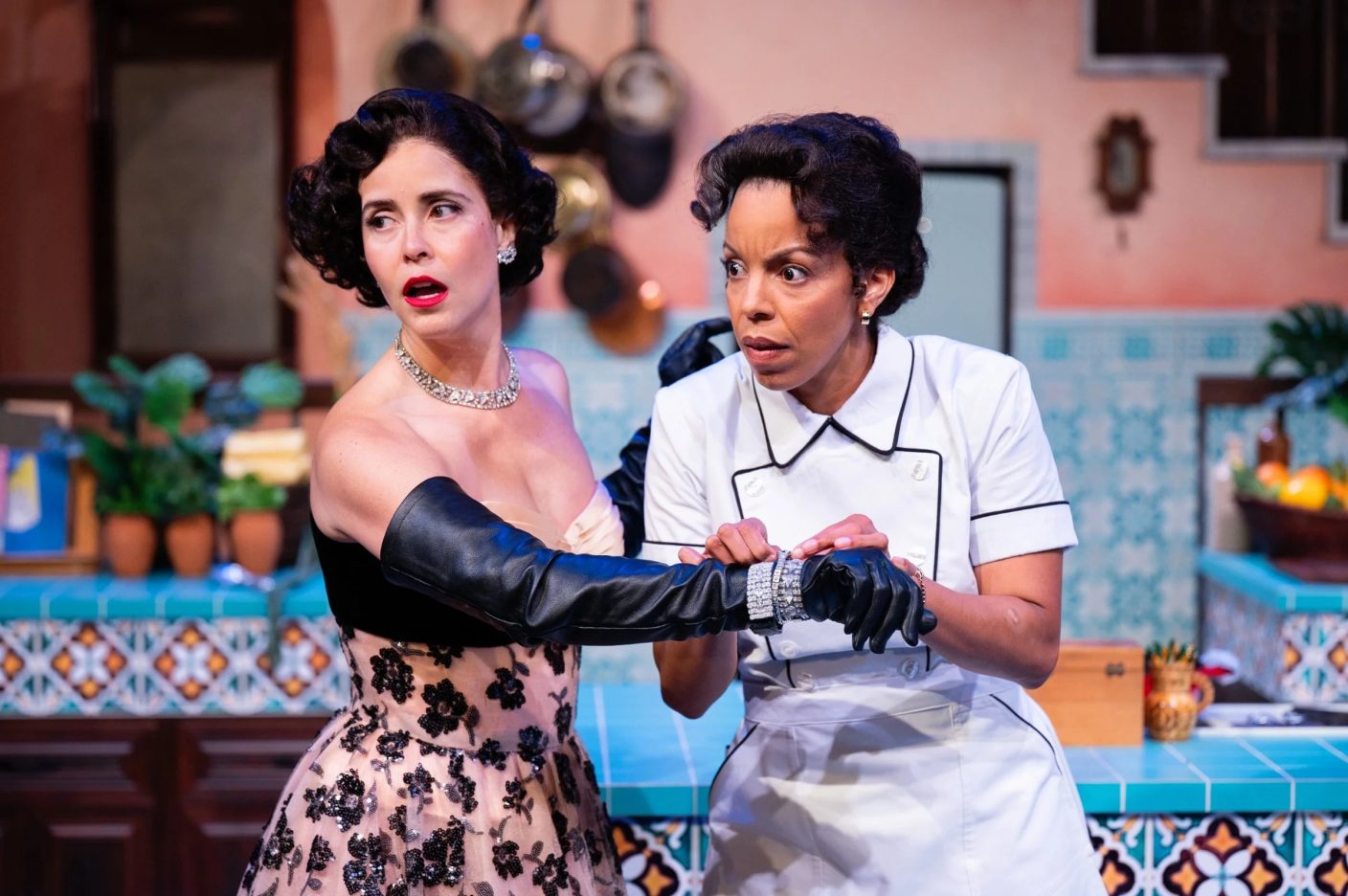
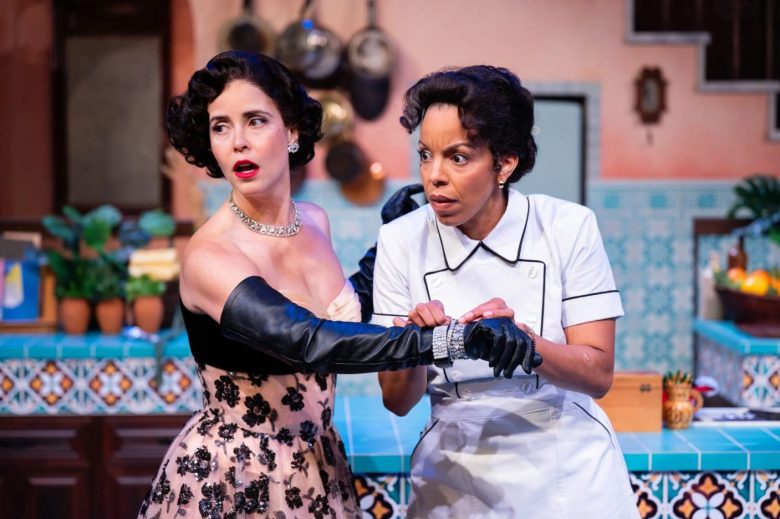 Gisela Chípe and Yesenia Iglesias in Eduardo Machado’s ‘The Cook’ at Berkeley Repertory Theatre. Credit: Ben Krantz Studio
Of all the scents that permeate Gladys’ kitchen in Havana on the cusp of 1959, it’s the aroma of revolution that lies thickest.
In Eduardo Machado’s spellbinding play The Cook, now running through Oct. 11 at Berkeley Repertory Theatre, tension hangs among the pots and pans. Since age 13, Gladys (Yesenia Iglesias) has spent her days preparing meals for Cuba’s upper crust. In The Cook, that means working for a wealthy family which includes mistress Adria (Gisela Chípe).
At the action’s onset, Adria’s priority is to ensure everyone sets their watch back an hour to keep 1958 just a hint longer. The fleeing of Cuban president Fulgencio Batista means that the start of 1959 will see Fidel Castro taking over Havana, forcing the rich family to vacate their home and start life anew in Miami.
‘The Cook’ runs through Oct. 11 at Berkeley Rep’s Peet’s Theatre in Berkeley. Tickets and more information here.
Yet before her Florida life begins with a million other Cuban exiles, Adria wants to be sure Gladys will care for the house until she returns, a promise Gladys accepts without reservation. Later, over the course of three powerful scenes that take place in the early 1970s and late 1990s, we see Gladys shed her servant’s uniform for the period clothing stemming from Adria’s bougie closet, sharply designed by Toni-Leslie James.
On a typically magnificent set from scenic designer Tanya Orellana, director David Mendizabal’s tight and focused direction utilizes plenty of tension. Machado’s writing, while bold, can also feel thinly staccato and uneven, undercutting some of the bigger payoffs the play requires. Still, there’s a quiet power in his words, which never feel overwhelming despite the volume of exposition and Cuban history that Machado includes.
Gladys’ husband sees the gleeful side of revolution
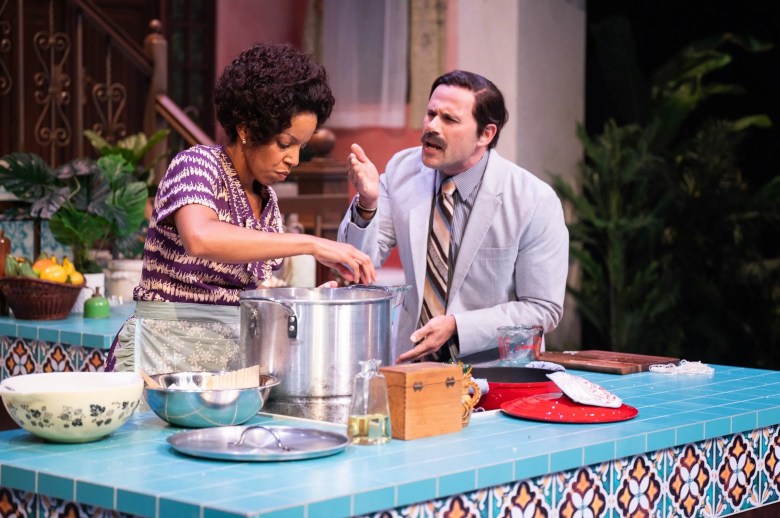 Yesenia Iglesias and Daniel Duque-Estrada in Eduardo Machado’s ‘The Cook’ at Berkeley Repertory Theatre. Credit: Ben Krantz Studio Credit: Ben Krantz Studio
Much of the tension is set up beautifully at the onset, with three dark-skinned Cubans tasked with preparing food for a massive celebration (the ways that light and dark-skinned Cubans engage and interact fuels the narrative further). Helping in the kitchen is Elena (Georgina Morillo, who plays Gladys’s daughter Rosa in Act Two), barrelling through to express grunty consternation, and Julio (Ashton Muñiz), a dutiful helper hiding a secret about his sexuality that threatens “re-education” at one of Cuba’s forced labor camps — the government’s preferred way of building a more masculine society.
Gladys’ husband Carlos (Daniel Duque-Estrada) falls toward the gleeful side of revolution, and as the 1970s roll around, it is clear why. Carlos, a lowly chauffeur, is promoted to Minister of Transportation, and he makes it extremely clear he is now a Communist bureaucrat. The transition puts him among the elites, untouchable to many, albeit extremely touchable to his mistress, who bears a love child.
A highlight of The Cook is how each character leans into any power they possess, a necessity of consolidation inside Communist Cuba, where the United States’ bruising blockade comes into direct conflict with Russia’s sizable funding of the island. While Carlos can save the lives of Gladys’ family members, he chooses not to, being much more willing to put his thumb on the scale of Marxism to get what he needs and defend Castro’s revolution to the hilt.
That revolution was never intended for Julio’s participation, which leads to a scorching scene towards the end of the first act. There is sad poetry in Julio’s belief that he be allowed to live and love as he desires, while flying too close to the sun by dating an 18-year-old son of a diplomat. The utter cruelty of Carlos and the stoic resolve of Gladys, in the hands of Duque-Estrada and Iglesias, especially in a critical moment like this, is majestic.
That majesty leads to some powerful payoffs in the play’s final frame. While the action of the entire play remains in the expansive kitchen, the quarters have now transitioned into a paladar, a home restaurant which the Cuban government caps to 12 seats, with only family members eligible for employment. Chípe as Adria’s daughter Lourdes, chronicling her mother’s history with a simple camera, witnesses the decay of a once regal home.
The play belongs to Iglesias in the title role
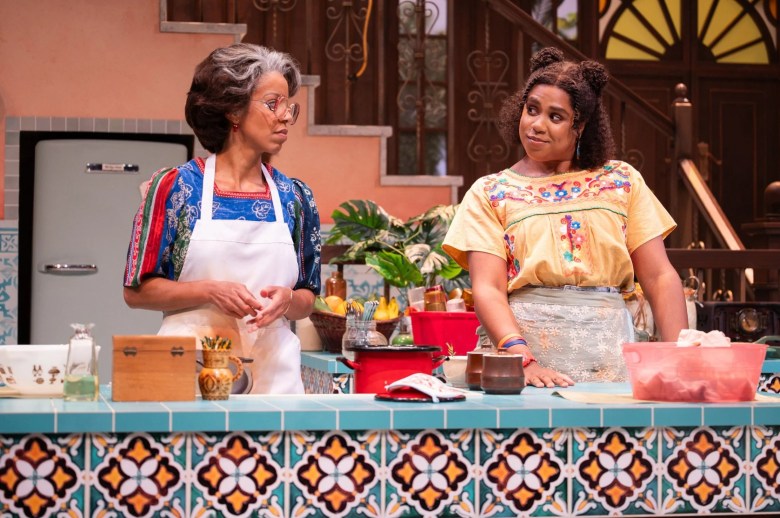 Yesenia Iglesias and Georgina Morillo in Eduardo Machado’s ‘The Cook’ at Berkeley Repertory Theatre. Credit: Ben Krantz Studio Credit: Ben Krantz Studio
Despite Gladys’ loyalty, 40 years of living outside Castro’s Cuba has turned Lourdes’s mother into an enraged expat, and Lourdes uses a racial epithet to express the consternation built from the unspoken tension that existed many years ago. In both roles, Chípe is a marvel, with a searing vapidity that leads to some of the play’s funnier moments, while later employing a strategy that advocates for her mother’s legacy of bitterness.
But the play belongs to Iglesias in the title role, who smartly stays away from clichés while playing each iteration of Gladys across a 40-year span. As the affirmation of the house and its proprietorship have shifted, Iglesias’s journey from dutiful to dominant is a wonderful showcase of range.
The Cook speaks of a different kind of dictator, one who rules her kitchen with loving dominance while serving hearty portions of moros y cristianos. Although a certain type of Cuban life was denied those closest to this simple cook, her eyes rest on what she believes is a more certain future — an uncompromising belief that Rosa will see food she crafts on the world’s finest plates, far beyond the surrounding waters within Gladys’s Cuban heart.
Berkeleyside is a media partner of KQED, a listener-supported public radio station serving Northern California. Berkeleyside occasionally republishes KQED stories we believe will be of interest to our readers.
“*” indicates required fields