
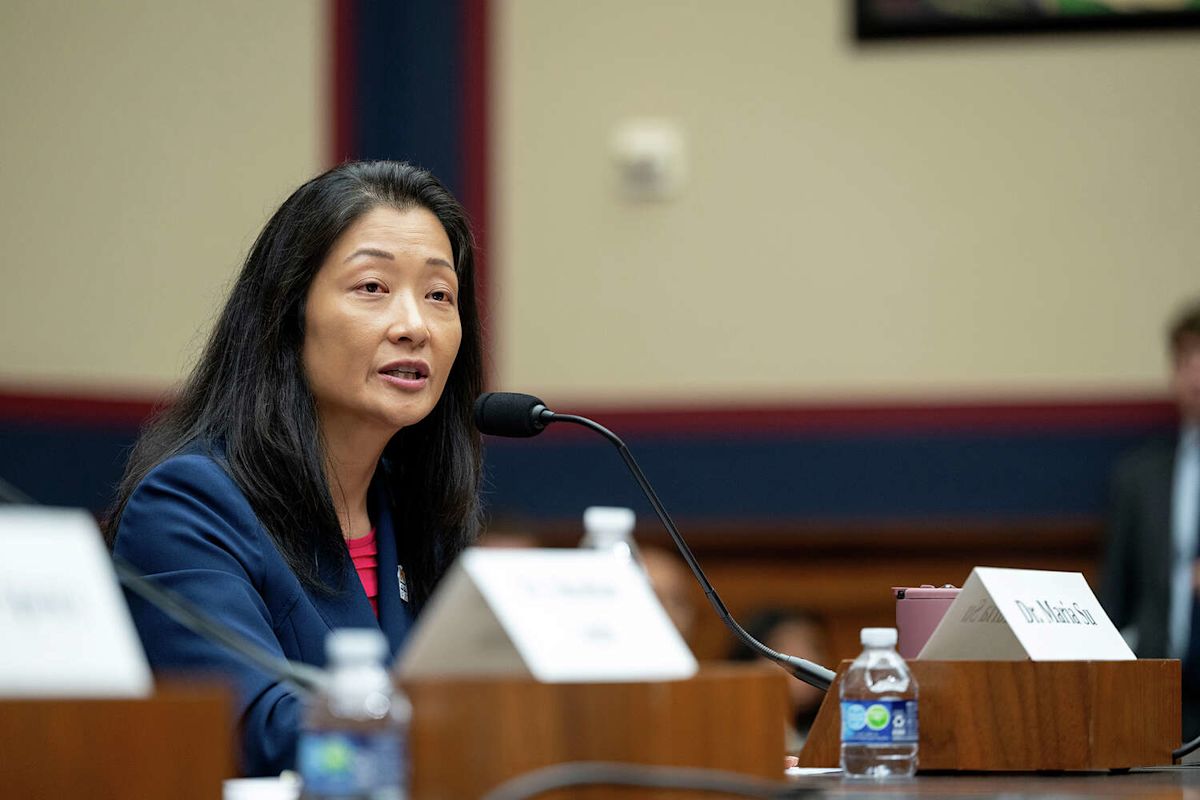
Salesforce’s annual Dreamforce conference in San Francisco always attracts prominent tech CEOs like Anthropic’s Dario Amodei and Nvidia’s Jensen Huang, plus a handful of celebrities like Matthew McConaughey and Reese Witherspoon. But this year it also included a different sort of a speaker who came to talk about artificial intelligence in public schools.
On Wednesday, Maria Su, superintendent of the San Francisco Unified School District, spoke about deploying AI products not in software development, but in the classroom. She argued that San Francisco school teachers need AI tools to be successful.
“We need to make sure we understand the tools that we put in front of our students, make sure we train our educators to use the tools right,” she said.
Salesforce, of course, makes AI tools, and Su’s appearance at Dreamforce comes after Salesforce’s Sept. 14 news that the company announced $18 million in new grants supporting SFUSD and other school districts. SFUSD also signed a contract with OpenAI earlier this year, deploying its ChatGPT Edu product to 12,000 teachers and staff. It’s also currently developing a comprehensive tech and AI policy, on which the school board is scheduled to vote on March 9, 2027.
But as public opinion sours on the AI and tech industry and a “Stop the AI Race” march disrupted Dreamforce on Thursday, Su’s AI advocacy is a step into contentious territory, and some teachers and parents are wary of AI’s advance into the classroom. Su’s no stranger to controversy, facing criticism from San Francisco teachers during their four-day strike earlier this year, and from Republicans over her support for transgender student protections, and now she’s drawing criticism for her AI push. More than 1,000 parents and teachers signed a petition that calls for limiting AI tools and restricting screen time.
Salesforce philanthropy
Su was effusive in her praise for SFUSD’s ongoing, nearly 14-year partnership with Salesforce. “It’s not a one-and-done situation.” she said. “If you commit to us, we’ll commit to you.”

Attendees gather at Salesforce’s Dreamforce conference at the Moscone Center on Sept. 15, 2026, in San Francisco. (Benjamin Fanjoy/Getty Images)
Given that Salesforce is a software company that sells AI products, like Agentforce, it has a vested interest in promoting AI products in new markets, which could include education. Since 2023, Salesforce has made AI a priority with its donations to SFUSD, encouraging training teachers to include AI in their lesson plans, for example. And its philanthropy isn’t new: Salesforce’s latest round of grants follows a previous donation of $13 million last October to San Francisco and Oakland public schools, and its total largesse adds up to more than $156 million since 2013.
Seemingly aware of the backlash against AI in the Bay Area, Su never used the word “AI” in her remarks – in contrast to her fellow speaker, Sheryl Lee Ralph, an Emmy-winning actor who portrays a kindergarten teacher in the mockumentary TV show “Abbott Elementary,” and the moderator, Salesforce Senior Vice President of Impact Sunya Norman. Instead, Su spoke in general terms of “tools.” Throughout the event, though emphasizing the importance of the “human relationship” in the classroom, she seemed certain that such tools would be used by teachers and students. She did not speak of listening to teachers or parents about whether they might want them at all.
In a follow-up interview with SFGATE, Norman said Salesforce has no expectations as to how or whether tech products will be used in the schools.
“It’s not a conflict of interest,” she told SFGATE. “It’s not about getting technology in the hands of middle school students.”

FILE: Students in Lynne Martin’s 5th grade class study math using Chromebooks at Markham Elementary School in Oakland, Calif., on Thursday, Sept. 5, 2019. (Paul Chinn/The San Francisco Chronicle via Gett)
In a statement, the school district did not answer SFGATE’s questions about potential impacts of AI products on students’ critical thinking and mental health. Instead, it included a reply from Su that said, “SFUSD recognizes the urgency of establishing clear, thoughtful guidance around student screen use and artificial intelligence as these technologies continue to evolve.”
The statement also pointed to the district’s webpage on Generative and Agent AI in SFUSD, which outlines general recommendations for classroom use of AI products like ChatGPT, such as for lesson plans and student art, while noting concerns about AI inaccuracies and student privacy.
Questions from parents and teachers
Similar to a debate over AI use that’s currently surrounding the California State University system, reception to the rollout of tech and AI products in schools from San Francisco parents and teachers has been mixed. On policies from AI in classrooms to cellphone use by students, parents want more transparency, said Emily de Ayora, communications director at nonprofit San Francisco Parents Coalition.
“We’re not opposed to tech tools,” she said. “We just want the district thoughtfully listening to parents, hearing their concerns, and including those in the process of building out policies.”
Adlah Chisti, another member of the group and a former teacher, went further, telling SFGATE that the school district has not provided data on the costs of the AI technologies or whether the AI products have any benefit for student success rates. She also laments the lack of regulations from city officials so far. “We shouldn’t be using SFUSD as labs to figure out this stuff,” she said.
Cassondra Curiel, the president of the United Educators of San Francisco union, who previously faced off against Su during the teachers strike – which was partly over limitations on the district’s use of AI – expressed a similar sentiment. “After making students and teachers lab mice, there has not been any data to show those tools advance the learning of students,” she said.
Both Chisti and Curiel, an English teacher, cite Amira as an example. The district introduced the AI reading tutoring tool last year, without consulting the union, Curiel said. (In a statement, SFUSD spokesperson Katrina Kincade did not respond to SFGATE’s question about communicating with the union, instead saying that the California Department of Education approved Amira in December 2024. “In our schools, we utilize Amira to practice reading fluency as an optional supplemental tool to the curriculum,” she said.)
Curiel argues that using Amira increases teachers’ workload, rather than reducing it, and limits much-needed student-teacher interactions as students strive to catch up with their peers’ reading skills, at a time when a majority of Americans read below a sixth-grade level, according to a Gallup analysis. In addition, Amira does not perform well with students who speak with accents or speech impediments, she said.

Maria Su, superintendent of the San Francisco Unified School District, speaks at Alice Fong Yu Alternative School in San Francisco, Sunday, May 18, 2025. (Jeff Chiu/AP)
In addition to reading, the AI tools could also change how math is taught. At the Dreamforce event, Su compared new tech tools to calculators, arguing that calculators did not harm students’ ability to learn math, despite some fears when they were first introduced. Yet the latest research on AI in math isn’t promising: A new study by researchers at UC Irvine and the educational publisher McGraw Hill that’s in peer review finds that high school students spend 30% less time on math homework problems that they can copy and paste in AI chatbots, and their performance drops 25% on tests.
Chisti particularly worries about potential effects on mental health if students frequently interact with chatbots.
“Why should parents have to be the ones raising this issue?” she asked. “There should be a halt on this, until we figure out what the impacts are.”
Both parents and teachers emphasize that they’re not opposed to tech tools per se in San Francisco schools.
“We’re not anti-technology,” Curiel said. “We’re against the companies and owners that want to exploit us.”
More News
– Uber ordered to pay $40M after California woman dies
– Calif. airport warns SFO travelers to ask ‘friend with a truck’ for rides
– Bay Area man loses historic compound after decades of disputes
– 2 Bay Area high school students ID’d in horrific crash
Sign up for SFGATE’s breaking news email
This article originally published at SF schools chief faces teacher, parent backlash over Salesforce-backed tech push.