
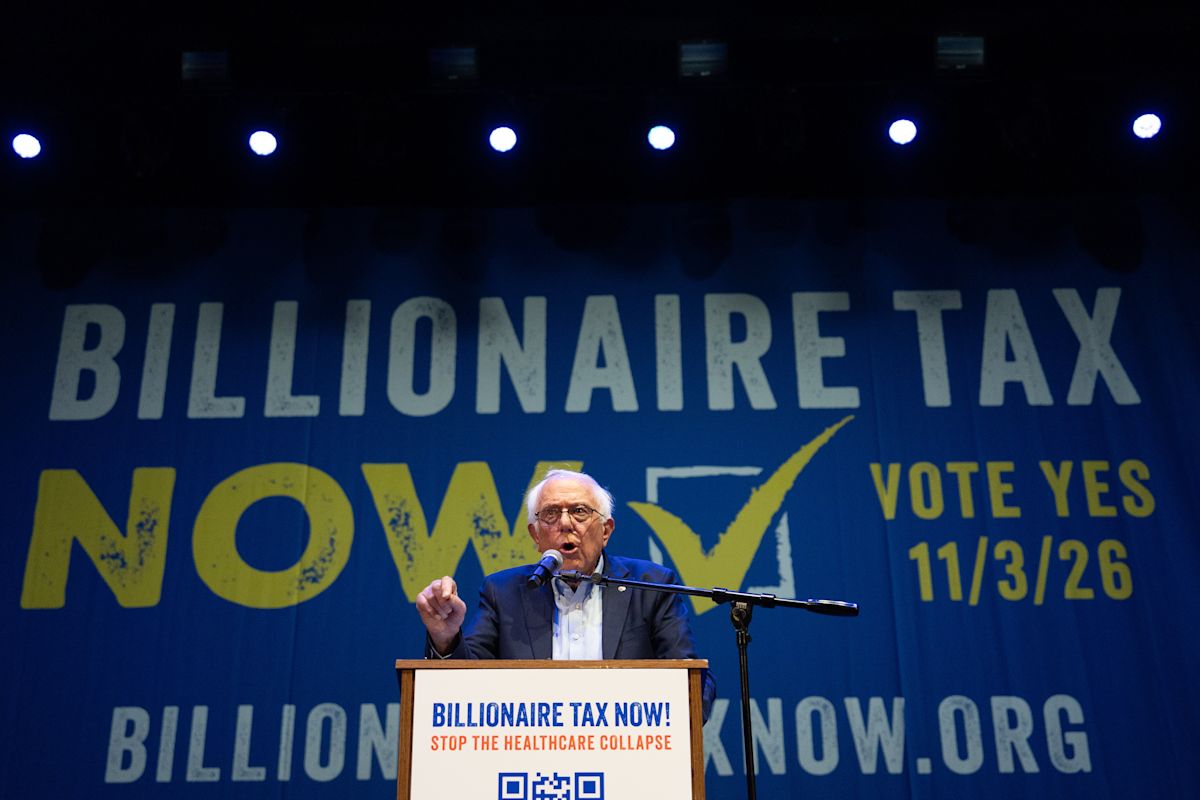
A proposed tax on billionaires is faltering in California, according to a new poll by POLITICO and its partners, with public support dropping off as opponents launch a massive advertising blitz.
Fewer than half of likely voters (45%) said they would vote for the tax on the assets of California’s wealthiest residents, while 43% said they would vote against it and 12% were undecided, according to the UC Berkeley Citrin Center for Public Opinion Research-POLITICO poll. That’s down from February, when proponents of the measure, Proposition 40, held an edge.
“The trend in Prop 40 is certainly going against Prop 40,” said Jack Citrin, a University of California, Berkeley, political science professor and co-director of the poll. “From a historical point of view, you’d think the no side are gaining and would potentially win.”
The proposed one-time, 5% tax has consumed California politics, drawing in Gov. Gavin Newsom and some of the state’s most powerful interest groups. A resounding 83% of likely voters said they had heard some or a great deal about the measure — a remarkably high number given that the main opposition committee only launched its first ad in late August. Likely voters who said they’d heard a “great deal” were opposed by a 57-38 margin.
“The campaign is just starting, and roughly a gazillion dollars are going to be spent on it,” said Jon Cohen, founder and CEO of TrueDot, whose firm fielded the poll. “The fact that the people who are the most tuned in are the most opposed points to significant vulnerability that I think the yes side has.”
Proponents face an overwhelming financial disadvantage. Virtually all of their funding has come from a single health care union, SEIU-UHW, while billionaire foes have allocated tens of millions to beat back and pass rival initiatives that would invalidate Prop 40.
That money will help opponents hammer at messages that look likely to resonate: The Citrin poll found voters were less likely to support Prop 40 if they didn’t believe it would be a one-time tax, as promised. Opponents went on air last week with an ad warning that “when the money runs out, Sacramento will be back with yet another tax.” And while Prop 40 supporters have dismissed that prediction as untrue, they are likely to be drowned out by detractors.
Despite those headwinds, the poll finds a window of opportunity for supporters. The sliver of likely voters who remain undecided are markedly more likely to lean toward voting yes (65%) than no (15%); the initiative is popular with Democratic likely voters, 66% of whom support it; and likely voters across parties are wary of billionaires, with 44% saying they do more harm than good versus 34% who view them favorably.
Still, it is a narrow path. Cohen said “overwhelmingly, the measure’s vulnerability shows in relatively soft support,” and Citrin noted the most persuadable bloc was likely moderate voters who are more receptive to economic warnings and less inclined to an aggressive soak-the-rich message.
“If you think about where the movement would be, it would be presumably not among the strong Democrats or the more liberal Democrats, but from people near the center and independents where the no’s have an opportunity to gain by hammering away at the weaknesses of the measure,” Citrin said.
Regardless of how Prop 40 fares, the poll suggests Newsom’s vehement opposition could be a liability if he seeks the Democratic nomination for president in 2028. A plurality of registered voters — including a plurality of Democrats — were more likely to say Newsom was fighting the tax to “protect billionaires and other wealthy interests” rather than to “protect California’s economy and tax base.”
“This looks more like an issue-specific credibility problem than a broader political collapse,” Cohen said, “but becoming the face of the opposition puts him conspicuously at odds with a sizable share of his coalition.”